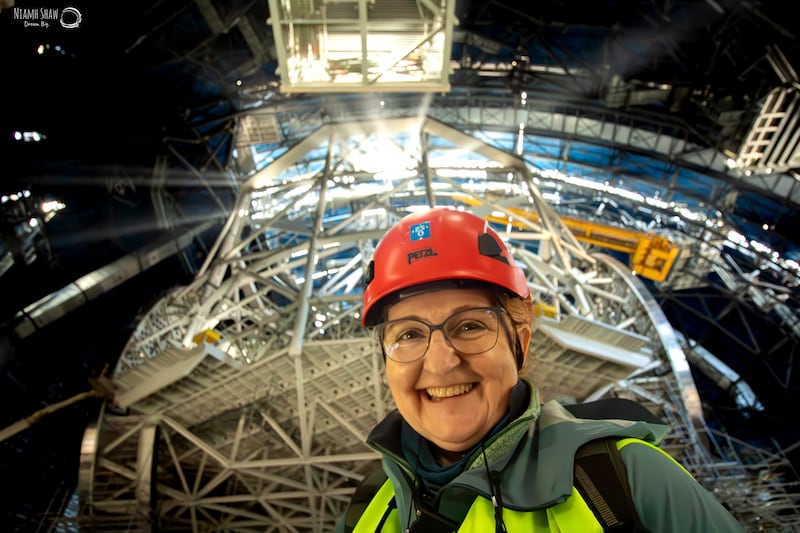
Last November, with a hard hat and a smothering of SPF 50, I stood inside the dome of the Extremely Large Telescope (ELT) on Cerro Armazones, a 3,046m-high mountain in Chile’s arid Atacama Desert.
A year on, and the people building this behemoth can see an end in sight. But the clear dark skies in this region are under threat, and pose a problem for the future of astronomy that’s even bigger than these enormous builds.
On Cerro Paranal, the 2,635m mountain nearby, the wind howls constantly on the observing platforms and domes of another telescope, the European Southern Observatory’s Very Large Telescope (VLT).
“I really love this sound,” said Mariya Lyubenova, ESO astronomer and head of media relations.
READ MORE


“When I was 16, I read in the newspaper that the comet Hale-Bopp would be passing in the sky that night.
“At the time, I lived in Sofia, the capital of Bulgaria. You can’t see a lot of stars from the city because of light pollution.”
Inspired by Hale-Bopp, Lyubenova set about building her own telescope using her mother’s convex make-up compact, a plastic tube and a second mirror.
A year later in 1998, as VLT was completed, she read an interview with the then ESO director general, Catherine Cesarsky, and was captivated.
“That was it. Seeing a female astronomer was proof that I could do that too. And now I’m sitting here, at the base of VLT listening to the sound of the wind. Life is unbelievable,” Lyubenova said.
But now something even more remarkable is taking shape on neighbouring Cerro Armazones that dwarfs the VLT. The ELT, when completed, will be the largest optical and near infrared telescope ever built.
Its main mirror, M1, part of a full assembly of five mirrors, is 39m across and made of 798 hexagonal segments that work together as a single surface, constantly adjusted by an intricate assembly of thousands of actuators and sensors.
As a member state of ESO, Ireland has a stake in this cutting-edge science. Irish astronomers can access time on its full suite of telescopes and Irish companies can bid for its contracts.
“The ELT costs around €1.5 billion; it’s a big number,” says Prof Tom Ray of the Dublin Institute for Advanced Studies and ESO council president.
“But let’s put that number in context. Spread over at least 20 years, the cost of the ELT is equivalent to one cup of very cheap coffee per person in Europe.”
Nothing can prepare you for the scale of engineering at the site. Davide Deiana, the ELT deputy site manager, compares the construction project to building a Formula One car.
“One team builds the machine and another fits it out and tunes it before the scientists take the wheel,” he said. “There is no room for error. A big mistake means no ELT.”
Everything about this construction is extreme: the telescope sits on a foundation 60m across and 3m thick, poured from 9,000 cubic metres of concrete. The moving ELT above this structure will weigh 4,600 tonnes and will turn on a film of oil just 70-80 microns thick, that’s about the width of a human hair.
Chile is earthquake territory, and to compensate, seismic isolators have been installed. Under normal conditions, the upper and lower slabs of this assembly lock together for stability, but when the ground starts to shake, that lock releases hydraulically in half a second.
Things are moving fast now. Back on Cerro Paranal, a team in a purpose-built factory coats and prepares the 798 segments that make up the M1 fully assembled mirror, at a production speed of two per day.
Last July, the whole telescope structure made a complete revolution on its base for the first time. Roberto Tamai, ELT programme manager for ESO, described how that felt to observe. “I had goosebumps,” he said. “And it is also scary, because it’s such a gigantic structure.”
In October, ELT successfully tilted up and down on its second axis for the first time. Almost 500 segments of the M1 mirror have arrived in the region, with the remainder arriving in Chile in the coming months.
The secondary mirror, M2, is 4.25m in diameter. “It is a jewel,” Tamai said. “This mirror has never been built before; it is a historical moment for astronomy.”
It is so momentous that Tamai wants to memorise the names of everyone involved in bringing the mirror to the ELT site. “They will tell their grandchildren of their role in ELT,” he says.
The engineers and construction teams live in a camp on the mountain a week or so at a time, far from family and creature comforts. “You are thirsty for green, for the sea, for home,” Tamai says. “I am completely cut off from the world; I don’t keep up with current affairs here; it’s not important here”.
With UV exposure far beyond the maximum of 11 and dry, thin-atmosphere arid air, no part of your body can be exposed to the elements. Even with appropriate protective clothing, your eyes dry out, you stay constantly thirsty, and you can get light-headed easily if you overexert yourself.
But alongside the engineering challenges, another, more lasting challenge looms in the darkness. Standing on the Paranal platform, Lyubenova notices more light on the horizon than on her last visit in 2019. “This is something that really struck me,” she says.
ESO’s own measurements back up her observation. Angel Otárola, atmospheric scientist at ESO, says artificial light in the region has risen from about 0.3 per cent above the natural sky in 2012 to about 1.2 per cent in 2026. While the region still has some of the darkest skies on Earth, the trend is moving in the wrong direction.
Then came INNA, a vast green hydrogen and ammonia plant proposed by the energy company AES Andes, to be built near both the VLT and ELT. ESO estimated it would have made the sky above VLT at least 35 per cent above the current baseline, and 5 per cent over the ELT.
These changes would have pushed out of view faint objects from distant galaxies or asteroids that could one day threaten Earth. Thankfully, AES Andes cancelled the whole project earlier this year.
Prof Eduardo Unda-Sanzana, director of the astronomy department at the University of Antofagasta, helped persuade the Chilean parliament to include artificial light as a pollutant in the region’s environmental legislation. INNA was the first big test of that law.
“This is a region of contrasts,” Unda-Sanzana says. “In one place you have the best sky in the world. In the places where people live – the cities – the sky is terrible. It’s an issue that’s bigger than astronomical observations.
“Our biodiversity is also suffering. The lights distract the birds from their flights near the sea, disorient them and draw them into the middle of the desert, where they get exhausted, fall and die.”
The telescope’s first imaging tests are still on track for 2029. Tamai’s biggest concern on that night will be vibration, a “killing factor” for telescope performance. But they will only know that they have overcome any vibration issues when full assembly of all parts is complete, and that can only occur on site, the moment when, for the first time, light passes cleanly through all five mirrors. He calls that “closing the loop”.
The ELT was built for astronomers and scientists to answer some of the biggest questions about our cosmos; it will search for rocky, Earth-like planets around nearby stars and light from the earliest galaxies ever formed.
The first scientific image of the night sky is planned for 2030. In astronomy, this moment is called “first light”. I ask Tamai what he will be doing that night. He doesn’t intend to give speeches. Instead, he will make sure everything is operating: “with a screwdriver in my hands if that is needed, or a sweeping brush – whatever is required; that’s where I’ll be.”
Niamh Shaw is an engineer, scientist and writer