
The shamrock ceremony in the White House has been a movable feast over the years and has been held on days other than March 17th as often as on St Patrick’s Day itself.
Happily, this year’s edition will take place on our national holiday, but that’s just about all the good news.
The less-than-good news is it’s going to be a tricky assignment for the Taoiseach. Last year, Micheál Martin’s visit came a few weeks after Ukrainian president Volodymyr Zelenskiy was mauled in the White House by Donald Trump and JD Vance.
That brutal encounter was so fresh in the memory that some expected to see yellow crime-scene tape cordoning off the Oval Office.
READ MORE


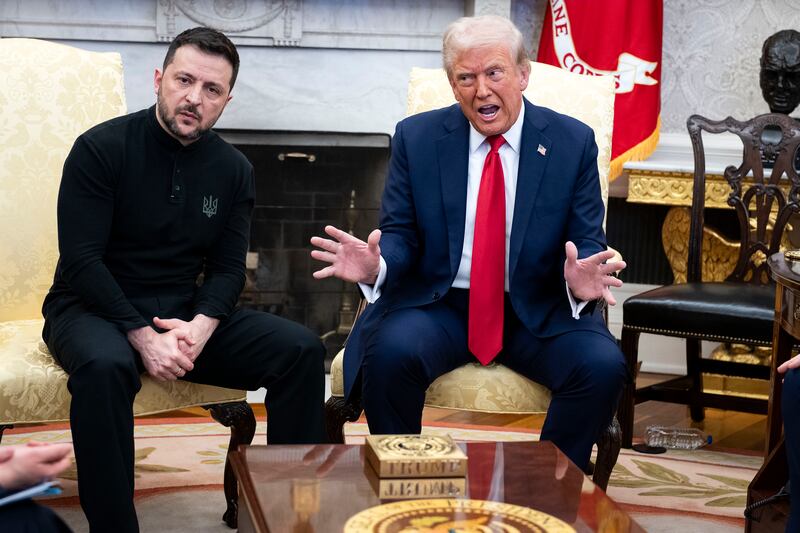
However, Martin survived his encounter with the unpredictable and volatile Trump, but not quite unscathed. He shipped a lot of criticism back home for being insipid and timid, like a pupil after being summoned to the principal’s office for a dressing-down.
Will it be different this year?
Trump has recently lashed out at British prime minister Keir Starmer and Spain’s Pedro Sánchez for showing anything less than total deference to him. The Government has noted that the military attack by the US and Israel on Iran had no international mandate and was not approved by Congress.
But senior Coalition figures have deliberately been reluctant to voice any direct criticism of the US. It would be safe to say at this juncture that confrontational is not an adjective that will describe Martin’s approach to the meeting.
Sinn Féin and Labour have called for a boycott of the ceremony by the Government. Would that be in Ireland’s interest, given the long and deep relationship the State has with the US? It would be a big shock if either of those parties refused to attend if they were in government.
Still, a daunting task awaits the Taoiseach. Irish Times Political Editor Pat Leahy is travelling to report on the events of the next week and our Washington Correspondent, Keith Duggan, will also be on hand.
The President’s role is not above politics
Last Sunday, President Catherine Connolly issued a statement to coincide with International Women’s Day that was, in essence, a withering criticism of the US and Israeli bombings of Iran.
She said recent attacks in the Middle East were “deliberate assaults on international law ... We must name them as such, without euphemism and without equivocation.”

The President was continuing on from where her predecessor, Michael D Higgins, left off, with statements on international affairs that nullified the principle that the office was “above politics”.
On Monday, the Government responded by stating it alone had the power to set foreign policy. However, there seemed to be an open acknowledgment from Government that the President is free to speak out on any issue.
Speaking in Brussels, Tánaiste Simon Harris said: “I have huge respect for the President, a huge respect for her mandate, her constitutional role and her office, and therefore her right to speak on issues of concern to her, and indeed issues of concern to the Irish people.”
Expect more outspoken statements from the Áras.
Republic–Britain defence and security co-operation
Jack Horgan-Jones and Barry Roche have been covering what has essentially been a “summit” between Martin and Starmer in Cork over the past two days.
The main takeaway is that the Republic and Britain have agreed to expand defence co-operation, particularly at sea. A new agreement will galvanise maritime security, particularly in the face of threats from the likes of Russia’s “shadow fleet”.

Obviously, such an agreement will be a trigger for Opposition parties and civil society groups who believe all of this is drawing the State away from neutrality and into the arms of Nato.
On another level, it is another step towards repairing the damage done to Anglo-Irish relations during the Brexit process. Although Starmer is no Tony Blair, as far as Ireland is concerned, he is keen to repair the damage caused by successive Conservative governments.
In a speech at Cork City Hall on Thursday, Martin said the State would “deepen co-operation” with the United Kingdom on infrastructure, housing, energy and climate, while “protecting our critical infrastructure, including under our seas”.
At the same event, Starmer said that in a world with “more conflict now than at any time most of us can remember”, it was important that close allies “work together and stick together”.
Taoiseach awaits his next dentist’s appointment at The White House
Energy price concerns and possible new supports
The consequences of war in the Middle East for Ireland became obvious in recent days, with large spikes in fuel and home heating oil prices, as well as significant increases in the cost of essential inputs such as fertiliser.
War-related economic pressures have dominated domestic political debate for the past fortnight. It is only because the Dáil is not sitting this week (with most Ministers away on St Patrick’s Day duties) that the issue has not boiled over.
The Government has indicated the introduction of an early energy credit scheme is unlikely. Moreover, it has said there will be a more targeted approach if the decision is made to intervene. Ministers have noted that when Russia invaded Ukraine in 2022, it took several weeks for the first scheme to be announced.

The Government has also sought to reassure the public about fuel supplies, saying it had no immediate concerns about oil shortages, despite global uncertainty.
A meeting of the Oil Security-of-Supply Group took place earlier this week and no immediate concerns were heard regarding the availability of fuel for the Republic market.
Although oil supplies are said to be stable, prices at petrol stations and oil deliveries have not been. As reported on Thursday, Minister of State at the Department of Agriculture Michael Healy-Rae believes the Coalition should review options to reduce the cost of diesel and other fuels if prices rise further.
“Once the price of diesel goes above €2 per litre, the alarm bells go off,” said the Kerry TD, who also suggested taxes on fuel should be reduced if prices remain high.
Minister for Finance Simon Harris on Friday said he was becoming more concerned about the inflationary impact of the war, but responded sharply to calls from the fuel industry to cut the tax on their offerings.