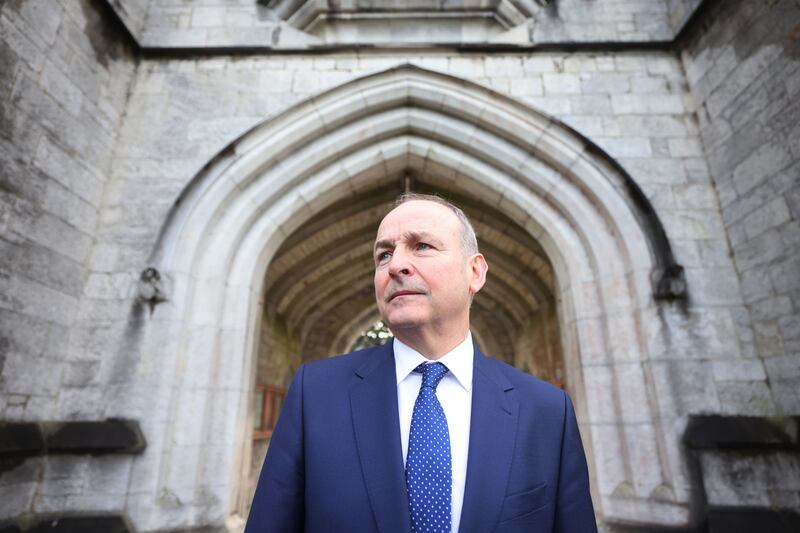
The senior infants from Douglas are delighted to meet the Taoiseach and get their photo taken with him at the Aula Maxima in University College Cork (UCC). They’re off to see the “dinosaur bones”, they told him. “No, no, I’m not a dinosaur,” he reassures them.
Some of his backbenchers might venture to disagree, but Micheál Martin is in sunny form. He is in Cork, which always cheers him up, and it’s only Thursday. The Central Statistics Office has just released figures which show a big jump in house completions last year, allowing him and his Ministers to claim “our plan is working”. It’s been a while since they could say that.
The reason for his unusual presence in Cork on a Thursday morning is to attend a conference at his beloved UCC (“You’re on hallowed ground here”) marking 100 years of radio in Ireland. His speech promises support for public service broadcasting, along with a few semi-pointed words about “standards”, for which he is a stickler.
But much of the conversation with The Irish Times is taken up with the volatile and unpredictable international situation, the subject that is preoccupying world leaders, from great and small countries alike.
READ MORE


Does the Taoiseach wake up every morning and check his phone to see what Donald Trump has done or said overnight?
“Not immediately. No, I don’t,” he says, slightly unconvincingly.
“And we did say last year that we wouldn’t wake up every morning wanting to respond to every announcement. And that still is my position, although in more recent times, the issues were ... maybe more serious and important in terms of the Greenland issue.”
The world has “changed obviously,” he says, moving towards a situation where there are two superpowers, plus one major power with nuclear weapons – ie, the US and China, and then Russia.
Russia’s nuclear arsenal, he thinks, is “where it derives, in my view, it’s leverage.” It is a malign force in Europe, he says, seeking to interfere in elections and disrupt democracies.
What about the American national security strategy, promising to support anti-EU parties and governments?
He is immediately wary of drawing any equivalence between Russia and the US, but stresses that what US leaders say about the EU is wrong.
“Europe is actually a bastion. And a beacon of hope for many people ... but actually Europe underestimates itself. It should be a bit more self-confident about its strengths ... in the economic field, the social field, the cultural field.
“The freedom of speech area, freedom of assembly and all of that, these are very important values and it’s worth our while protecting those and articulating for them.”
It has been widely commented on that the lesson that EU leaders took from Trump’s visit to Davos and the Greenland issue was that they needed to stand up more to the US president. Was that the way he reads it?
[ Greenland dispute shows why Europe must be more self-reliant, Taoiseach saysOpens in new window ]
“I read it this way: I think Europe was firm. It was calm. It didn’t compromise on any fundamental principles around sovereignty of Greenland or Denmark ... There was a very fundamental principle at stake that there couldn’t be any compromise on. And there wasn’t.”
Would US action against Greenland have been a fundamental break between the EU and US?
“That was a broad view, yeah,” he says.
But Martin, leader of the EU member state with perhaps the closest ties to the US, is extremely wary of the idea of any sort of conflict.
“The engagement worked. The US pulled back and entered into a framework of engagement and discussion on it,” he says.
“But I would be cautious ... standing up sounds great and all of that, but be under no illusion, that if there is an implosion in the US-EU relationship, everybody suffers. And the damage is very serious, because it’s a very critical trading and economic relationship. There’s no getting away from that.
The universal lesson in power and politics is there are limits to power
— Micheál Martin
“So it’s all very well talking about anti-coercion measures and all of that – ultimately if you deploy those, well that’s it then. You are in a downward spiral of significant impact on people that we represent. And ultimately, leaders have to represent our people and protect them.”
He takes another lesson from the Trump climbdown on Greenland, too.
“The universal lesson in power and politics is there are limits to power.”
In a changing and uncertain world, he sees “enormous challenges” ahead in security, military issues, climate and economics.
What about the fines – they could be as high as €28 billion – that Ireland might face for failing to reduce emissions sufficiently?
“I don’t see it happening to the scale that people talk about,” he says.
He says he has “always had an issue” with the precise targets on emissions for a given year – though he was taoiseach of a government that introduced them – and hotly disputes the notion that green issues are less of a priority for this Government than the last one.
We will not be in any way moving from our position of military neutrality
— Micheál Martin
“That’s only political chatter. The Greens and the Soc Dems will throw that out. No evidence for it, actually ... but yeah, Eamon [Ryan, former minister for the environment] was good at setting the targets ... but it was never quite clear in terms of the pathway.”
He is acutely concerned – and rather pessimistic – about the situation in Ukraine and wonders if Russia really wants to end the war. He stresses Ireland’s willingness to play a role in a peacekeeping force – something that would require both the abolition of the triple lock and a ramp up of military capacity.
“We will not be in any way moving from our position of military neutrality, which is defined as not joining a military alliance, we will not be joining Nato.”
But he wants to continue the “respected tradition” of Irish peacekeeping.
“It’s important for the military as well, and the soldiers, and our naval personnel, that they have these opportunities. When I was in Lebanon before Christmas ... they were saying, ‘will there be any chance of just being extended’?”
So we won’t join Nato, but we will play a greater role in EU defence efforts?
“Yes, but we’ve always been part of the Common Defence and Security Policy.”
Martin insists that military capacities will have expanded by 2030 to enable Ireland to monitor Irish airspace and territorial waters, and also the subsea cables that pass through Irish waters and carry internet traffic between the US and Europe.
When the Russian ship Yantar lingered over interconnectors with the UK recently, he says, “Irish naval divers ... had to go down to check that nothing untoward had been laid or whatever – that’s the level of stuff that’s going on.”
However, he says that energy security – including the LNG (liquid natural gas) terminal on the Shannon estuary – and safeguarding ports are also essential parts of the picture.
What about the Occupied Territories Bill? Martin himself has all but ruled out the inclusion of services.
It is, he says, “a symbolic act” that will have no economic impact on Israel. He defends the idea of the Bill to put pressure on Israel but oozes caution on how it will be perceived in the US, where anti-BDS (boycott, divestment and sanctions) laws could target US companies operating here if the legislation is introduced.
On the inclusion of services, he says: “I do think we need to be sensible here. We have to protect our own interests as well. And I’m not sure, you know, that that the benefits outweigh the damage that would be done.”
But you could make exactly that argument on goods?
“I’m not sure you could because I don’t believe that the impact is anywhere comparable.”
Has that impact been assessed or measured?
“There’s been some desktop stuff done in terms of economic impact but I believe there’s a need for a fuller economic evaluation.”
So will that happen before the Bill is introduced?
“Well, I don’t want to say what the Minister may do ... that may happen.”
He worries about the extent to which the public finances are dependant on corporation tax, but defends public spending increases of recent years, pointing to the huge increase in population.
He also argues that the criticism from Opposition parties is that he doesn’t spend enough. Every week he hears demands for more spending. He acknowledges that once you “ramp up” spending, “it’s very hard to ramp it down.”
Is this not why you should be so careful about ramping it up in the first place?
“I know, I take that point ... So look, I am worried about the high dependence of corporation tax. That is clear. I accept Ifac (Irish Fiscal Advisory Council) concerns about that.”
However, he says, there are political realities for a government with resources available. “You might say this is an excuse. I’m just being very realistic about it. There are political limitations to what any government can do.”
It’s understandable, the anger within the party in the context of the presidential election
— Micheál Martin
The Galway West and Dublin Central by-elections will take place in April or May, he says, and the expectation management has started already. Fianna Fáil will be “vigorously contesting” the elections but these are “difficult” constituencies.
“I think Dublin Central, is particularly difficult ... We haven’t won a seat there for quite some time, and we’re starting off on a very low base there so we’re realistic in terms of that.”
Does he think that the unrest in Fianna Fáil before Christmas over the presidential election has damaged the party with voters?
[ Is Micheál Martin’s Fianna Fáil leadership at risk? We asked the party’s TDsOpens in new window ]
“I think it’s understandable, the anger within the party in the context of the presidential election.”
But do you think it’s time for your backbenchers to zip it now?
“Well, look, I think there’s a genuine feeling within the party to move on from it. I think when there’s too much internal criticism ... the party doesn’t do well with the people. I know that from ever since I became leader.
“When the party is united and focused on the delivery of policies and articulating what issues matter to people on the ground, we do well. The people want to hear about their problems.
“Today, as we do this interview, we have news of 36,000 houses. I think Fianna Fáil has played a role in increasing the number of houses being built in this country since we came back to power in 2020.”