

We don’t buy cars the same way we buy other consumer durables. Our fridges are, generally, not extensions of our personalities. We are generally unworried about how well or ill our choice of washing machine reflects upon our lifestyle choices. But a car? A car speaks volumes. Even those who think themselves uncaring of cars buy with one eye on image, on perception.
Which is why it’s important that we have more enjoyable, engaging and downright fun electric cars. It’s the fun cars that allow us to tell more entertaining stories and to build legends, and which therefore make electric vehicles more desirable. Until now, with rare exceptions for the likes of Alpine, Cupra and Porsche, buying an electric car has been all about rationality at its most extreme, even downright penny-pinching.
Peugeot is about to change that. It’s not that the new E-208 GTi is the first electric hot hatch (the Alpine A290 and the Cupra Born and Raval VZ got there first), but it’s the first that you don’t have to explain.
Thrown down a set of Alpine or Cupra keys on the table at the cafe and you’re in an aeon of explaining what the brand is and why you bought it.
READ MORE


Throw down, instead, a Peugeot GTi keyring and, since 1984, everyone knows what you’re about. If explaining is losing, then a GTi is definitely winning, and Peugeot is bringing the celebrated badge to electric motoring just before VW with its one-two punch of the new ID. Polo GTI (which will be this E-208 GTi’s sternest competition) and the ID.3 GTI.
The E-208 GTi is also a fond farewell to a car that’s been around since 2019 and which will shortly be replaced by an all-new 208 with far more avant-garde styling, both inside and out. In the grand tradition of such things, a hot hatch version seems an appropriate way to wave goodbye to a car that, more than once, took Peugeot to the top of the European sales charts.
To turn it into a GTi, visually, Peugeot has dipped into the Eighties back catalogue and brought forth memories of the original 205 GTi. Arguably the best hot hatch ever (although Renault and Volkswagen would dispute that), the 205 GTi set the template for a succession of gorgeous, fast, nimble Peugeots to follow. In invoking that memory, the E-208 is setting a bear trap for itself – fail to live up to the legacy and it will be roundly pilloried.
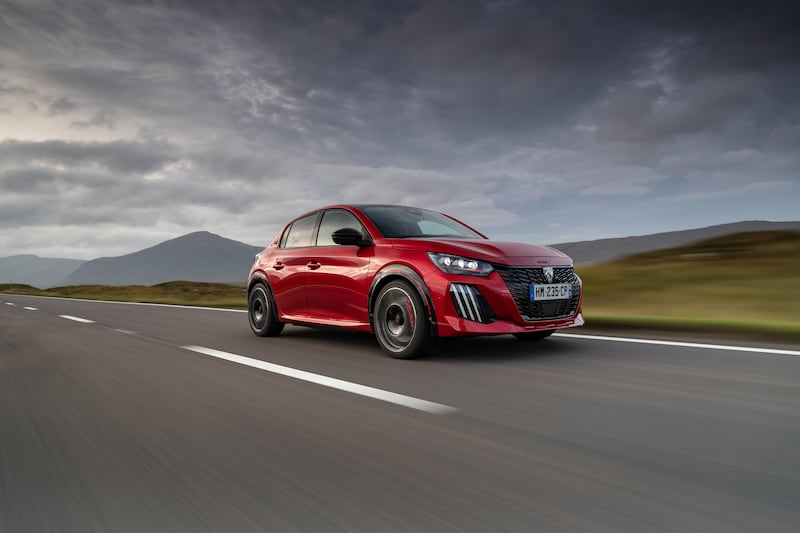
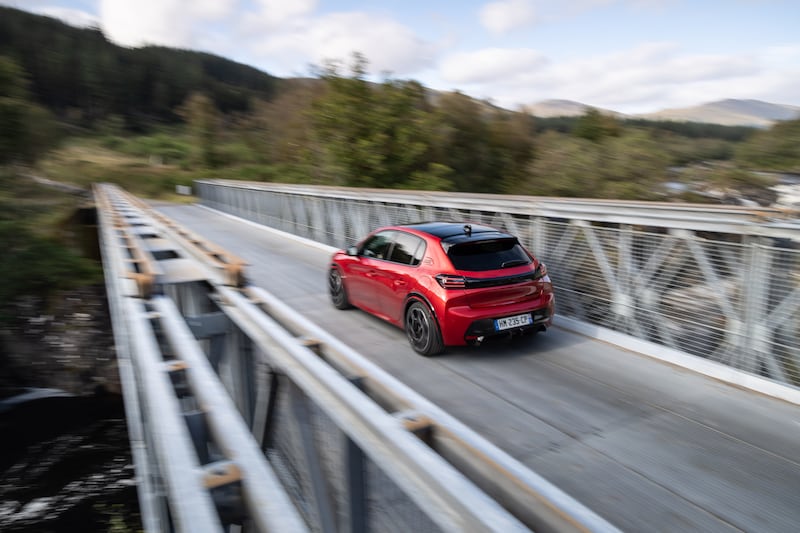
It gets off to a good start. The 205 GTi’s red pinstripes are brought up to date for 2026, and there’s a wealth of gloss black exterior trim and 208 GTi badges on the rear roof pillars, just as per the original.
More importantly, both aesthetically and in an engineering sense, the suspension is 25mm lower and as much as 58mm wider, which gives the E-208 an aggressive, but not outré, stance. Combined with some gorgeous 18-inch alloy wheels, it looks great.

It looks good inside too, with the 208’s ageing cabin titivated with fabulous high-back bucket seats which are among the best chairs in the game, lots of black leather and red stitching and bright red carpets. These are utter dirt magnets, but they couldn’t be more Eighties.
Space in the back is more usable than it is generous and the 309-litre boot is only just about able to keep the E-208 GTi on the right side of practical, but so far it’s fulfilling the hot hatch mantra – everyday use, happy day thrills.
Power comes from a 281hp electric motor driving the front wheels through a grip-sniffing limited slip differential, and energy comes from the same 51kWh battery which powers the regular E-208. Range is claimed at 375km on the no-cost option efficiency tyres, or 352km on the grippier, sportier Michelins which are a standard fit.
To make the E-208 GTi work properly, Peugeot turned to the boffins at Peugeot Sport, the company’s in-house racing team, which designs and runs its Le Mans racing efforts. That Le Mans 9X8 – only fitfully successful – is a hybrid, and that means Peugeot Sport has much expertise in batteries and motors working under the toughest conditions imaginable. So, the Sport guys didn’t just work on the suspension, steering and brakes, but also on the battery cooling and motor tech.
This is possibly why the E-208 GTi doesn’t suffer too badly from an underfed range. On our brisk test drive around the lowlands of Scotland – where you’ll find some of the best and most GTi-friendly roads in the world – we were on course to squeeze around 330km out of a full charge. It’s not intercontinental range, but it’s decent.
[ Range Rover Sport goes electric without losing its appetite for performanceOpens in new window ]
Better by far than decent is the way the E-208 GTi drives. The steering, controlled by that small, hexagonal wheel, is sharp and talkative, and the wider, lower suspension plants the Peugeot firmly to the ground. That front differential – much less aggressive in its actions than in the related Opel Mokka GSE – finds grip and traction where others wouldn’t, and so the E-208’s nose sticks to the inside of a corner like honey to the bottom of a bowl of porridge.


The suspension is firm – it gets a bit rough around town – but the E-208 GTi feels wonderfully fluid on the open road, inducing grins and giggles in roughly equal measure. It is an utter delight to drive and wears its celebrated GTi badge with insouciance.
[ Volkswagen ID.Polo first drive: The Germans remember how to make a VWOpens in new window ]
It will be a car of limited appeal nonetheless. Only 40 are allocated to Ireland, arriving next February with a price tag orbiting around the €40,000 mark, which makes the Peugeot pricier than rival VW, Alpine and Cupra products, but also more powerful.
Crucially, it’s also the car that might – just maybe – convince petrolheads that being an electron-head is actually a good idea. A little more range would be welcome, of course, but this E-208 GTi is such good fun that you’ll forgive that literal shortcoming. It’s a fitting electric debut for an acclaimed badge and, hopefully, a car that inspires enthusiasm well into the coming all-electric era.


