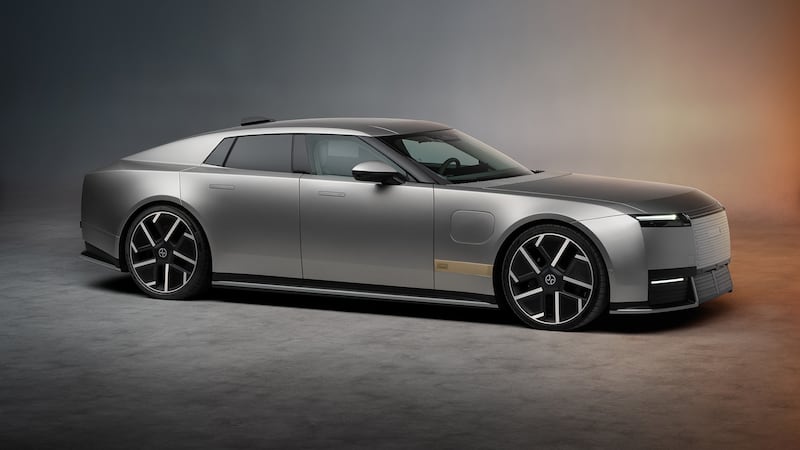
Some cars wow you with their design, to the point where you take a step back, trying to establish a baseline of understanding. The Jaguar Type 01 isn’t like that. Perhaps because we all saw the Type 00 concept and made up our minds about how this production four-door coupe (a GT in Jaguar-speak) would look.
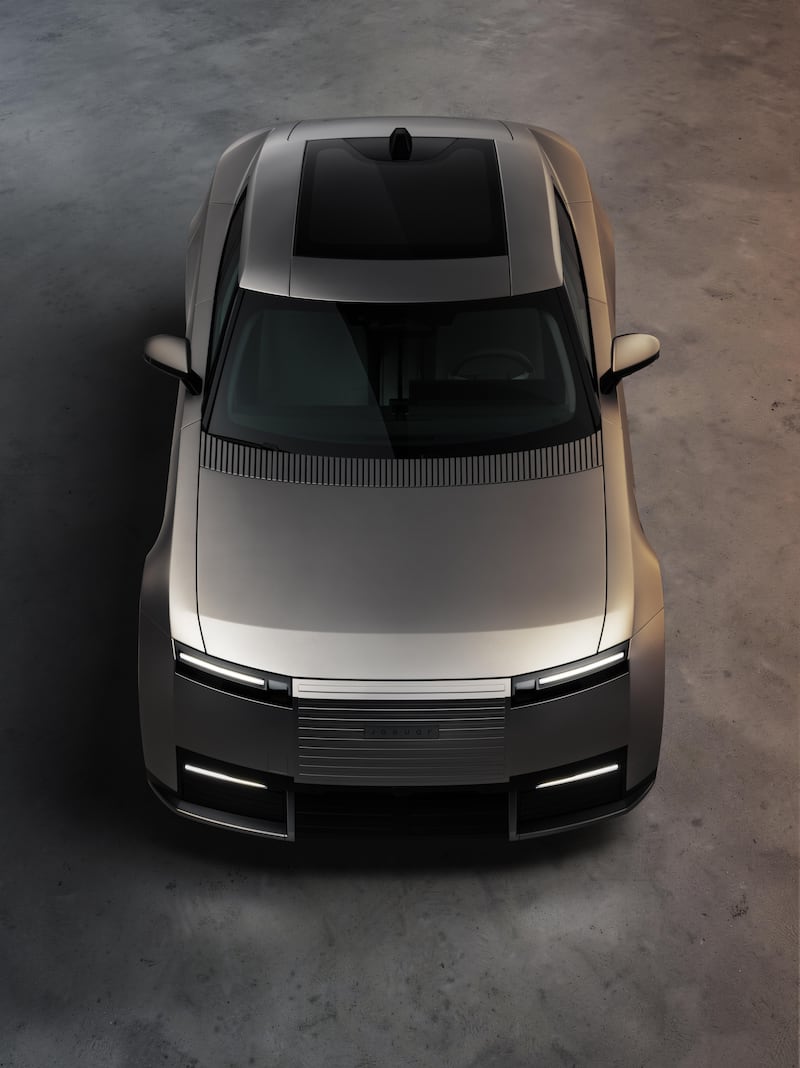
Perhaps because the Type 01’s styling is in some ways less dramatic than you’d think. Perhaps because the photos simply can’t fully capture how this car actually looks. The surfacing is incredibly clean and free of needless flourishes. To appreciate this, you need to see light play across its surfaces.
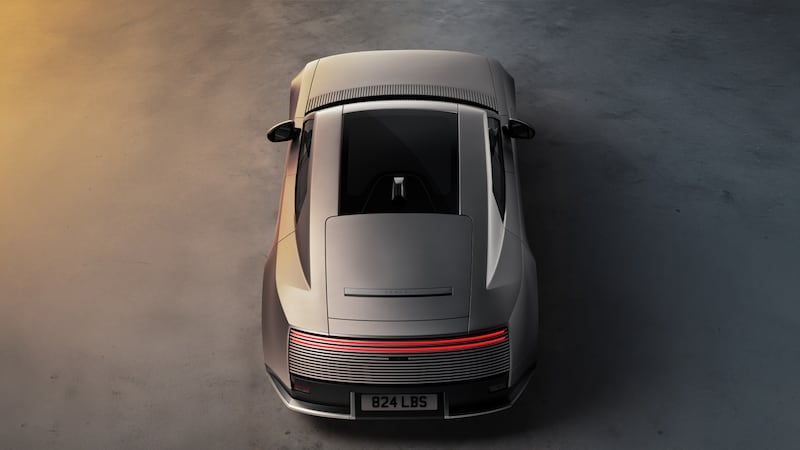
Instead of stepping back, the Jaguar Type 01 draws you in. You start to notice the fine detailing, such as the incredibly slim four lines of LED lights (some 120 individual bulbs) that make up the headlamps. The way the rear “grille” looks far more dramatic, and enticing, than that of the concept car, which looked like an air conditioning unit had got lost on the way to the recycling centre.
Then your eyes make their way – via the sheer sides and the long, flat bonnet – to the rear three quarters. Here the sweeping rear pillar – which looks like a combination of a 1960s E-Type’s rear haunches and a 1970s XJS’ “flying buttress” pillars – meets the top of the rear wings; there’s a triangular indentation, almost as if someone pressed the nib of a fountain pen into the soft clay of a styling model.
READ MORE


That whole rear panel, which extends from the rear wheelarch to the roof to the edge of the windscreen, is one pressing, which was genuinely thought to be impossible to make until Jaguar’s engineers spent 1,500 hours developing new pressing tools, which are four storeys high and press the aluminium panel with up to 2,500 tonnes of force. It’s indicative of how much effort Jaguar has put into this new car and, indeed, into the wholesale reinvention of the brand.
To recap: Jaguar was shedding customers and cash at an unsustainable rate. A line-up of handsome, sharp-driving cars wasn’t enough to take on the might of BMW, Mercedes, and Audi, and an early lead in EV tech – with the I-Pace – was squandered as that model was only fitfully updated.
At the last moment, a ready-to-go all-electric new XJ saloon was canned, as Jaguar management realised that only a full and total reinvention of the brand and its cars would suffice.
Cue a two-year production shutdown, the creation of a new line-up of all-electric models, a concept car that drew admiration and ire in equal amounts, and a marketing campaign that had the anti-woke brigade reaching for their predictable poison pens. Phew.
Rawdon Glover is Jaguar’s managing director and has been at the centre of this storm to recreate one of the most storied brands in motoring and move it into a new era of selling fewer cars, albeit more profitable with prices closer to Bentley than BMW. A more boutique brand, then, leaving more mass-market premium sales to its sister brand Land Rover. How, then, will we know whether this has all worked?

“I think the challenge for any new car isn’t necessarily year one sales, but how it sells in year four,” Glover tells The Irish Times. “There will be other models, so it’s all about the success of the product cycle. So we’ll get a good idea now whether we’ve been successful or not, but it’s about the longer term. Does someone buy one of these and then move on to another model in the line-up?”
Jaguar is, of course, owned by the vast Indian-based conglomerate Tata who bought JLR (Jaguar Land Rover) from Ford in 2008. The Indian owners apparently make Glover’s life a little easier.
“We need to get a return on the investment in this platform, and the key thing for me is that Jaguar has not been additive financially to the organisation for some time. It needs to be,” Glover says.
“I’ve not seen anything from our shareholders thus far that isn’t totally supportive of the direction that we’re going in. Jaguar in India means something quite different to what it does in many other markets. It’s really held in very, very high esteem, and it was one of the big reasons that Tata bought up JLR. That was the emotional draw for them, but as a company, Tata is not a short-term company.”
The business case might seem tricky to make from the outside. A luxury car with electric power is, it seems, not really what many luxury car buyers want just yet. But Jaguar says its research shows that 78 per cent of the potential customers it polled were far more interested in style, branding and performance than on the power source. Crucially, an equal 78 per cent of those buyers would be new to the Jaguar brand, and conquest sales will be crucial.
Certainly, the Type 01 will have a more than adequate technical specification. Three electric motors (two at the rear, in a single compact unit) developing 1,030hp, with 0-100km/h acceleration in just 3.2 seconds (although Jaguar says that the “in-gear” acceleration times were far more important during development).

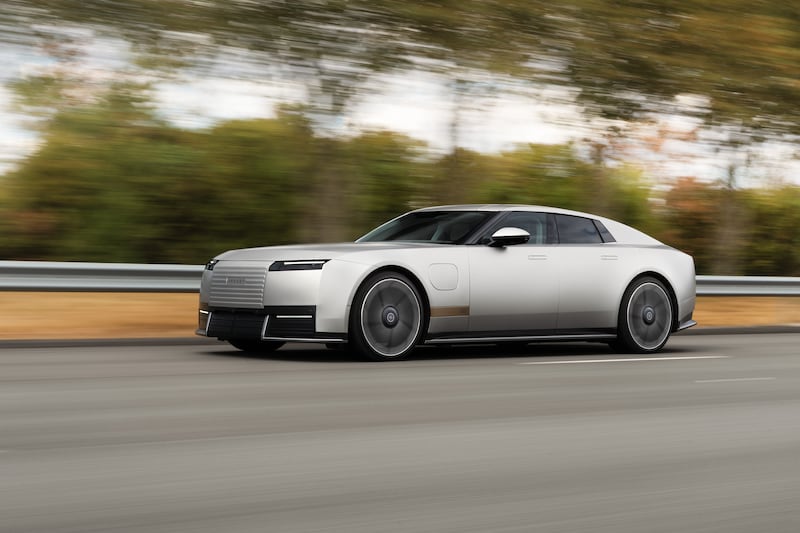
A large 120kWh battery with a potential range of 700km. Air suspension that drops the car 15mm on its springs for better efficiency at speed, and ultra-fast charging that adds 300km of extra range in 13 minutes of charging if you can find a rapid enough charger. The “sustained highway driving” range (motorways, in other words) is reckoned to be around 520km.
Inside, the cabin is calm, uncluttered and light. There’s no rear window, so you get a rear-facing camera instead, whose display screen is mounted low on the dash, in a position familiar to driver of 1960s cars.
There’s a single 24-inch sweep of digital screen behind the wheel and a small seven-inch screen on the console between the seats for major controls. Brass (actually anodised aluminium because brass is heavy) trim runs along a dramatic central spine that divides the cabin into four individual seats, and there’s soft carpeting that extends to the lower parts of the doors so that you feel as if you’re enveloped in a soft bathtub.
There’s not a lot of space. This is a large, long, low car (just 1,400mm tall) and headroom front and rear is only just about adequate. Getting into the back seats involves heaving yourself over a broad sill and then in through a small door, but it’s comfy once you’re in there.
Jaguar does admit that it’s focused on the comfort and layout for front seat passengers, but it has separated out the battery pack, leaving a deep well into which rear-seat feet can fit and allowing both front and rear seats to be mounted lower to keep that plunging roofline. This is a selfish car, in that respect. The boot is small and shallow – although there’s some deeper underfloor storage – and there’s a shallow “frunk” under that endless nose for stashing your charging cables.
[ Range Rover Sport goes electric without losing its appetite for performanceOpens in new window ]
At the rear, the aerodynamics have been so finely honed that there’s actually 4kg of overpressure – a gentle push from the air – to aid efficiency. The distance between the top of the front wheel arch (which houses 23-inch alloys as standard) and the beginning of the bonnet is actually even more shallow than that of the F-Type sports car, yet there’s far more suspension movement.
While the earlier messaging was all about how the Type O1 was breaking with Jaguar’s tradition, it couldn’t be further from the truth. The E-Type and the XJS shocked and stunned when they made their debuts, and the Type 01’s handling and ride have been inspired by that of the gorgeous mid-1970s XJ12-C Coupe.
[ Best used electric estates: what should replace my diesel Mazda6?Opens in new window ]
This is a car that allows some body roll to keep its occupants comfy, rather than trying to knock their fillings out in search of sportier handling. It seems to be a car with soul, rather than the faceless hordes of stamped-out-by-the-hundred Chinese competitors.
Will it work? Can Jaguar pull off its all-electric moonshot? We can’t wait to find out. Now we know what the new Jag finally looks like in the showroom-ready metal, we have but a few more months to wait until we, and customers, get behind the wheel of the actual production car. The effort, the hype, and the hope will be answered.


