

Bones sometimes tell their own story. A dozen skeletons are carefully laid out on individual sheets of white cloth, stretched across tables in a lab in Nicosia, the divided capital of Cyprus.
The remains belong to some of the 2,002 people who were reported missing and presumed killed during the ethnic violence that tore the small Mediterranean island apart in 1974 and a decade before in 1963.
For the last 20 years the Committee on Missing Persons has worked to locate the sites of mass graves across the island, to exhume remains and use DNA testing to identify the bones, so that families can have a proper burial.
Remains have been recovered from wells, fields, hillsides, riverbeds and caves, where Greek Cypriots and Turkish Cypriots were killed by the other and hastily buried.
READ MORE


The committee’s investigators speak to ageing witnesses, chase up confidential tips that continue to come in, and read archival records for scraps of information, to find sites where bodies may have been buried.
[ Cyprus’s frozen conflict holds lessons for any Ukraine peace dealOpens in new window ]
Three quarters of the missing are Greek Cypriots, many who were killed during the brutal 1974 invasion of the northern third of the island by the Turkish army.
The invasion was initially launched to protect the Turkish Cypriot minority, several days after a short lived coup backed by the Greek military junta seized power in Nicosia, with the intention of uniting Cyprus and Greece.
Half a century on and the conflict remains unresolved. A buffer zone patrolled by United Nations peacekeepers still splits the island in two.
Then there are the missing Turkish Cypriots, large numbers of whom were killed by extremist militias during ethnic violence that flared up in 1963 and 1964.

The skeletal remains laid out in the committee’s laboratory were recovered from a mass grave on the third of the island governed by the Turkish Republic of Northern Cyprus, a state recognised only by Turkey.
Some of the skulls are visibly caved in. Half of the dead were children. “Every one of them has their own story,” says Istenç Engin, a laboratory co-ordinator who has worked for the committee since 2006.
“The excavation was in 2023, but it took them almost a year I think to finalise it. Then we started to analyse. Last year we sent samples in July and now we are in the process of the identifications,” says Engin.
Bones are commonly recovered from graves mixed together. Piece by piece they have to be separated and the individual skeletons “reconstructed” as much as possible. It’s a slow, painstaking process.
To date the remains of 1,069 of the 2,002 missing have been successfully recovered and identified.
There are no dental records from the time to check against, so the committee rely on DNA testing of the bones and samples taken from surviving relatives.
Sometimes a wedding ring with an inscription is found, a notable piece of clothing, or an intact skull with a golden tooth, that will aid the process.
When the remains are identified the bones are returned to families. “What we see is that even though 50 years has passed, it’s as if they lost their loved one yesterday,” says Gulbanu Zorba, who co-ordinates the identification work.
The committee operates on a “bicommunal” basis, meaning the staff are drawn from Greek Cypriot and Turkish Cypriot communities. It is chaired by a retired diplomat from each side, and a third member nominated by the UN.
“Most of us we are working here for a long time,” says Theodora Eleftheriou, a forensic anthropologist in the lab. “You are exposed to the families’ emotions and their wounds,” she says.
“We’re all Cypriots. That’s important for the project, because we can feel it’s for our people ... not just addressing the wounds of the past, but also to help [build] maybe a better future for our children,” she says.
“It was easier at the beginning to locate burials, now it becomes harder and harder.”

A lot of witnesses and perpetrators have died, taking crucial knowledge to the grave with them.
In some instances bodies were never buried. By the time the bones were discovered they had been worn down to fragments by the elements, making DNA testing difficult.
The landscape itself has changed massively in the 50 years. New developments have been built that can’t be levelled, despite information pointing to possible unmarked graves underneath. In a lot of cases bodies were dug up from initial sites and reburied elsewhere.
The committee located and exhumed the remains of 184 missing people in 2010. Last year it was 23.
Even when investigators know they have a strong lead, recovering remains can be a challenge.
The engine of the JCB digger is coughing away as it digs a 70ft-long trench in a field, near a small village called Ambelikou, on the northern coast of Cyprus.

You can start to taste the coming summer in the air, but it’s not here yet. When it does arrive this field work will be hard going in heat that can hit 40 degrees.
The excavation team is hoping to find the remains of a Greek Cypriot killed in 1974. Multiple eye witnesses from the time reported seeing the body.
Yellow daisies and long grass that covered the ground were cleared off the day before, while the team marked out the boundary of the site they planned to search.
“We have a system to check the soil, using the vehicle to dig a trench down to the undisturbed layer,” says Ali Culluoglu, who is leading this excavation.
“If in any case we find any remains, we stop the machine and then we jump into the trench and start checking it manually with the trowels and the hand,” he says.
A previous dig in 2012 by a row of nearby olive trees recovered a small number of bones. Unfortunately they were too decayed to provide a positive DNA match.
New information provided to investigators pointed to the adjacent field, where they are digging today. “Until we find the remains the case is never closed and the investigation keeps going,” Culluoglu says. There are usually seven or eight active digs across the island, north and south.
Incredibly, Culluoglu was involved in an excavation that recovered the remains of his own grandfather, who was among the missing. “We found him on a hill ... I was digging the site.” Uncovering the remains in 2015 brought his family a lot of comfort, he says.
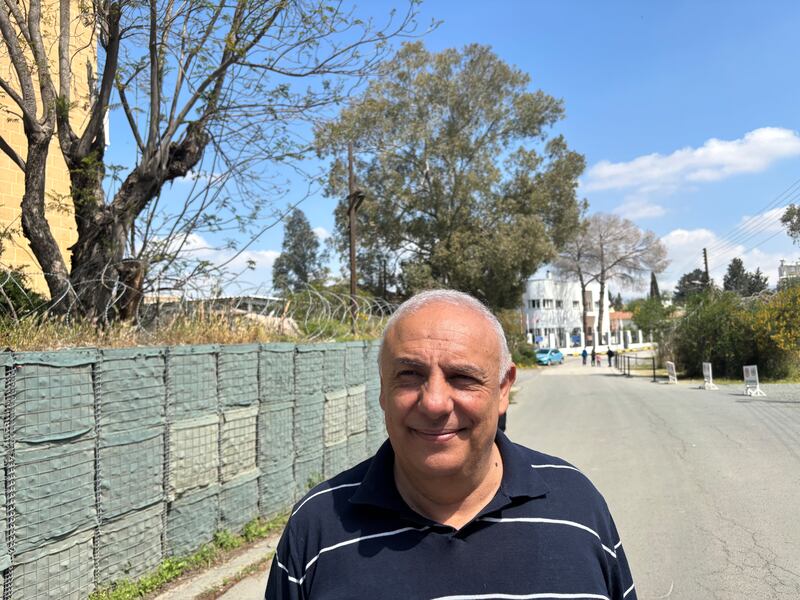
The committee does not have a remit to establish how the person died, only to identify the remains. Some families already know the answer.
Petros Souppouris was 10 years old when his parents and siblings were killed by an armed group of Turkish Cypriots in 1974. “I was there, so I knew that they were dead. I was also wounded with three bullets,” he says.
His father, Andreas, and mother Areti, his brothers Ioannis (9) and Dimitris (4) and two-year old little sister Julia, were killed in the massacre. One other brother, Costas (8), managed to flee and survived.
His family and other Greek Cypriots had been sheltering in their house in a village north of Nicosia, after Turkey invaded. A group of three Turkish Cypriots ordered them out and shot them.
An officer from the Turkish army later came across the bloody scene and directed medical aid be provided to any survivors. “They took the wounded to the house just opposite. I knew that my father, my mother, my brothers, my sister, they were dead, but despite that they were considered ‘missing’ from our side,” Souppouris says.
Souppouris is speaking to me over coffee and lemonade in the Home of Cooperation cafe, beside the UN’s offices in the buffer zone, at one of three crossing points in the capital.
[ Inside the ‘dead zone’ in Europe’s last divided capitalOpens in new window ]
It was only in 2007 that the mass grave, dug 400m from his family home, was located and the bodies of parents and siblings exhumed, he says.
They were unable to locate the remains of Ioannis. “He was never found. I saw him with blood and bullet [wounds] on his head. So still we are missing him,” he says.
Even though he knew long ago his family had been killed, the funeral felt like a closing. “It was hard but it was a relief,” he says.
Souppouris, now 62, who became an airline pilot, says for years his story was used for “propaganda” purposes by the republic of Cyprus government, to rail against the crimes committed by Turkish Cypriots and Turkey.
Souppouris takes a different view and forgives the young men who murdered his family. He speculates that they could have been Turkish Cypriots living in a nearby village, who for years during the 1960s were attacked and harassed by Greek Cypriot militias.
Souppouris gives talks in schools with a Turkish Cypriot whose mother and four siblings were killed during the ethnic violence, to promote a more rounded understanding of the conflict.
“The kids, they are not taught the truth ... If we don’t learn about what happened, why it happened, root causes, then we cannot continue,” he says. “It was from some extremists from both sides that the situation broke down,” he says.

It was crucial that Greek Cypriots and Turkish Cypriots learned to live together on a “bicommunal” basis, for any future settlement to work, he says.
Negotiations to resolve the “frozen” conflict came close in 2004 and again in 2017, before collapsing, in part due to reluctance from the Greek Cypriot side.
The proposed solution had been a single federal state that would include some powersharing elements and allow each community to run most of their own affairs.
Progress stalled under a hardline Turkish Cypriot leader, Ersin Tatar, however the election late last year of the more moderate Tufan Erhurman has raised hopes talks may begin again.
Locating and identifying the bones of the remaining 933 missing people cannot wait for Cypriot politicians, plus governments in Ankara and Athens, to all finally align to have their own Belfast Agreement moment.
“We are fighting against time,” says Hakki Muftuzade, the missing committee’s co-chair representing the Turkish Cypriot community.
“We still have people who are close to first hand witnesses, like friends of people involved, children of people involved ... Once we lose those as well, it will be more difficult,” adds Leonidas Pantelides, his counterpart nominated by the Greek Cypriot side.
The duo get on well and do their best to steer clear of politics in any public comments. They reckon they have a window of three to five years before an older generation with valuable knowledge is gone.
“There is a kind of social consensus that this has to be done,” Pantelides, the former diplomat, says of the committee’s work. “Everybody realises it’s difficult and it’s painful, but it has to be done”.


