
Some years are more disorienting than others. This one, at once intense and purgatorial, was scarred by humanitarian catastrophe and war in Gaza, vast displacement and internal conflict in Sudan and a cocktail of insidious authoritarianism and trade-war fervour in the United States.
As Ukraine defended itself for a fourth year, the drone incursions, cyberattacks and shadow fleets of “hybrid warfare” lent disconcerting ballast to the view that Europe was not so much sliding into a direct confrontation with Russia as already at war with it.
With 2025 marking the start of the century’s second quarter, the age of instability rolled on. The ominous sense that even greater disasters – geopolitical, environmental, cultural – are pencilled on our future calendars was a pervasive one, surfacing in poll after poll, meme after meme.
“Things happen,” Donald Trump shrugged in November as he dismissed the 2018 assassination of Washington Post columnist Jamal Khashoggi while sitting beside Saudi crown prince Mohammed bin Salman, the man US intelligence services say orchestrated his dismembering.
READ MORE



As a catch-all, nothing-to-see-here, move-on response, it encapsulated the era of impunity, disdain and upheaval. Halfway through the 2020s, it seemed the rules-based international order was out and “things happen” was in.
January set the baffled tone. Two extreme weather events either side of the Atlantic exemplified themes that were to recur over the course of 2025, from ill-preparedness, a feeling of abandonment and questions about Government accountability at home, to disinformation, climate denial and a coarsened political culture in the US.
Here, the record wind speeds of Storm Éowyn left behind unprecedented damage and became the costliest “weather bomb” in the history of the State. The perils of past dithering were laid as bare as the forests in Éowyn’s path.

“There was no plan, and you left the ESB to do the heavy lifting,” Social Democrats TD Jennifer Whitmore accused the newly formed Government. It was a line that would find echoes in later high-profile criticism of how things work, or don’t work, in Ireland.
For many Storm Éowyn mutated into a forlorn waiting game. In the immediate aftermath, the ESB’s power-check website was consulted 12 million times. It was 18 days before some households got theirs back. Storm names had reset to “A” by the time a Government-commissioned review recommended improvements to emergency communications by state agencies and acknowledged there had been some “confusion”.
In the US a political hurricane returned to Washington DC as catastrophic wildfires tore through Los Angeles, smothering the city in dystopian smoke. Fake pictures of the Hollywood sign on fire went viral, while Republicans, including president-elect Trump, falsely blamed firefighters’ water shortages on Democrat policies intended to preserve a “worthless fish”.

In a year that began with Meta boss Mark Zuckerberg announcing an end to independent fact-checking on his social-media platforms in the US, it fell to outgoing US president Joe Biden to rail against a “tech-industrial” complex in which “the truth is smothered by lies told for power and for profit”, artificial intelligence (AI) can “spawn new threats” and there’s a “dangerous concentration of power” in the hands of the ultra-wealthy.
But few were listening to Biden. They were listening to Zuckerberg tell podcaster Joe Rogan about his plans to celebrate “masculine energy” in the workplace.
The new coinage for the influence of “tech bros” was the “broligarchy”, as demonstrated by the strange sight in February of trillionaire-in-waiting Elon Musk, accompanied by son X, pulling focus from Trump in the Oval Office as he fielded media questions about whether he was orchestrating a takeover of the federal government.
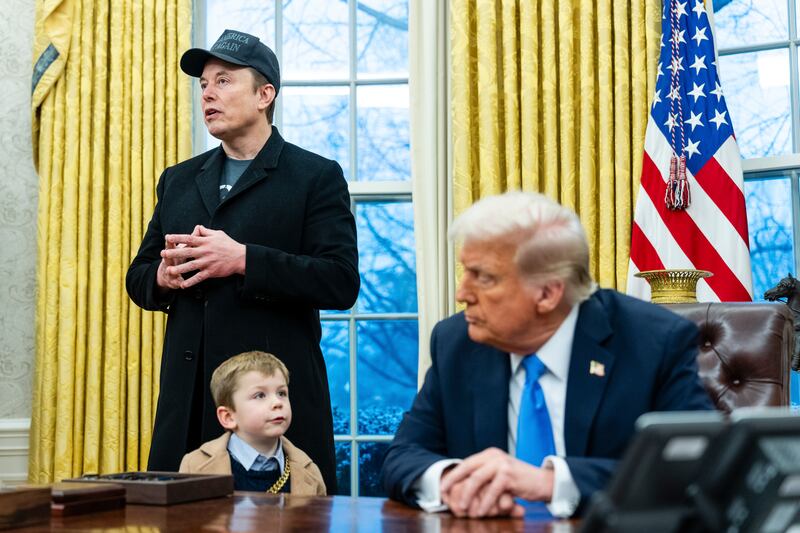
Soon after, while on stage at CPAC – a right-wing conference – the Tesla boss was handed a power tool by Argentina’s president Javier Milei and duly brandished his “chainsaw for bureaucracy” before a cheering crowd.
As it transpired, Musk’s involvement with the Department of Government Efficiency (Doge) lasted only slightly longer than the average handshake between Trump and French president Emmanuel Macron. Doge itself was disbanded in November, though in the whiplash-inducing style characteristic of the Trump 2.0 regime, Musk was by then sniffing around Washington again, attending the White House dinner for the Saudi ruler.
Threats spawned by an unfettered AI industry ran from the psychological to the economic. Concerns that vulnerable users were becoming emotionally dependent on chatbots competed for news space with predictions that a tech-stock bubble was on the cusp of a painful burst. Do not “blindly trust” AI was the advice not of sceptics, but of Sundar Pichai, chief executive of Google-owner Alphabet, as he admitted the AI investment boom had some “elements of irrationality”.
The revolution was, alternatively, overhyped, misunderstood, taking a breather or only warming up, depending on who was talking. But its confused casualties were everywhere, from authors who discovered their pirated books had been used to train generative AI tools – “fair use”, US courts ruled – to British musicians, including Paul McCartney, who protested against a proposed weakening of UK copyright law by releasing a “silent album”.
Irish civil liberties groups criticised Government plans to enable An Garda Síochána to use facial recognition technology, which is deemed a “high-risk” AI system under EU legislation.
Minister for Justice Jim O’Callaghan insisted it would only be deployed in “very controlled” circumstances, but the worry, as expressed by the Artificial Intelligence Advisory Council – the State’s expert group on AI – was that its use would risk a “gradual mission creep” toward a mass surveillance society.
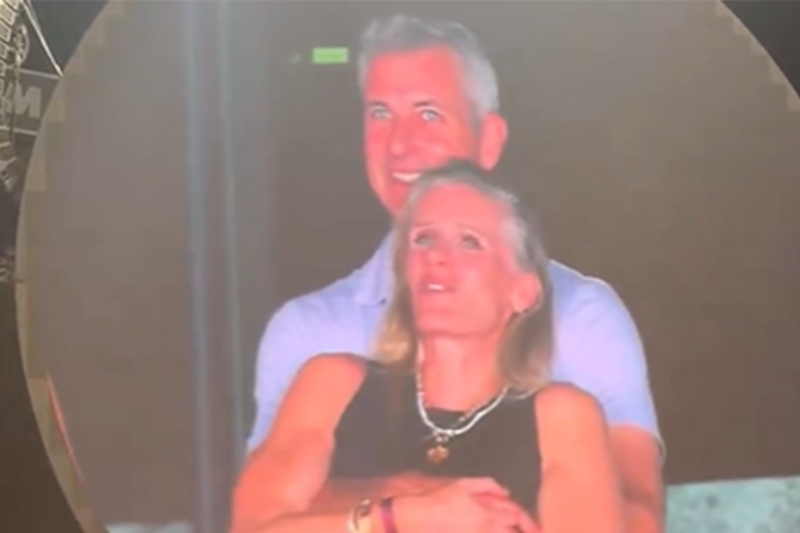
With news outlets happily dwelling on daft stories such as that of married tech boss Andy Byron caught embracing colleague Kristin Cabot at a Coldplay concert in Massachusetts in July, not every aspect of our surveillance culture could be pinned on AI. Sometimes all that was required was timeless prurience and a “kiss cam”.
But this was not a vintage year for unshakeable tech optimists. “Something went wrong” was the droll front-page headline of UK newspaper Metro in October after a bug at Amazon Web Services took out everything from Roblox to Ring doorbells.
A cyberattack on Jaguar Land Rover dented the British economy, ransomware kept Marks & Spencer offline for months and an attack on software provider Collins Aerospace in September triggered what was just the latest iteration of travel hell at several European airports, including Dublin’s.
The screen year saw a searing hit drama on Netflix, Adolescence, reignite debates about the role of toxic online content in the lives of young people. Others grew extra weary of giving algorithms the power to manipulate their time. Social media, no stranger to sparking a backlash, was again the subject of one, with New Yorker writer Kyle Chayka arguing that ordinary people could soon stop sharing their lives online. He called this point “posting zero”.
AI “slop”, bot-fomented hate, the desire for privacy and the real-life havoc caused by single points of failure on the internet all deepened valid anxieties about the outsize power of tech giants in 2025.
As for Trump, he was fond of AI slop. A second wave of “No Kings” demonstrations in October saw millions across the US object to his expansion of presidential power. Trump duly reposted an AI-generated video of himself in the cockpit of a fighter jet, dumping what some headlines coyly referred to as “brown liquid” on the protesters beneath him.
If this year extended the age of instability, it also offered proof that world leaders had entered a new era of indignity.

The Oval Office was the location for an unusually abrasive scene in February, as the US president, flanked by vice-president JD Vance and other wingmen, accused a straight-talking Volodymyr Zelenskiy of “gambling with world war three”. For Trump, there was an upside to his ensuing shouting match with the Ukrainian president. It was all “going to make great television”.
By the time Canadian prime minister Mark Carney ventured into Trump’s den with the sombre reminder that “Canada is not for sale”, the Oval Office had transformed into what the New York Times labelled a “rococo gilded nightmare”. It turned out that Karoline Leavitt, the White House press secretary, had been speaking literally, not figuratively, when she declared at her inaugural briefing that “the golden age is back”.
That was not quite how a gloomy Keir Starmer put it as tariff wars raged in April, despite best collective efforts to schmooze Trump. “Old assumptions can no longer be taken for granted. The world as we knew it has gone” was the UK prime minister’s blunt synopsis.
But while Trump’s showbiz instincts for grand claims, sudden reversals and wild non-sequiturs found their form throughout a spring of US tariffs tit-for-tats, the bewildering pace of White House drama belied a competing narrative: that everything had stalled.
Gen Z-ers latched on to a meme to sum up how they felt. “Recession indicator” was the tag nervously applied on social media to everything from the popularity of Labubu dolls to the release of a new Lady Gaga album. It was less a commentary on economic sluggishness than an expression of jokey despair.
In Ireland, where Central Bank data again found that the richest 10 per cent of households hold almost half the wealth, infrastructural stagnation remained a dismally reliable generator of news and commentary.
John Collison, home-grown tech billionaire and one of several Silicon Valley-based investors to back a controversial project to build a “utopian city” in California, wrote in The Irish Times of his dismay at the “timidity” of Irish leaders and their penchant for ceding responsibility to unelected officials. “Why can’t Ireland just do things?”
“Just doing things” certainly seemed challenging at times when it came to children’s health: The national children’s hospital, which had an original completion date of 2020, missed its 14th, 15th and 16th dates for substantial completion as the relationship between Ministers and construction company BAM stayed sickly. The debacle prompted one of the year’s 15 references in the Oireachtas (by 12 different politicians) to “Groundhog Day”.
As for the housing crisis, the Government announced an autumn strategy to deliver 300,000 homes by the end of 2030. “We will be held accountable,” Taoiseach Micheál Martin insisted as he defended the removal of annual targets. Before the plan’s unveiling, Minister for Housing James Browne had some advice for aspiring homeowners: “Hang in there.”
But will they? In a Sign of the Times survey published by Ipsos B&A in April, only 53 per cent of people aged 16-34 said they felt Ireland was a good place to live, compared to 80 per cent of people aged 55-plus. There was evidence, too, that turbulence overseas had darkened the mood at home.
“Ireland feels like a small boat caught in a tempestuous storm,” Ipsos B&A chief executive Luke Reaper said, describing a “tense” nation looking outward to a complicated and “unsettling” world.
That it was an increasingly unstable world for immigrants was obvious from the enthusiasm with which political leaders, either representing or responding to a surge in right-wing populism, rewrote laws to create a more hostile environment.

An emboldened Immigration and Customs Enforcement (ICE) agency in the US embarked on a year of raids, detentions and deportations. Britain’s Conservative opposition liked what it saw and outlined plans to introduce its own ICE-style “removals force”. Here, Tánaiste Simon Harris said he thought immigration “too high” and wondered why “we’re not having that sort of discussion at a policy level in Ireland that every other European country is having”.
Faith that world leaders were grown-ups who would sort everything out took a measurable knock. Every year communications firm Edelman publishes a “trust barometer” based on surveys in 28 countries, including Ireland.
In January its report found that three in five people had “a moderate or high sense of grievance”, meaning a majority believed governments and businesses made their lives harder and served narrow interests, with the system favouring the rich. Fear of being purposely misled, including by the media, rose to a 25-year high, while trust in employers “to do what is right” slumped.
For those keeping a close, distressed eye on events in the Middle East, helplessness was a familiar emotion. Amid intensifying bombardments and Israel’s near-total blockade on aid into Gaza, “WCNSF” was standard medical vocabulary. Dr Morgan McMonagle, an Irish surgeon, wrote in The Irish Times that its meaning had to be explained to him during his first humanitarian mission – at home in Waterford he didn’t have any use for the phrase “wounded child, no surviving family”.
By July the situation endured by the people of Gaza was so visibly dire, even Israel’s ally Trump, watching via television, was moved to say he was “not particularly convinced” by Israeli denials. The children “look hungry”, he said. “That’s real starvation stuff. I see it, and you can’t fake that.”

Against all expectations his administration engineered a ceasefire deal on October 10th. But peace proved illusory, with officials in Gaza reporting that 360 Palestinians were subsequently killed by Israeli airstrikes. The oxymoron was “post-ceasefire attacks”.
The UN’s warning of a “generational” terror threat loomed large as antisemitic incidents increased worldwide and two gunmen opened fire on a Jewish celebration on Sydney’s Bondi Beach, killing 15 people.
Meanwhile, bloodshed in Sudan’s civil war barely troubled the radar of the international community yet was found in October to be “visible from space”. This was after Yale University’s Humanitarian Lab studied the satellite images and identified 31 clusters of objects consistent with human bodies in or near the paramilitary-controlled city of El-Fasher.
Modern satellite technology means most activities of scale – from the scorching of Los Angeles to the bulldozing of the White House’s East Wing – will be visible from space. But the application of the phrase to the Sudanese atrocities seemed a particularly damning judgment. “The stain on the record of the international community is less visible, but no less damaging,” UN human rights chief Volker Türk said.

The simultaneous tragedy and high-stakes absurdity of the geopolitical year was underlined by Trump’s confident assertion that he had solved a non-existent war. “You should make an apology to us,” Albanian prime minister Edi Rama teased Macron at an October summit in Copenhagen. “You didn’t congratulate us for the peace deal that president Trump made between Albania and Azerbaijan.”
Beside him, Azerbaijan president Ilham Aliyev, whose country had been embroiled in conflict with Armenia, roared laughing. “I am sorry for that,” a deadpan Macron said.
A war that never happened is one thing. A war happening without official acknowledgment is another. Fiona Hill, who was the White House’s chief Russia adviser during Trump’s first term, reiterated her belief in September that Vladimir Putin was at war with the West. Other experts agreed.
That month Russian fighter jets violated Estonian airspace, while Denmark joined Poland, Germany and Romania in reporting drone sightings near airports and military bases. Belgium was next, then drones were spotted over Dublin Bay during Zelenskiy’s visit to Ireland. Fears rose that underwater cables were at risk of sabotage, with one Russian intelligence ship entering Irish-controlled waters in April and another using lasers to disrupt RAF pilots tracking its activity near UK waters in November.

The Kremlin’s response to most allegations of hybrid warfare was to brand Europe “Russophobic”. Nevertheless, the big new European project as 2025 neared its end was the establishment of a “drone wall” – an anti-drone defence system that stretches from the Baltic States to the Black Sea.
Alongside suspected jamming of GPS signals, electoral interference in Moldova and other tensions, Russia’s alleged tactics acquired an AI dimension, with a London-based think tank, the Institute for Strategic Dialogue, finding that hundreds of pro-Kremlin, English-language websites were “grooming” chatbots such as Gemini and ChatGPT.
As December arrived it seemed Europe was on the verge, but of what?
Trump circled back to his view, made plain in February’s Oval Office showdown, that Ukraine – the front line of Europe – “doesn’t have the cards”. Zelenskiy’s response then had been a simple one: “I’m not playing cards.”
This year of card-game analogies, AI deepfakes, drone strikes, masculine energies and red weather alerts also brought the first babies to belong to a new generation, Generation Beta. They will eventually inherit the decade’s debris.
But whether we remember 2025 as a time of particularly high levels of mistrust, discord and calamity ultimately depends on how 2026 unfolds. The one certainty, for now, is that “things happen” and they will keep on doing so.