
The protracted regeneration of flat complexes such as Dolphin House in Dublin’s southwest inner city may be causing harm that outweighs the benefits of new development, according to a study from Trinity College Dublin.
Stress, anxiety and “a pervasive sense of precarity that seeps into daily life” caused by prolonged and uncertain regeneration plans have left residents with “a sense of powerlessness” like a “sword of Damocles” hanging over them, according to Joe Whelan and Ruby Stein of the Trinity School of Social Work and Social Policy.
Dolphin House, a complex of 392 flats built in 1957 beside the Grand Canal in Dolphin’s Barn, was one of several older dilapidated complexes in the city scheduled for regeneration 20 years ago.
In 2007, a regeneration board was established with plans to demolish and rebuild the estate using a public-private partnership (PPP) model. The following year, the economic crash hit, but the council said it would still plan for the regeneration of Dolphin House.
READ MORE


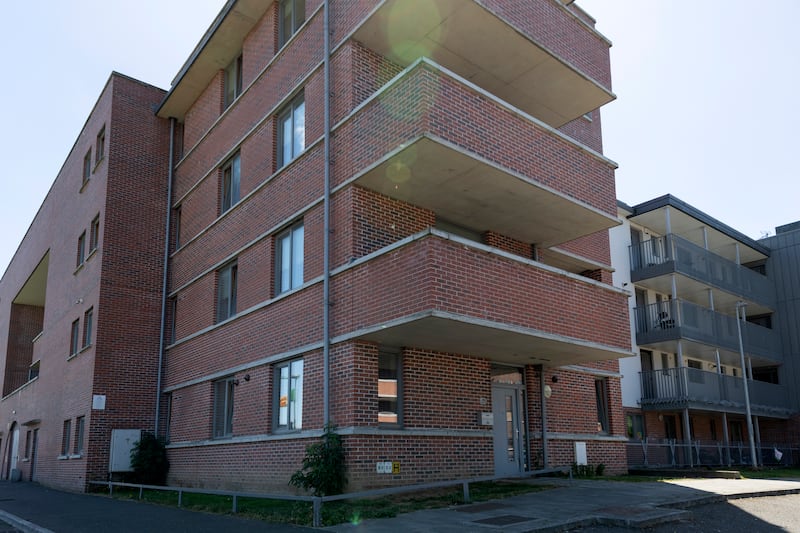
In 2012, the council announced a “deep retrofit” of the flats. The following year it produced an amalgamation project where 72 existing flats would be reconfigured to make 63 larger apartments in addition to the construction of 37 new homes. This phase was completed in 2018, but no plans were in place for the rest of the complex, which remained in an extremely poor condition with mould, damp and sewage problems.
In 2021, the council published a plan to complete regeneration in phases by 2030. This work has yet to start, but a phase of 30 new homes has, in recent months, been granted permission. Full completion is now not due until 2035.

Trinity’s research was conducted in collaboration with a steering group of residents, representatives and community workers and involved interviews over a six-month period with more than a dozen residents and a senior city council housing official.
Residents interviewed spoke of feelings of abandonment and that regeneration was no longer a source of optimism but “something that residents live with like a sword of Damocles dangling over their heads, eroding surety and preventing long-term planning, thus directly impacting daily life”.
Several spoke of the dire conditions in the flats, particularly after heavy rainfall. “You’d wanna see what was coming up out of me sink; you’d wanna see what was coming out of me bath … Oh, it was horrendous! And it was all piss, urine – everything – crap. Everything that comes up your drain was coming up,” said a resident, given the pseudonym Bernie.
Another, given the name Charlotte, referenced how the de-tenanting of flats in preparation for demolition left some residents living in mostly empty blocks, which felt cold and unsafe.
“You have no neighbours. You see nobody. You talk to nobody. It’s a complete and utter disgrace the way Dublin City Council has left us.”
The council official told researchers the council spent “about a hundred and forty million on maintaining and upgrading our housing stock” annually. But this was “nowhere near enough money to maintain the level of stock that we have”.
The council was dealing with mould and drainage issues, he said, but where flats were designated for regeneration, the council could not “go in and do large works to those buildings”.
The study concluded that “prolonged uncertainty during regeneration should be recognised as a form of social harm”. It said: “Where regeneration cannot be delivered within a clear and reasonable time frame, the findings raise the question of whether prolonged regeneration may produce harms that outweigh its intended benefits.”


