
In the past decade there has been a significant growth in the number of alternative schooling models, mainly at preschool and primary school level, in Ireland.
These include outdoor play schools, for example The Nature Kindergarten in Killruddery, Co Wicklow, and a forest school in Co Clare; so-called democratic schools; mixed-age classrooms; schools with democratic governance; and the longer-running Steiner Waldorf schools, with their emphasis on holistic child development through thematic seasonal learning modules.
High anxiety levels among children following the Covid pandemic, also spurred some parents to look beyond the standard classroom-based approach to teaching.
The aftermath of the pandemic also saw a big increase in home-schooled children, from 1,500 to 2,500.
READ MORE


In September 2025, another alternative schooling model – outdoor primary schools – was opened in Ireland.
[ Have you heard about ‘democratic schools’?Opens in new window ]
Fee-paying school The Outdoor Primary School (TOPS), in Greystones, Co Wicklow, which had a modest first intake of 14 pupils, shares the grounds with the SEC International School on the edge of the coastal town. The pupils – aged four to 11 – also have use of two indoor classrooms for a segment of each day.

“So many parents are crying out for other options and we see ourselves as in between traditional education and the other alternative schools such as democratic schools,” says school principal Louise Nelson.
She has a background in bushcraft (forest skills such as lighting fires, using tools carving wood and learning knots) and taught in traditional primary schools in Asia, the UK and Ireland before setting up TOPS.
The three core pillars are nature, nurture and knowledge, she says. “It’s about giving children a connection with nature, making sure relationships between teachers and pupils are strong so that they can take risks and get things wrong without feeling bad.”
In the knowledge pillar, the mixed-age groups follow an inquiry-based approach to learning rather than a standard subject-driven curriculum. So, for example, when learning about rivers, they are asked what they already know and what they would like to know and these questions are then explored, covering history, geography, maths, English and art in an integrated manner.

The Department of Education doesn’t recognise this approach to teaching so the school doesn’t qualify for capital grants, teacher salaries or any funding at all. Fees are €10,500 for the year, spread out over 12 monthly payments of €875. And the school is monitored and inspected by the alternative education department in the child and family agency, Tusla. The school is also seeking accreditation from the International Baccalaureate World Organisation.
But, apart from the teaching approach, the huge difference between TOPS and any other school is that the children spend most of their school day outdoors. They begin their day in the forest with a meeting. They move indoors for literacy and numeracy activities. They have their hot lunch in the canteen and then, after breaktime in the yard, they move back to the forest for cooking, art, maths and music.
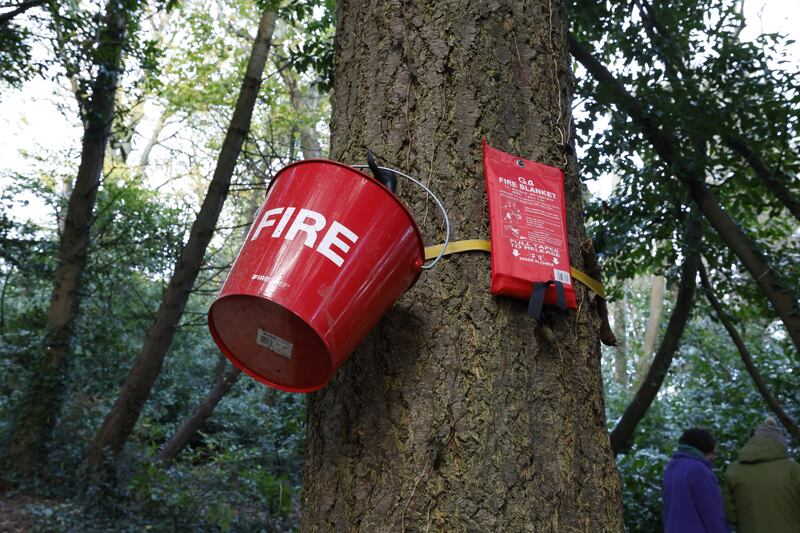
On a chilly, but sunny, winter afternoon when we visit, everyone is in the forest adjoining the school grounds. The children run around playing on swings or sit whittling sticks with knives or hammering small nails into wood. The teacher and teacher assistants sit on logs, wearing coats and hats, supervising the activities.
The children are wearing waterproof dungarees over several layers of clothing with fleece-lined boots. Nobody looks like they feel the cold, while my hands are frozen taking notes outdoors. There are gazebos, polytunnels and open-style tents with clipboards, art materials and so on to provide shelter if needed. Investigation stations are equipped with measuring tapes and magnifying glasses to further explore the woodland. And books are stored in a repurposed stand-alone fridge.

“A lot of people panic about the weather, asking: what do the children do when it’s raining? Well, they put on their raincoats and wellies,” says Nelson. A parents’ meeting before the start of term advises parents how to layer up their children’s clothing with thermal wear for being outdoors.
Nelson says being outdoors is the key defining feature of the school. “Children learn better when they move, and children who can’t sit down in classrooms become the leaders outside. But it doesn’t suit every child,” she says.
She also says that mixed-age classrooms allow children to learn at their own pace. “Peer comparisons knock confidence, especially for boys,” she says. The school is also open to neurodivergent children who struggle with the discipline and noise in traditional classroom settings.
Nelson aims to build pupil numbers to about 120 in the next few years and has no concerns about children who have learned in such an environment adapting to traditional secondary school.
“I’ve spoken to secondary schoolteachers who have taken children from inquiry-based learning schools and they say that these students are more independent and more invested in their learning,” she says. She believes they make the transition from primary school to secondary school more easily because they are used to being on the move a lot during the day.

Matthew Fallon, a second-year student in the primary schoolteacher training at the Marino Institute of Education is on placement. “It’s important for children to spend time outdoors, and mainstream education is trying to implement more outdoor learning,” he says. Giving children opportunities to be outside is a counterbalance to growing attention on digital learning, he believes.
Canadian teacher Sarah Kisch moved to Ireland with her Irish husband from Asia. “I’ve taught in progressive schools all over Asia. I’ve never used a workbook and worksheets with children,” she says.
She is a big fan of mixed-age classrooms and believes children learn better through inquiry-based learning. “Nowhere else in society do we segregate people by age except in education, and with inquiry-based learning, they get a deep understanding of concepts rather than copying their peers from a workbook.”
Sabine Smullen arrives to collect her six-year-old daughter, Indie. “One size has to fit all in a normal school and that wasn’t for Indie,” Sabine says. “So many young children are suffering from anxiety and she was one of them. But here, the children’s voices are heard and they can have their own opinions.”
Clara McCormack arrives to collect her boys, Albie (6) and Louie (4). “I love the outdoors and the whole philosophy of inquiry-based learning,” she says. “We lived in Australia for 12 years and the lifestyle there is so much more outdoors that we looked into outdoor education here before we came back.”
Nelson says a number of the families with children in the school have returned from abroad.
As we say our goodbyes watching some of the children climb a tree before hopping into their parent’s cars, she adds: “Three-quarters of English and Irish children spend less time outdoors than prison inmates.”


