
Unions at RTÉ are to meet next week to consider their response to the next round of cuts at the organisation, which shed about 100 jobs and confirmed the closure of its documentary unit at the end of last year.
Siptu divisional organiser Adrian Kane said attitudes had hardened among RTÉ staff after the first round of restructuring, with group of unions secretary Sorcha Vaughan saying “the reality of cuts had hit” due to changes made in recent months.
Siptu officials and members of the union working at Montrose on Tuesday briefed Opposition TDs on developments at RTÉ. They claimed RTÉ has become more important to the general public in the period since it was plunged into crisis in June 2023 by the scandal surrounding payments made to broadcaster Ryan Tubridy.
“The ground has shifted so much in terms of the digital world we are living in, with more and more of the media being owned a tiny elite, a quite extreme group of people,” said Kane.
READ MORE


“I think people are increasingly worried, not just about public-service broadcasting but about the relationship between the citizen and the State. There’s a huge, profound shift taking place and people want to be assured about where they are getting their media from.”
Asked whether unions had left it too late to resist the scale of change under way at RTÉ, Kane said he did not think so and “nothing is being ruled in or out at this stage”.
“I do think there’s been a sea change in attitude among our own members, a feeling that we need to make a stand.”
He said there was the potential for matters to come to a head when a feasibility study on the outsourcing of The Late Late Show and Fair City is delivered, which he believed was “quite imminent now”.
Siptu members recently passed a vote of no confidence in the management’s strategic plan for the organisation by an overwhelming majority, but Kane acknowledged a shift in the Government’s position on funding the broadcaster would be required if the current plan for 300 more job losses and substantial outsourcing of programme making is to be avoided.
Eileen Culloty, deputy director of the DCU Institute for Media, Democracy and Society, said public-sector media has a “unique democratic role” as “part of our critical democratic infrastructure” and that to undermine it opened the wider media landscape to “influence and manipulation”.
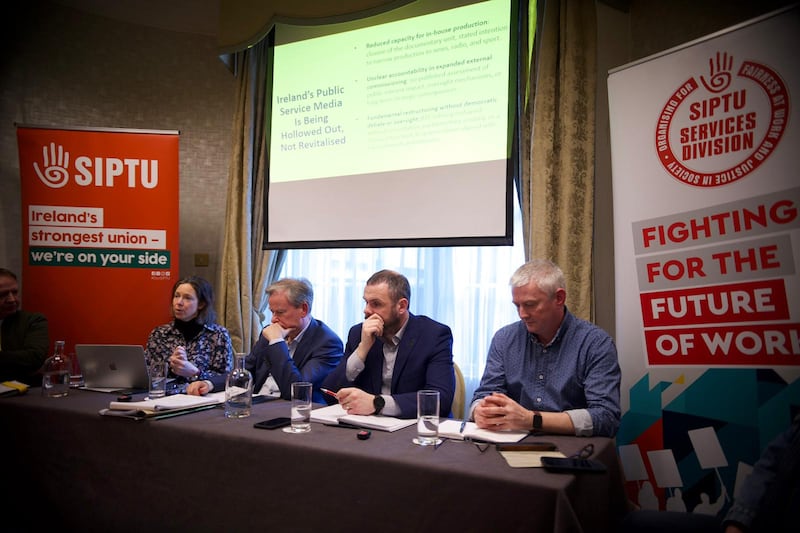
“This is happening right now,” she said, citing geopolitical tensions, the growing centralisation of media ownership in the United States and what she described as the moves by the owners of large tech companies with “anti-democratic forces”.
She described the lack of provision for programming aimed at young people at a time when they are being so widely targeted by media of “dubious quality” as “bonkers”.
A number of staff addressed the meeting with Stephen Kelly, a percussionist with the RTÉ orchestra and a Musicians Union of Ireland representative, saying members of the orchestra fear for its future given suggestions by Bakhurst in a recent meeting that RTÉ’s Radio Centre, where it is currently based, is likely to be closed in the coming years.
Ruth Kennington, a staff member in RTÉ radio and a Siptu representative, said funding was the key issue with a direct correlation between it and how important populations in different countries believed a public-sector broadcaster was to them.


