

For beef farmer John Curran the hour-long road trip to Athlone for the anti-Mercosur rally on Saturday is a minor inconvenience compared with last month’s trip to Brussels.
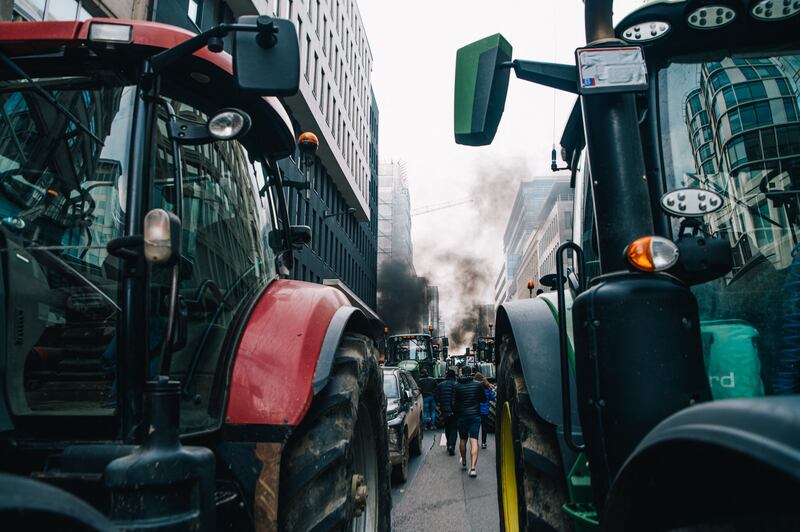
He was one of hundreds of Irish farmers who flew to the city to join others from across Europe in protest at the proposed trade deal which has just been ratified by the European Union as a bloc – though five countries, including Ireland, voted against it.
Mr Curran with his wife Fiona and daughter Mary keeps about 100 head of cattle for the organic market and 170 sheep on his 200-acre farm outside Kells in Co Meath. He did not inherit his farm; he accumulated it since branching out on his own in 1997.
Like most Irish beef farmers, Mr Curran had a great year in 2025. A worldwide scarcity of beef drove prices up by 40 per cent. For some farmers it was the first time they have had a decent margin for 30 years.
READ MORE


The Mercosur deal would reduce barriers to trade between four South American countries and the EU. The Mercosur nations export primarily agricultural products, including meat, and minerals to Europe, while machinery, chemicals and pharmaceuticals go in the other direction.
For Mr Curran, the concern is that the 99,000 tonnes of beef which the deal will allow into the EU market with substantially reduced tariffs will affect the fragile margins Irish farmers can expect to make in a normal year.
Ireland has six million head of cattle. Brazil, he points out, is the largest beef producer in the world with 238 million head of cattle, while Argentina, Uruguay and Paraguay all have herds that dwarf Ireland’s in size.
“There is no tagging, there is no traceability. It’s a free-for-all. The beef is full of hormones and they are using antibiotics that have been outlawed in Europe for years,” he said.
“We know Brazilian beef has been taken off the shelves in Ireland. We need equivalence of standard. It would be an acceptable compromise if it was policed properly, but we know from investigations that doesn’t exist over there.”
[ Irish MEPs to oppose Mercosur deal in final European Parliament ratification voteOpens in new window ]
In a combined market of more than a billion people, he admits the Irish beef farmer is a minor consideration in the scheme of things, but all is not lost.
“I was surprised when Italy voted yes. When I was out in Brussels at the Mercosur protests, there was a huge contingent of Italian farmers there,” he said.
“The Italian government is going to hit serious resistance getting this through their parliament. I don’t think it is done or dusted yet.”
Tom O’Connor, a beef farmer from Moone, Co Kildare, said the EU had “raised the white flag” in relation to animal welfare standards with the Mercosur deal.
“From the day a calf is born until I take it to the factory, everything is traced. We have a better transparency in the food we produce than we have in the health service,” he said.
Observers have said the 100,000 tonnes which will be allowed in tariff-free is a small amount for a huge market.
Mr O’Connor says it is the equivalent of the steak meat of four million cattle as it is the higher-value cuts that will be sent into the EU market.
“We’re going to get hammered on the higher-end cuts”.
Michael Haverty, a beef farmer from Clonbern in north Galway, said that as a father of three he understood the concerns many households have about rising food prices.
“We are well aware of the cost of food, but Irish consumers can rest assured that our meat is probably the safest meat you can eat.”
He is hopeful the deal will be stopped by MEPs, but, if not, “we might end up in damage limitation”.
“It is important, if it does happen, that European consumers are fully aware of the differences between European and Mercosur beef.”


