
Tis the season for indolence and lie-ins, when even the sun chimes with the times and becomes a tardy riser. Languid days mean it’s easy to fall into a pattern of overindulgence and lethargy, but the festive season doesn’t have to be soporific. Head outdoors on a clear, frosty morning and the first lungful of cold air is instantly invigorating. Then find a walk with a fascinating story to entertain and you have a memorable outing for the family.
Lúb na Cille, Co Kerry
In 1969, the people of the Corca Dhuibhne fell on their feet. The arrival of renowned film-maker David Lean to shoot the movie Ryan’s Daughter proved transformative for the area. Locals were employed to build a mock-up village, and since poor weather delayed shooting, local pubs and guest houses had a field day. If visiting Dingle this holiday season and looking to discover more about Ryan’s Daughter, Lúb na Cille is the answer. Starting from the Ionad an Bhlascaoid, this easy 5km walk offers panoramic views of the Blasket Islands and also traverses the area where Ryan’s Daughter was shot. The mock-up village has been demolished, but you will see the ruined schoolhouse used in the film. Here, you may recount that when it was released, the film was, despite its stunning cinematography, critically panned. With Lean’s confidence shattered, the maker of classics like Dr Zhivago and Lawrence of Arabia did not make another movie for 14 years.
Ballykeeffe Nature Reserve, Co Kilkenny
Situated 12km west of Kilkenny City, Ballykeeffe Wood is ideal for families. The 3km looped walk dallies over a limestone outcrop covered with oak and ash woodland. Leading to a clifftop above a worked-out quarry, it offers splendid views over Slievenamon and the Comeragh Mountains. Here, you explain that this was once a dump until members of Tyndall Mountaineering Club began sharpening their mountaineering skills on its vertical walls, with the result that Ballykeeffe became a popular rock-climbing venue. As the venue was increasingly utilised, the local community decided to turn the quarry into an entertainment venue, taking advantage of the spectacular setting. Rebranded as Ballykeeffe Amphitheatre, it is now a multifunctional resource where rock-climbing coexists beside a summer programme of theatre and concerts. And you can give young people a special treat by seeing how far they can climb sideways, while remaining safely near the ground.
Devil’s Bit Loop, Co Tipperary
This 5km loop walk starts from Barnane Carpark and comes with abundant stories. According to tradition, the devil, while being chased from Ireland by St Patrick, took an angry bite from the summit and dropped it to form the Rock of Cashel. A meeting attended by 50,000 was held here in 1832 to support Daniel O’Connell’s anti-tithes campaign, while the priceless book of Dimma was reputedly found in a mountain cave. One story tells of a man called John Rutter Carden, who was jailed for harassing a young woman. On release, he built a large tower on the mountain that some believe is a monument to unrequited love. The walk is a lovely outing with young people enjoying the rocky scramble to a summit offering splendid 360-degree views.
READ MORE


Muckross Loop, Co Kerry

Another walk replete with stories starts from Muckross House, Killarney. Here, you can tell how Queen Victoria came to Muckross in 1861 as a guest of the Herbert family. Declaring that the lakes surpassed her highest expectations, she thereby kick-started tourism to Killarney. The unchallenging 10km trail meanders the isthmus separating Muckross Lake from Lough Leane, with the ancient yew woodlands at Reenadinna, a good place to see Ireland’s last herd of native deer. Here, the Colleen Bawn Rock recalls the tragic story of Ellen Scanlon, whose murder in the early 19th century inspired Julius Benedict’s melodramatic opera, The Lily of Killarney, even if the original crime took place elsewhere. Onwards past Dinis Cottage, a former hunting lodge, before making the short diversion to the biscuit tin-pretty Meeting of the Waters. Continue by the lakeshore to cross the N71 twice before finishing in the serene grounds of Muckross Estate.
Causeway Walk, Co Antrim
After the defeat of the Spanish Armada, La Girona, one of its largest ships, put in to Killybegs in Donegal for repairs. Meanwhile, other ships were being battered to matchwood along Ireland’s storm-lashed west coast. About 800 survivors from these shipwrecks made their way to Killybegs and were taken aboard La Girona. Overcrowded with 1,300 men, she sailed for Scotland to reprovision before returning to Spain. After rounding Malin Head, a fierce gale hit La Girona and her rudder failed. Helpless as a drifting petal, she was blown on to the unforgiving Antrim coastline, where only a handful of Spaniards survived. To reach the shipwreck site, known locally as Port na Spanaigh, start from the Visitor Centre and follow the bracing clifftop path above the Giant’s Causeway for about 2km to reach the Chimney Tops viewpoint. Beneath lies poignant Port na Spanaigh, where, local tradition holds, the cries of those who perished still echo on stormy nights. Afterwards, retrace your steps to the Visitor Centre.
Liam Lynch Loop, Co Tipperary

Begin from a car park about 1.5km south of Goatenbridge, where purple arrows point 3km along a forest roadway to a large round tower. This is where you explain that this edifice honours republican Liam Lynch, who died in the Civil War. By springtime 1923, the position was desperate for anti-treaty forces, with Lynch, the Chief of Staff, under pressure to call a ceasefire. To discuss this, he convened an officer meeting for April 10 at Goatenbridge. While he overnighted at the isolated Houlihan farm, Free State soldiers were seen approaching. Lynch and his companions immediately rushed up a deep ravine, but were then forced to cross open mountain, where Lynch was shot. He died later, marking the effective end of the Civil War. Afterwards, retrace your steps or continue through the sublime scenery of the Knockmealdown Mountains for another 8km.
Cong Wood Loop, Co Mayo

The trailhead is near the iconic statue of John Wayne and Maureen O’Hara, which recalls a momentous time for Cong village when The Quiet Man movie was filmed here. Renowned film director John Ford, whose parents were Irish, fulfilled a lifelong ambition by making a film on location in Ireland. Afterwards, join the red arrows for the Wood Loop and continue through Cong Abbey, where Rory O’Connor, Ireland’s last High King, died in 1198. Beyond is a pretty, castellated footbridge over the Cong river, where a memorable scene from The Quiet Man was shot. Onwards then through woodlands, which were once part of the 26,000-acre Guinness Estate, to Pigeon Hole Cave. Here, children will love entering to see the subterranean river that is reputedly the abode of a magic trout. Then follow the arrows back to Cong.
The Walls, Derry City

The story starts in the 16th century, when the Walls of Derry were built to protect Protestant planters. In 1689, they proved their worth. Feeling isolated in a hostile country and fearing repetition of previous massacres, 13 apprentice boys slammed the gates in the walls against King James’s army. The subsequent unsuccessful siege of Derry then set in motion a tit-for-tat sectarian conflict lasting almost to the present. The one-mile walk around the Walls of Derry offers a rich palette of stories. You get a bird’s-eye view over the famous Bogside, where Catholics lived outside the city walls. Beyond, Union Jacks and political slogans adorning the Fountain Estate show loyalists still see themselves as under siege. Then there is St Columb’s, Europe’s oldest purpose-built Protestant cathedral, while beside the Walls the Tower Museum tells the colourful history of Derry since prehistoric times.
Union Rock Walk, Co Sligo
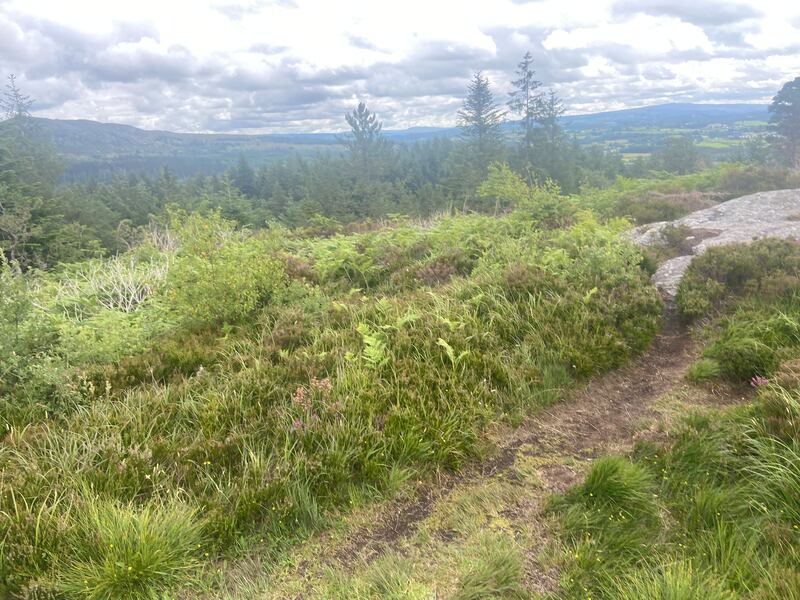
The Union Rock Walk, located near Ballysadare, is denoted by red arrows and leads to a lovely viewing point. Initially, it follows forest paths through native oak woodlands until the arrows convey you sharply left to gain a wooden boardwalk leading upwards. From the top, there are views towards mystical Knocknarea and Benbulben. Here, you explain that William Butler Yates is buried beneath Benbulben, while mythology-steeped Knocknarea is reputedly the resting place of Connacht’s Queen Maeve. This is a splendid opportunity to regale the family with stories of the Táin Bó Cúailnge, when Maeve attempted to steal Ulster’s prize bull, Donn Cúailnge. Also, mention how, in harsher times, the Coopers of Markree Castle, who held 40,000 acres, would place a flag on Union Rock to inform their tenants that it was time to pay the rent. Finish by retracing your steps to the car park.
The latest edition of John G O’Dwyer’s book 50 Best Irish Walks is out now from Currach Books


