

I went into the cinema on Saturday wondering at what point I might hear people crying.
Pretty much all the reviews I had read about the film of Maggie O’Farrell’s novel Hamnet mentioned a kind of Greek chorus of sniffs and stifled weeping being audible at a certain part of the movie. I wondered if I’d cry myself.
A couple of hours later I dropped into a nearby pub where a friend was having birthday drinks. She and her husband had seen Hamnet the night before. I had texted to say the film would make me a bit late. She had texted back obliquely: “Have many thoughts on Hamnet.”
It turned out we had the same thoughts. I had barely taken my coat off when the unfiltered review of the movie I had just seen came right out of my mouth. Most of it was composed of questions.
READ MORE


It went something like this.
Are we being had? Is everyone in a cult? Am I a barbarian?
Why is the whole movie so literal, with no subtlety? Is it because it’s about Shakespeare and the people who make the movie think that might put audiences off, so they spell every single thing out like bullet points on a flip chart of old?
Why is there zero chemistry between Paul Mescal and Jessie Buckley, as if Shakespeare and his wife, Agnes, come from different centuries and randomly encounter each other in some time-travelling forest? Why was Mescal so miscast?
Why does the film have not one but two excruciating birth scenes, the oldest cliche in film? Why would anyone think this is gripping, moving stuff?
Once was bad enough. The second time around I considered going to the bathroom to skip the scene of the birth of twins. It was just as unmoving and tiresome to watch as the first birth scene. Again, I am a barbarian. Ice, not blood, clearly travels through my veins.
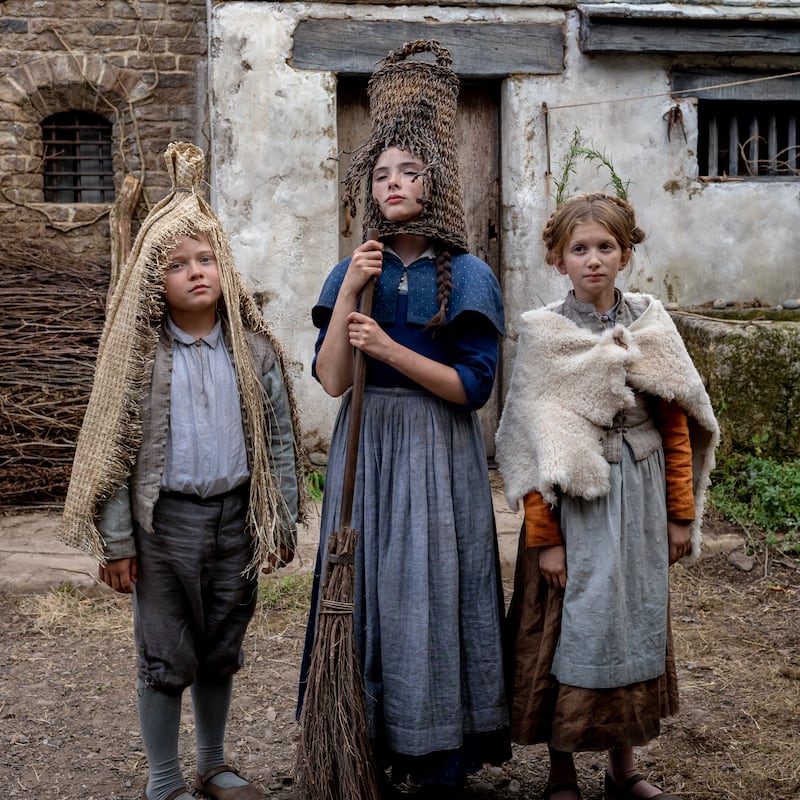
A child dies in this movie, which is no spoiler, as his name is in the title, and it all actually happened in the 16th century. Again, I felt as if someone was trying overly hard to emotionally manipulate me, in the coarsest possible way.
Let’s pause to say that of course the death of a child is an unspeakable tragedy in any era. But it’s not unspoken in Hamnet. It’s yelled at full volume. It felt like a great big box-ticking cinematic exercise in trying to provoke grief. Less is not more in Hamnet. More is clearly meant to be more.
I did not cry when young Hamnet finally expired – although, judging by the nose-blowing around me, some people certainly did. I felt slightly more moved when I saw the makeshift funeral ceremony for Agnes’ dead bird of prey, but not by much.
And, oh my, did it all go on and on and on, until I felt I had been at the cinema for such very long hours. By the time the film ended I was close to comatose with boredom, and rolling my eyes at the screen.
“I thought I was the only one who didn’t like it,” my birthday friend said when I eventually took breath.
I was so surprised that I disliked Hamnet quite so much that I spent the rest of the weekend trying to figure out why.
O’Farrell, who adapted the Oscar-nominated screenplay from her book with the film’s Oscar-nominated director, Chloé Zhao, wrote one of my favourite memoirs ever, I Am, I Am, I Am: Seventeen Brushes With Death.
Mescal was incredible in Aftersun, a movie I loved, and a role for which he was Oscar-nominated.
Buckley – who is from the beautiful county where my father was from, so please don’t point your rapiers my way, Kerry people – has already won several awards for her role. She is tipped for an Oscar – which, if it happens, will make her the first Irish woman to win best actress.
All the people involved in creating these disparate parts of the film are amazingly talented. I sincerely hope Buckley wins the Academy Award on March 15th. Who wouldn’t want that for her? What Irish person wouldn’t be both proud on her behalf and delighted for her if that happens?
And yet. I think I fell prey to the hype that has surrounded this film for months. I had some expectation that it would be daring and brilliant and moving. Many people who love Hamnet have indeed felt just this way after watching it.
But we are all different people, and we are all capable of responding in differing emotional and intellectual ways to the same experience. That’s what makes life interesting. I’m glad I saw Hamnet, even though I didn’t like it. It made me think. As Shakespeare wrote in his most famous monologue, which Mescal quotes in full in Hamnet, “To be, or not to be, that is the question.”


