![Gavin McCrea: 'The relationship I have with Paris [is] one of longing'](https://www.irishtimes.com/resizer/v2/AMAL7XXRHJFTLOAMG2RQYLAFB4.jpg?auth=b6d622000439a51c99104c250da9c79e1c059965fbbc9f19e0af366c655da653&smart=true&width=1024&height=683)
“London was never even on my radar,” Gavin McCrea tells me on Zoom. “You know, it was always Paris. I was going to live in Paris.”
This desire provided the setting of his new epistolary novel Rousseau’s Lost Children, where a middle-aged Irish academic named Gavin Mulvany writes in 2022-23 to a Jean-Jacques Rousseau who responds in 1777-78. Gavin winds up accompanying Rousseau on his Paris walks. With maps of the routes they take and atmospheric descriptions of the various arrondissements, the book provides full immersion for anyone who has yet to take the Paris plunge.
McCrea himself is one such person. “On both of the occasions that I tried to move to Paris, I totally failed,” he says. “It was too much for me. I couldn’t find a place. One of these times was sort of related to a relationship that didn’t work out … I’ve lived in various places, and I’ve returned to Paris on visits, and there’s always been: why haven’t I ever made it here? Why haven’t I ever been here for a long period of time? It just never happened. So that’s the relationship I have with Paris, one of longing.”
Not least among the factors hindering him was the expense. Berlin offered more realistic rent on a writer’s income. “Berlin was just so much more relaxed, and it worked out and things went my way.”
READ MORE


McCrea and I were both living there when we first met two years ago at an Irish Embassy literary event. I mentioned I was reading Annie Ernaux and he showed me a book of hers he was carrying in his pocket. We’ve been friends ever since. Only later did I realise I’d already read McCrea’s first novel, Mrs Engels, in 2016; completely uninvolved in the literary world at the time, I’d admired it without looking up the author.
Despite McCrea’s Berliner credentials, it’s not a coincidence that he set Rousseau’s Lost Children in Paris, the city that remained out of reach. “If I don’t have a sort of desire, a feeling of desire when I’m writing, something is missing … And I’m not necessarily talking about sexual desire. I’m just talking about longing for a world that I won’t experience, probably.”
Central to the book is Cyprien Abreo, a French academic who becomes the protagonist’s mentor before embroiling him in a sexual misconduct scandal. Abreo is one of a male triad structuring Gavin’s thoughts. Pedro, his partner back in Ireland, is a stable love interest wanting children (Gavin doesn’t, at least not now). Rousseau is a purely platonic companion whose initial surly resistance to Gavin’s intellectual courtship – “Even Voltaire would struggle to mangle the language so successfully” – gradually gives way to genuine engagement. The married and apparently heterosexual Abreo rests between the two positions in a non-sexual relationship charged with tension. This ambiguity serves Abreo, not Gavin, but the latter gets enough out of it to have great trouble leaving.
[ After all these years in Berlin, I’m back in Dublin as a tourist in my hometownOpens in new window ]
“In a sense it wounds [Gavin] deeply,” McCrea says. “And yet, when I was writing it, I was thinking, God, I would have loved to have had a relationship like this at his age … And of course, it’s archaic, it’s a kind of trope, it’s a cliche. And yet, I did [fantasise about it] as a young man. There’s no doubt about it. I was never brave enough to really pursue it or to look for it. But I did imagine a sort of older Prince Charming coming into my life and ruining it.”
If the powerful older man is something of an archetype, rarer is the seriousness and nuance with which McCrea examines male friendship. “I could not reconcile this inattentive conduct with the signs of intimacy that you had given me on our previous meetings,” rebukes Rousseau when Gavin doesn’t write for months. “I wanted to write to you to complain; I did not have the strength to do so.”
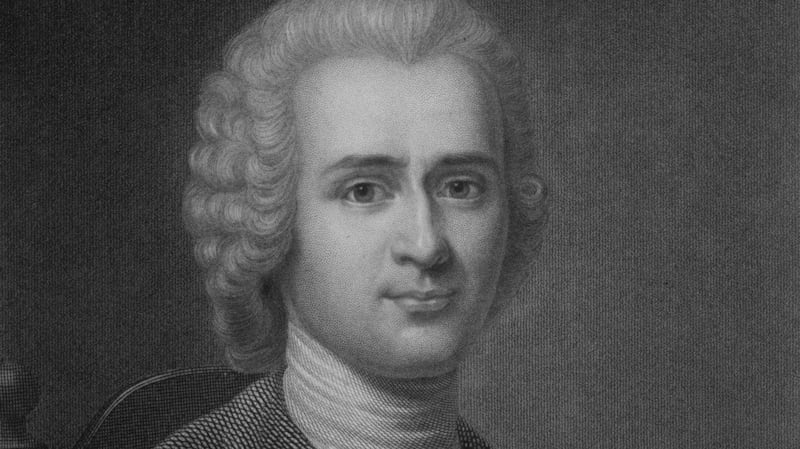
I remark that we often see men in literature requiring an external goal to spend time together platonically: a shared quest, a mystery to solve, an earl’s prize canary going missing if we’re in PG Wodehouse. McCrea’s depiction of deep male friendship as an end in itself reflects what he’s encountered in life. “I do have experience of relationships, of friendships with straight men … And they were always quite intense … And so I think this novel was an attempt to kind of explain that.”
McCrea allows that the seeming profundity of these connections might come more from psychological mystery than from substance. “If someone’s quiet and not saying anything or not communicating with you in a way that you understand, you begin to believe that actually there’s something deep there … There may be nothing.”
McCrea was not supposed to write this book. He had accepted a decent advance – “I wouldn’t say, globally speaking, an enormous advance, but certainly the biggest advance that I’ve ever earned” – to write an academic text on Rousseau. One day, after a year of research, he sat down at his desk and the unthinkable happened. “I wrote in the voice of Rousseau, that first letter … And I said, oh s**t, I’m writing a novel. Oh s**t, I’m writing an epistolary novel. And oh s**t, I’m breaking my contract.”
He worked on the novel for almost a year before showing it to his agent. “And [she] said, okay, well, you’re breaking your contract, which you already know, but this is good. So just keep going and we’ll see what we can do. So that was sort of miraculous of her to say that, because it could have gone another way.” The strictly nonfiction academic publisher wasn’t able to accept the novel, but the agent sold it quickly to John Murray.
Rousseau’s Lost Children is McCrea’s fourth book, succeeding two historical novels and a memoir. He sees this new novel – experimental, semi-historical, pseudo-autobiographical – as a natural progression in his writing practice. “If I hadn’t written those books before, there’s no way it could have come out in this way,” McCrea says.
“I wouldn’t have had the confidence to do it. I wouldn’t have had the need to experiment with form a little bit more. I wouldn’t have had the need to experiment with what historical fiction means … and I wouldn’t have had the confidence to play around with the self in the way that I do in this book if I hadn’t written a highly intimate memoir.”
The premise of the novel – two people living in different centuries go on walks together – is one the characters sportingly accept as possible, just as no one in Kafka’s Metamorphosis wonders how exactly a person wakes up an insect. “But I did want the question to be the extent to which Rousseau is a figment of Gavin’s imagination … To what extent is Gavin writing Rousseau? To what extent is Rousseau writing Gavin? All of that kind of stuff. I wanted to play around with that a little bit. And it was really fun.”
When you’re treated a certain way by a society … you become questioning very quickly, very early on. You don’t trust what people are saying on the surface
— Gavin McCrea
The choice to give Gavin the writer’s name raised the stakes of grappling with moral complexity; neither author nor reader is cushioned by comfortable distance from reality. “Gavin is a cruel person in the book, on occasion,” McCrea says. “He does bad things. He commits a crime, he manipulates to get what he wants, and so on. Let’s say he’s very, very flawed.”
The novel’s epistolary form playfully mirrors 21st-century communication, where mediation through text and image – as once happened through letters – makes us faster to judge online than we would be in person. “I wanted [Gavin] to be the one on the wrong side, let’s put it like that. I don’t necessarily want people to believe that I’m on the wrong side, but I want people to believe that I could be or could have been … I’m not here to justify anything or anyone.
“You know, if someone does something wrong, they’ve done something wrong. I’m not here to upend that or to say someone shouldn’t go to jail. What I merely am showing is that there’s a story behind every deed. Every dark deed. And there are consequences. You know, there are always consequences to such actions.”
McCrea’s suspicion of snap judgments and easy answers comes partly from his experience as a gay man. “When you’re treated a certain way by a society, and in a very generalised way, not just one person in your classroom … you become questioning very quickly, very early on. You don’t trust what people are saying on the surface. You’re delving in, you’re looking behind. What do these people really mean? How they’re behaving doesn’t make sense to me. How can I make sense of this?”
The character Gavin is perplexed by human irrationality, sometimes hilariously so; I laughed uncontrollably at his impatient assertion that “All Oedipus has to do is make two unbreakable rules for himself: never to kill an older man, and never to marry an older woman”. But McCrea himself tries to keep his fiction a space of curiosity, not sanctimony. “It’s such a precarious position to be the person pointing the finger … As soon as you point the finger, which I do on a daily basis regularly, I can see what shaky ground I’m on. And that’s really interesting to me. And I think that’s interesting to every fiction writer, frankly, to see how the ego judges … Because, you know, it can so easily all fall apart.”
When it does, we are not all so lucky as to have Rousseau guiding us. All the more reason to bathe in these letters and emerge understanding a bit more about human darkness.
Rousseau’s Lost Children is published by John Murray tomorrow


