

This year’s Moth Poetry Prize judge, Ishion Hutchinson, who is Professor in the Humanities at Cornell University in New York and a recipient of the National Book Critics Circle Award for Poetry, claims that you have to approach poetry “the same way Faulkner said you have to approach Joyce’s Ulysses, like the illiterate Baptist preacher approaches the Old Testament: with faith".
The prize is one of the most prestigious for unpublished poems, judged anonymously, and with a prize pot of €11,000. Hutchinson was tasked with choosing a shortlist of just four, and commending a further eight poems.
The four poems shortlisted are: After Athenry by Ronald Carson, The Fall, 1989 by Elena Croitoru-Reed, Delinquent by Juleus Ghunta and Shazaya by Adam Oliver.
“After Athenry is a wondrous excavation of ancestral ground,” says Hutchinson. “The music resounds beautifully with the burden of Seamus Heaney’s origin poem, Digging, only here the ambivalence of inheritance is more brutal, sad and graphic: ‘My grandfather’s name / is a black bead in the mouth of the guard’s whistle, / and I carry it the way a convict carries his iron tally.’
READ MORE


“It is a landscape of such pure nullity that even sparse moments of renewal and possibility ‒ ‘here the hunger grass still grows, / pale as the eyelid of a newborn’ and ‘the condemned man still singing’ ‒ are tinged with existential bleakness. Even so, After Athenry is far from a self-pitying exercise in guilt complex. Rather, it is an unsentimental praise poem, a dark song to a kind of ‘knuckle-bones’ tenacity in light of the harshness of both natural and human nature."

Ronald Carson was born in Belfast and left in the 1990s, when leaving, he says, still felt like a choice. He has spent the decades since in southern California, working in aerospace while writing poems. His work moves between the Troubles and the palm trees, between his grandfather’s name and his own sons’, between the permanent way and the famine road. He won the 2025 Francis Browne Poetry Competition and is developing several collections exploring exile, inheritance and the Irish diaspora. He is completing a masters in management at the University of Illinois College of Business. He does not find these things contradictory.
Elena Croiroru-Reed’s The Fall, 1989 is, says Hutchinson, “a claustrophobic evocation of what it would feel like to live in a servile, surveilled state in which “‘someone was always watching / the square from the colossal / honeycombs of tower blocks’. That kind of extreme political haunting is enacted in a prismatic series of disquieting imagery. The extensive use of slashes not only subtly augment the pervasive, fugue-like, eerie haunting of these images but also daringly unsettle the syntactic and textural harmony of the prose poem form.”

Croitoru-Reed is a British-Romanian writer with an masters in creative writing from the University of Cambridge. She won the Charles Causley Poetry Prize, the South Bank Poetry Prize and was commended in the National Poetry Competition. She also was a finalist for the Manchester Poetry Prize, the Bridport Prize and other awards. Her first poetry pamphlet won the Live Canon Pamphlet Prize. Her work is forthcoming or has appeared in POETRY, World Literature Today and The Poetry Society.
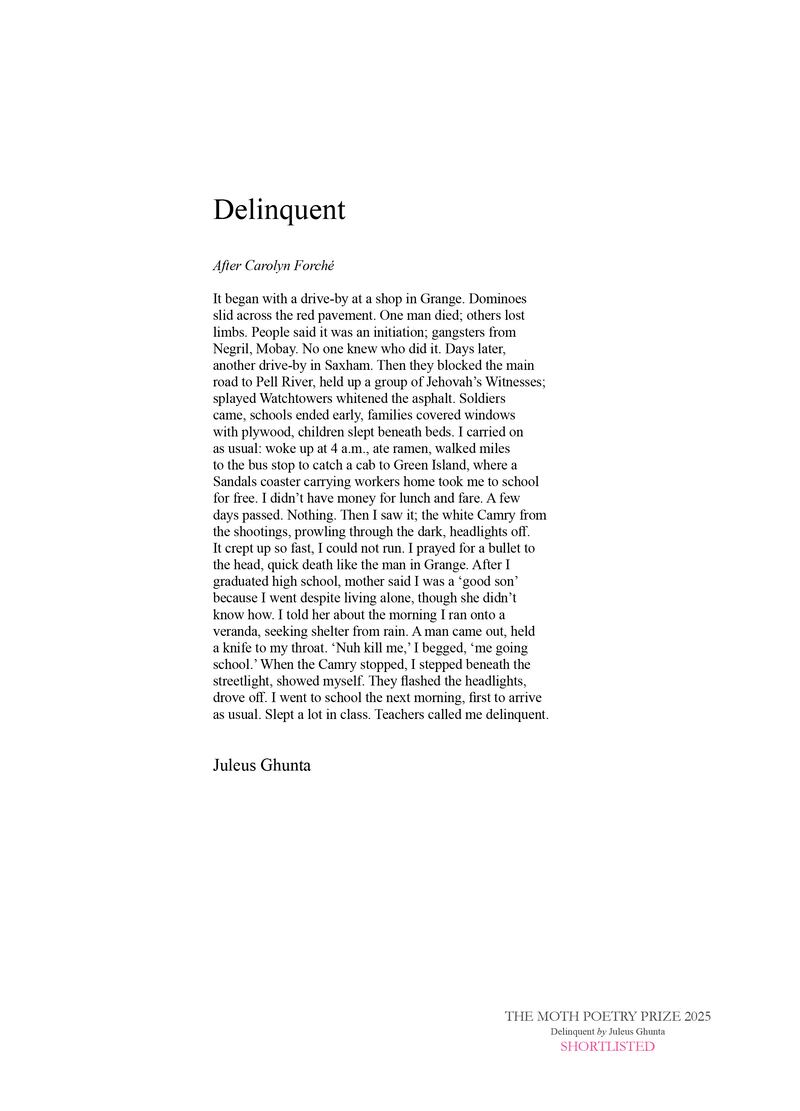
Delinquent by Juleus Ghunta is “a very fine composite of counterpointing narrative. Each observation and description strike with a lucid, impersonal force. The beauty of this force is how it moves the portrayal of the nightmare cycles of ‘inner-city’ violence with spectacular dramatic energy: ‘soldiers / came, schools ended early, shops closed at six, families / covered windows with plywood, children slept beneath / beds.’ Against this, heartbreakingly noir-like and diaristic, is the dispassionate autobiographical presence, who, to survive ‘carried on as usual’, without rancour but with an inexhaustible inner dignity forged out of the exhausting volatility of everyday circumstances.”
Ghunta grew up in Jamaica. As a 2017 Chevening Scholar, he earned an MA in Peace Studies from the University of Bradford, where he was awarded the Social Ambassador Prize for outstanding contribution to the Division of Peace Studies and International Development. His poems have appeared in The Caribbean Writer, sx salon, Wasafiri, Poetry Archive and Chiron Review, among other journals. In 2025, he was selected by the Writers’ Guild of Alberta as one of six Writers-in-Residence tasked with supporting emerging writers. He received the Catherine James Poetry Prize in 2017, won a Poetry Archive Wordview Prize in 2023, placed second in the 2024 Charles Causley Poetry Prize, and was honoured with the 2025 Buffys Literary Arts Award by Arts Council Wood Buffalo. His work was a finalist for the Small Axe Poetry Prize (2015, 2016), the Wasafiri New Writing Prize (2022, 2024), and the Alberta Magazine Awards Essay Prize (2025). He is the author and editor of several children’s books, including You Never Know What You’re Going to Get: An Anthology of Short Stories (Chalkboard, 2025).
Adam Oliver’s Shazaya, which is “delineated in couplets that have a clipped, cinematic tension, is about the harrowing moment and aftermath of a car bombing in Beirut. The spare, impressionistic language heightens without poetising the vivid, tragic reality of such state violence. Its unflinching, clear-eyed depiction of the irreparable severity of that violence on a single human ‒ ‘stitching / him forever to that blast’ ‒ cuts deep into those who can’t even articulate less imagine such violence, commonplace as it has become in our world. This stark intimate scope is one of the splendid achievements of Shazaya, how its caring, careful documentary accuracy underscores and voices the unbearable final elusiveness and bewilderment central not just to strong art but also to the act of witnessing."

Oliver is from west London. He is a graduate of Cambridge University’s masters programme in creative writing. He taught English for more years than he cares to remember in England and Italy, and most recently was the headteacher of Robert College, Turkey’s leading school. He is currently caring for his mother and writing all the poetry he can, including completing a collection about her loss to Alzheimer’s disease, entitled Disappearing Act. Alongside poetry, he is working on a nonfiction book about how to bring meaningful environmental sustainability into schools, and a graphic novel.
Hutchinson also commended poems by Anya Kirshbaum (USA), Hannah Perrin King (USA), Alvy Carragher (Ireland), Anthony Lawrence (Australia), Mark Tredinnick (Australia), Michael Prior (US), Genevieve N. Williams (US) and Kwasi Owusu Gyeabour (Switzerland), all of whom will receive prizes of €250.The overall winner, who will receive €6,000, will be announced at a live event on The Moth’s Instagram page at 6pm on April 15th. The remaining three shortlisted poets will each receive €1,000.
Meanwhile, The Caterpillar Poetry Prize, run by The Moth and judged by Robert Schechter, closes on March 31st, and The Moth Short Story Prize 2026, judged by Wendy Erskine, will open in early April. The winners of each of the four annual Moth Prizes are published in The Irish Times online, while the first prize-winner of The Moth Short Story Prize is printed in the newspaper’s summer fiction series.
For more details see themothmagazine.com


