

Bad words can get in the way of good art. It’s not cursing and swearing but “artspeak” that is to blame: the problematised juxtapositions that some believe will add gravitas tend to kill the joy.
It is definitely a risk to use jargon in the name of your show – even if it does come from a different field. Key Learnings from Cross-Market Synergetic Alignment is the mouthful of a title for the Royal Hibernian Academy’s current take on commodity culture. Give them the benefit of the doubt and let’s assume it’s humorous.
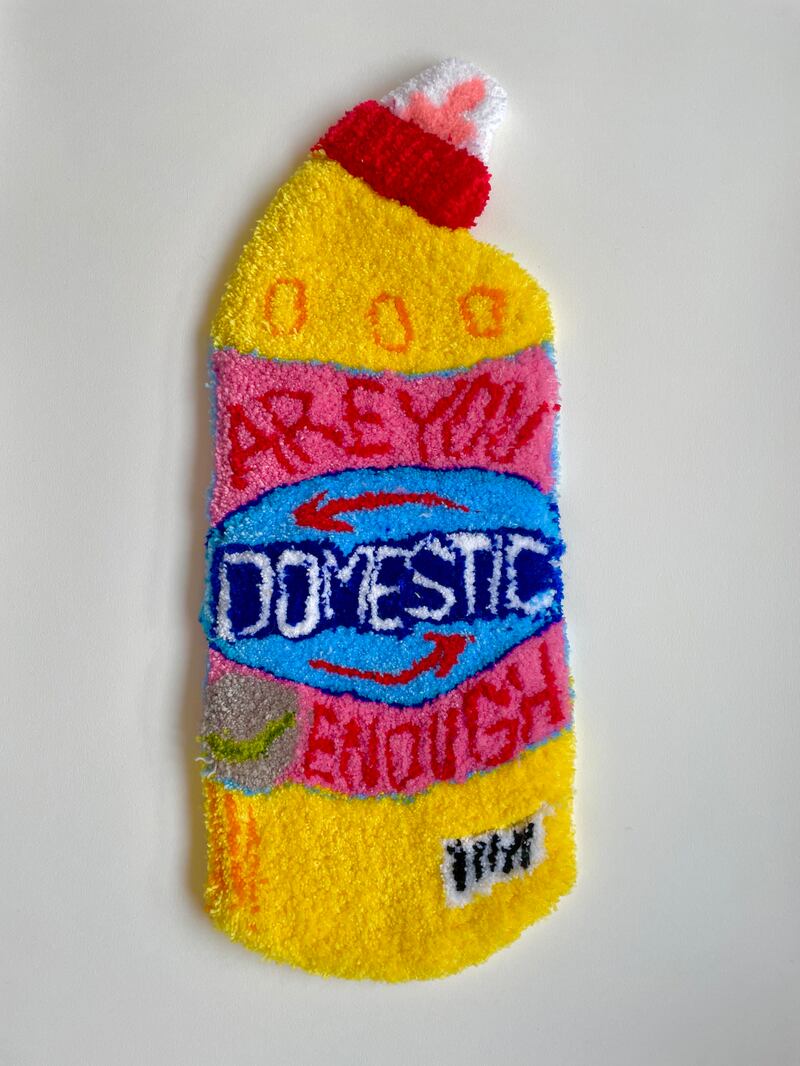
The artists involved are definitely excellent. Between them, Noel Hensey, Caroline McCarthy, Emily McGardle, Aideen Barry, Asha Murray, Liliane Puthod, Amy McNamara, David Timmons and Richard Collier approach the relentless promotion of things to buy via a range of media, from film to plastic and from painting to hand-tufted rugs.
It is a giddy ride. Can happiness be found in a clean house? Asha Murray’s neon-bright installation is there to persuade you. Could a new face cream be the answer to that missing piece of your soul? Amy McNamara’s Restless Retail offers products such as Maybe Not Moisturiser, with the tagline “See no difference in only nine weeks”.
READ MORE


There is plenty to think about within Key Learnings, but there is strangely little to help with the actual learning. Maybe it’s because we realise that the exercise in awareness-raising is ultimately futile. Despite knowing how much overconsumption is damaging to both the environment and our inner peace, we continue to fall for marketing’s cynical seductions. You can’t sell to people who are content, so advertising is designed to create a feeling of lack while simultaneously suggesting its promise of fulfilment, endlessly.

Vance Packard wrote about all this in his book Hidden Persuaders, originally published in 1957 and still worth reading today. And it was a decade ago this year that Steve Howard, Ikea’s head of sustainability, announced that we had “probably hit peak stuff”.
Back in 2016 he was suggesting that the furniture behemoth would “be increasingly building a circular Ikea where you can repair and recycle products”. A recent trip to the company’s Ballymun emporium shows that the area dedicated to these endeavours is still very small.
In this context Caroline McCarthy’s Useless (Original), from 2015, delivers rewarding layers of meaning. A long table is covered with bent screwdrivers. These are useless indeed, except for the fact that by being in a gallery, and in our commodity culture, its value is not so much amplified as transubstantiated by its presentation as art. This in turn gives rise to ideas of how much the market distorts our relationship to, and understanding of, art.
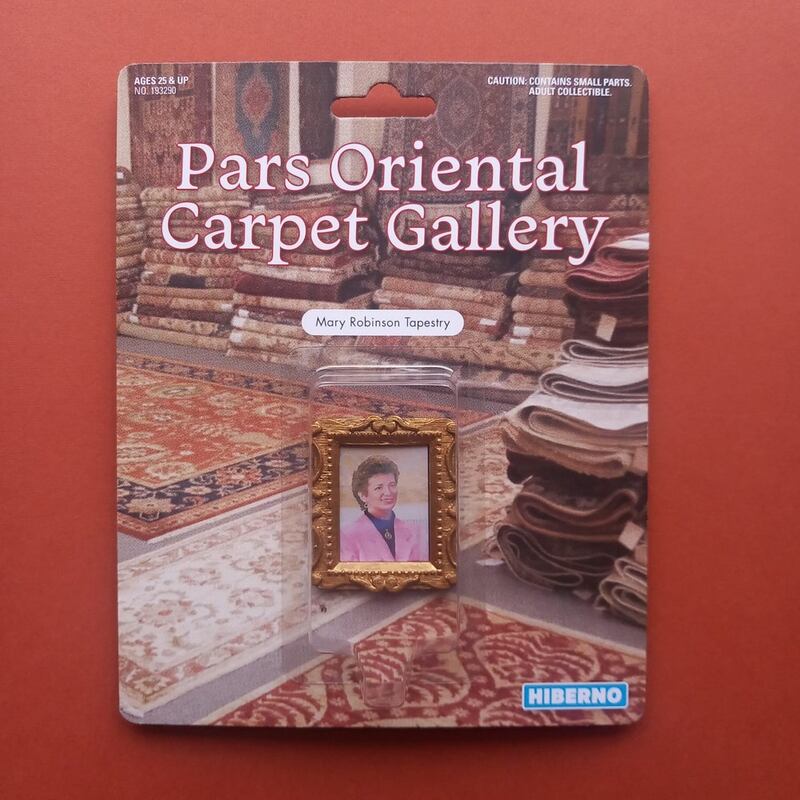
Richard Collier’s Hiberno Toys series (2023-26) does something similar, but in a different direction. By taking people and moments from recent Irish history, Collier creates action figures and play sets. They include Local Man, Father Ted, Anna Livia and the John Delorean FBI Sting Action Playset. In the process Collier underlines how people and things pass from the individual and particular to the more or less mythic. Identity is lost as people and events become common and commodified property.
Elsewhere, Aideen Barry brings us on a typically surreal, characteristically brilliant journey into the relentless cycle of domesticity, which can eat away at body, mind and spirit, with her 2015 film, Not to Be Known. This is accompanied by a suite of Barry’s more recent Monachopsis prints (all 2020), in which hearts scream, eyeballs peer out of extraordinary places and a series of imaginative tortures and violent ends are visited on smartphones.
Monachopsis is defined in John Koenig’s Dictionary of Obscure Sorrows as “the subtle but persistent feeling of being out of place, as maladapted to your surroundings as a seal on a beach”. Koenig goes on to describe the sensation of being “lumbering and clumsy, huddled in the company of other misfits, dreaming of life in your natural habitat, a place where you’d be fluidly, brilliantly, effortlessly at home”.
His dictionary, which is available online as well as, since 2021, in book form, nicely captures our contemporary obsession with miniature discontents that never actually get assuaged, no matter how much self-help we consume or stuff we buy.
Still suffering? Emily McGardle may have the answer with her series of products and services, including a Conversation Buddy for those who can’t tolerate small talk, sachets of Powdered Enthusiasm and bitter sweets to suck “while you wallow in self-pity”. Presented as “medicinal treats” on supermarket shelves, her bright and eye-catching boxes raise a smile, although a little goes a long way.


Humour is a tricky thing; art likewise tends to work best when its subtleties are made available for discovery rather than being explained. That said, a little help is useful from time to time. Here, the exhibition’s curator seems to have decided to lighten things up, and the usual gallery information panels have been reimagined. The artists’ names are splashed on yellow and red stars, and the more typical lines of text telling you something about the artists and their backgrounds have been replaced with a couple of short lines on the work.
The trouble is that they seem to be designed to tell you how to feel rather than giving you ways into the work.
Do you need a text to tell you that McGardle “uses deadpan humour”, or is the humour of it something you can judge for yourself? And does Liliane Puthod use “cliche to great effect”? Surely the level of the effect is up to you to judge. Do David Timmons’s prints “intrigue the senses”? It begins to come across as accidentally patronising, which is a shame, as the ideas raised in the work are rich and timely.
Gallery texts require a fine balance to get right. You want not to explain the work but to provide enough context for visitors to come to ideas, and that is lacking here. It would be useful to learn, for example, that Murray’s installation includes shopping lists and notes that the artist began collecting while out walking in her local area during the pandemic.
These fragments of unknowable other lives are collaged and framed, as well as tufted into wall pieces, striking a beautiful balance between loneliness and intimacy, and creating space for stories to evolve in the mind.
Then there is McCarthy, who has been exploring consumer culture throughout her career, often blending imagery from art history with more mundane materials, such as her brilliant The Luncheon (in the Irish Museum of Modern Art’s collection, and not on show here), which is a large-scale photograph of a fruit-filled still life, itself made entirely of toilet paper.
In a clever piece of programming, the exhibition has shared the building with Fiona McDonald’s Inhale Exhale (which runs until Wednesday, March 25th) and John O’Reilly’s Walkways of the M50 (which ended on March 15th).
McDonald’s work tracks carbon dioxide in rewetted bog lands, giving us a chance to get intimate with the slow rhythms of a recovering environment; O’Reilly paints the quiet and forgotten edge spaces of Dublin’s traffic-clogged ring road. Both exhibitions are subtle explorations of the fallout from overconsumption, and its antidotes.
Despite the colour and energy of Key Learnings, and the thought-provoking nature of the parallel exhibitions, there is an air of semi-neglect hanging over the RHA in recent months.
On my recent visit some of the lights in the gallery showing Sasha Sykes’ Filial Love (which ends on Sunday, March 29th) weren’t working, and the video wasn’t screening properly. Likewise, the sound for McNamara’s Restless Retail wasn’t properly synched (and not just in the part that is meant to be that way). In Key Learnings, Noel Hensey’s references are described as “rye” on the wall panels, which I assume should be “wry”.
These are all unfortunate glitches.
The RHA’s previous director, Patrick Murphy, departed in December, having announced his retirement in May of 2025. A replacement has yet, at time of writing, to be appointed. Nathalie Weadick, the former director of the Irish Architecture Foundation, stepped in on an interim basis in February.
The recruitment of a new full-time incumbent has dragged on. The first-choice candidate reportedly turned the role down, and there has been disagreement about next steps.
During Murphy’s three-decade tenure, the RHA had built up a significant international reputation, and platformed the work of at least two generations of Irish artists to audiences in Ireland and to the wider world. It would be a shame to squander that legacy now.
Key Learnings from Cross-Market Synergetic Alignment is at the Royal Hibernian Academy, Dublin until April 19th


