

How casually the Kinahan organised crime cartel talked about taking lives – and how hard they worked at it – was revealed in dramatic fashion in a Dublin court last week.
The content of secret messaging chats was set out for the first time at the Special Criminal Court during the sentencing hearing of Sean McGovern, a senior lieutenant in the Kinahan gang.
The messages were sent on a supposedly secure private network system known as “secretblackmars” used by a cartel leadership “cell”.
The network was far from secure. Gardaí gained access to many of the messages via modified Blackberry handsets they seized from cartel members almost a decade ago.
READ MORE


In messages dating back to 2016, the gang members discussed bringing in an Irish hitman – referred to in the texts only as “Teeth” – to shoot dead Noel Kirwan (62), whose friends called him “Duck Egg”. Teeth was chosen as the hitman.
McGovern, a father of two, said on the chat to an associate: “Reckon putting the Teeth on the Duck, get his confidence back.”
The associate replied: “I’m sure Teeth be working very soon mate. But I be saying only a defo set up, or someone sitting on their own. So no running into crowds or up hills.”
McGovern replied: “Give him the Duck, give him the Duck for confidence.”
It did not matter that Kirwan had no involvement in crime and had nothing to do with the Kinahan-Hutch feud that would result in the murders of 18 people between 2015 and 2018.
The ease with which Kirwan,a grandfather, could be killed, and the fact he was a friend of the Hutch family, made him a legitimate target in the eyes of the Kinahan gang.
Dubliner McGovern (40) last month pleaded guilty to two charges of directing an organised crime gang as part of the Kinahan-Hutch feud. He directed cartel plans between October and December 2016 for the murder of Kirwan on December 22nd, 2016. He also directed the cartel’s failed efforts to shoot dead James “Mago” Gately between October 2015 and April 2017.
Gately was a close associate of the Hutch gang and a former Kinahan cartel member. He carried the coffin of Gary Hutch at his funeral after he was shot dead in Spain in September 2015 by the Kinahan cartel – the first murder of the feud. Hutch was also once a member of the Kinahan cartel with his friend Gately.
Divisions had first emerged in August 2014 when Hutch tried to have cartel leader Daniel Kinahan murdered. The Hutch faction split from the Kinahan cartel, resulting in the feud.
McGovern was wounded when the Hutch gang attacked the Kinahan cartel at the Regency Hotel in Dublin on February 5th, 2016. Kinahan cartel member David Byrne was shot dead in the attack, sending the feud into overdrive.
Two days after the Regency attack, messages posted in the Kinahan leadership’s chats – disclosed in court this week – showed them discussing the targets they could shoot in revenge.
One senior cartel figure or figures, not named in court, sent messages under the usernames “Cap”, “Bon” and “Bon Neww”. McGovern used the handle “Knife”. Another cartel member, Peadar Keating, used the name “Leg”.
“They’re desperate. That was their big stand, they wanted to do us all,” Cap told McGovern of the Hutch gang’s Regency attack.
McGovern replied, telling Cap: “They targeted us all. They wanted you and the rest of us was a bonus. This is personal. On my baby’s life I’m not stopping.”
Cap replied: “Mate, nobody is stopping until they’re all dead.”
McGovern said: “I’m sick over David [Byrne]. It could have been the six of us and they could have wiped out the whole bloodline.”
He continued: “Mate I’m fuming I swear to God what about doing Mink’s daughter or will that bring too much heat?” That is thought to be a reference to veteran criminal Gerry “The Monk” Hutch, uncle to Gary Hutch.
Cap replied: “Yes, but maybe only Neddy.”
The next day, February 8th, 2016, Eddie Hutch, who was sometimes called Neddy, was shot dead outside his Dublin north inner city home. He was Gerry Hutch’s brother.
“Duck Egg” Kirwan was photographed by the media at the funeral of Eddie Hutch. He would be murdered in the feud 10 months later.
Just over two weeks after Eddie Hutch’s murder, McGovern, who was still recovering from being shot himself, messaged Cap, pushing for further bloodshed. He suggested that if they spread false claims, they could draw the Provisional IRA on their Hutch gang rivals.
“Sooner the better we drop one of these mate, I feel a bit of luck,” he said. “Think these Provos will do him if we put it out there that the Provos backing drug users.”
The cartel’s secret messaging and McGovern’s arrest
McGovern was the first member of the Kinahan cartel’s Dubai-based group to be arrested in the Middle Eastern city, in October 2024. He was also the first to be extradited to Ireland, in May 2025, and the first to go be brought to justice in an Irish court.
His conviction comes after a decade-long investigation by the Garda’s Drugs and Organised Crime Bureau (DOCB).
The case hinged on the series of secret messages gang members sent to each other between 2015 and 2017.
The messages were sent via modified Blackberry devices with PGP (pretty good privacy) encryption software – the go-to set-up for organised criminals at the time. The Blackberry devices could be remotely wiped in the event they were seized by the Garda or other police forces.
Some of the devices were seized by the Garda from McGovern and Estonian hitman Imre Arakas, who was working for the cartel in Dublin, following their arrests in 2017.
The wiped messages could not be accessed at that time, but advances in technology since then allowed investigators to retrieve them.
When Arakas was flown into Dublin by the cartel on April 3rd, 2017, it was for the purposes of murdering Gately.
Gardaí had intelligence he was arriving. They followed him around the city the day he landed in Dublin and he was arrested in the early hours of the following morning.
Arakas, a former wrestler and one-time Estonian separatist who spent time in Russian prisons, was articulate and matter of fact on his Blackberry chats to the user named Bon Neww.
In messages forwarded by Bon Neww to McGovern, Arakas said: “It seems possible to take him down when he comes out of the car then on the way to the front door. The problem is there is nowhere to hide.
“A silencer would be good and it would be very good if the ‘dog’ [the code word he used for gun] is accurate. It could be just one shot to the head from distance. It’s possible I will see what I can do. Best regards.”
Bon Neww replied: “We have a tracker on his car. We track him live. So when he is headed back to apartment, 10 mins away get in position.”
Bon Neww told McGovern: “Ha ha ha ... if we get Mago [Gately] this week we all be laughing.”
When these messages were presented in court this week during evidence given by Det Supt Dave Gallagher and Det Sgt Donal Daly, McGovern sat in the dock and looked disinterested but also appeared nervous and under pressure.
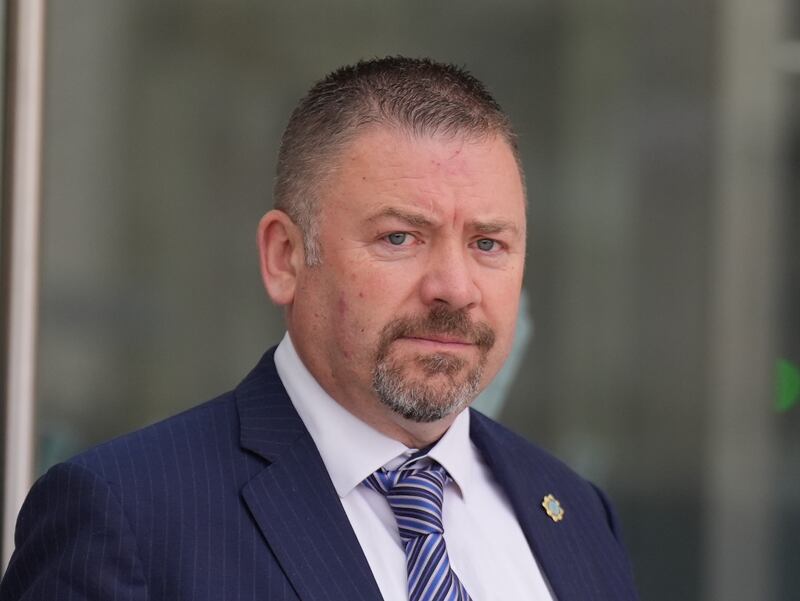
Dressed in navy trousers and a zip-up top, he used a pencil to tinker with Sudoku puzzle books.
McGovern looked older, thinner and greyer than in the photos taken of him by tabloid photographers a decade ago.
Panic in Kinahan leadership cell
When hitman Arakas was arrested so soon after arriving in Ireland – and a tracker the cartel had placed on Gately’s vehicle was seized on the same day – panic set in on the Blackberry chats.
They wondered how Arakas had been arrested so quickly.
McGovern was concerned there was a “rat” in their own organisation. They seemed astonished Irish news outlets knew who Arakas was, with reports even referring to his nickname “The Butcher”, almost immediately.
“Don’t need to see [news]papers to know it’s one of our own. 100 per cent all going to jail. Stitch up mates,” McGovern texted.
Gang member Keating replies: “Me and you ain’t any rats we are the ones up to our bollox in it.”
McGovern responded: “How the f**k are they charging him [Arakas] with murder? Time to get the f**k out of here before we are all in cuffs.”
Bon Neww replied: “Ireland make up new laws every day.”
“Yes, it’s a joke to be honest,” wrote McGovern.
Bon Neww replied: “We have to change tactics, mate. Have a new plan don’t worry, but I need to get out of there for a bit. We’ll have Mago in two to four weeks.”
McGovern said: “Best news of the year that will be, once everyone is safe”.
Bon Neww replied: “Hate the horrible rat bag. Get Mago.”
McGovern said: “Weasels get caught out in the end.”
Who wrote the murder messages?
The men using the Blackberries always used monikers or “handles”. However, McGovern’s and Arakas’s Blackberries were seized from them, linking them to those devices.
Garda investigations over years also yielded a web of supporting evidence: from seized mobile phones to seized car trackers to a satnav to CCTV footage. There was evidence gathered by Garda surveillance and material found during searches by gardaí.
The trail of the cartel suspects’ movements and activities tallied so often, and so completely, with the messages on the Blackberries that there is no doubt they are the authors.
McGovern, the crime director
In the period covered by the charges against McGovern relating to his directing of organised crime – October 2015 to April 2017 – the Dublin criminal was not at the apex of the global Kinahan cartel. He had not yet relocated to Dubai, where the leadership was then based.
He was not as insulated from the risk of being caught as the leadership based in Spain and Dubai was at the time.
He was watched by gardaí and recorded on cameras and he left a trail of data in his wake.
The evidence built a circumstantial case so strong McGovern opted not to fight the charges.
The Garda surveillance was extensive. Two days in late March 2017 in particular show the extent of that surveillance.
On the first day, McGovern went to Dublin Airport’s car park to collect a van to travel to Belfast. He was suspected to be preparing for a murder attempt on Gately, who had been hiding out from the Kinahan cartel at addresses in Newry and Belfast around that time.
McGovern was recorded, with Keating, at Dublin Airport by its blanket CCTV system, while his messages on the chats confirmed he was collecting a vehicle at the airport.
McGovern was captured on his own CCTV system leaving his home in Crumlin, south Dublin by bicycle. He was caught on CCTV at the airport picking up the van, wearing the same leisure clothes. He then drove to Belfast in the van to check the College Court apartments where Gately was living, recorded by the CCTV system at the block.
But before he arrived in Belfast, McGovern stopped at motor appliance retailer Halfords in Dundalk to buy a satnav for the van. CCTV from the shop was later retrieved by gardaí, showing the purchase of the satnav, from which data was also later accessed by gardaí.
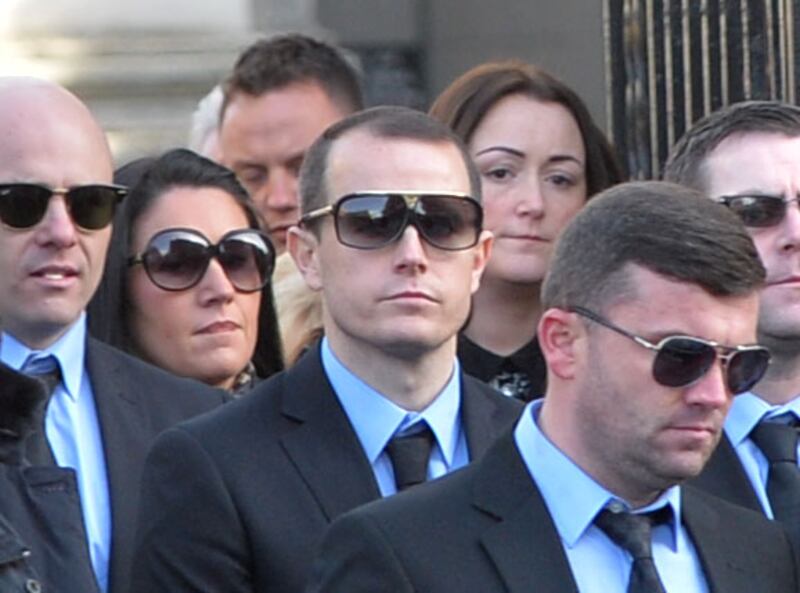
A Garda tip-off meant surveillance officers were able to watch McGovern arriving at the airport, paying for parking and leaving.
His own home CCTV system captured him arriving back at his house. He then posted a message on the Blackberry chat, announcing he had just arrived home from his trip to Belfast.
On March 30th, McGovern was in Belfast again at the Gately apartment block, with Keating and cartel member Douglas Glynn.
Their activities, including the fitting of a tracker on Gately’s car, were recorded by McGovern’s new satnav and also on the CCTV system in the apartment block.
McGovern had a key role in controlling a series of trackers that were manufactured in France and bought by the cartel from a “spy shop” in Leeds, England.
These were attached to vehicles owned by the cartel’s targets and some of their relatives in a bid to identify where and when they could be attacked.
At one point, McGovern brought a tracker to his house to charge it. The device emitted a signal while at the property. In January 2017, McGovern also used his personal phone to call a number linked to one tracking device.
He then sent a message with the codes of five trackers to Keating, saying: “Just in case I lose them.” Keating’s phone, which contained the message, was later seized.
McGovern also used a “cartel safe house” – an apartment in the South Beacon Quarter in south Dublin – which was identified and searched by gardai on January 31st, 2017.
His DNA was found on a laptop used to access the trackers’ live data and control panel. His finger prints were found on a power cable and a tracker instruction manual hidden at the apartment.
Analysis of the laptop revealed it had been used at least 1,387 times to access the trackers.
December 22nd, 2016 - the day of Kirwan’s murder
A seized disposable “burner” phone, which gardaí proved McGovern had operated, was used only for the murder of Kirwan.
Another phone, linked to the man who pulled the trigger, was active from December 12th to 22nd, the day of the killing. The only phone number that it called was the phone number McGovern used exclusively for the murder.
McGovern contacted a man in the Leeds spy shop in the minutes before the Kirwan murder. That short call was made as the victim was leaving a restaurant, commencing his drive towards his home and his death.
After the call to the spy shop employee, McGovern changed the settings on the tracker attached to Kirwan’s car, so it would signal its location every 30 seconds rather than every four hours, the power-saving setting to which it had been set previously.
This change provided the best live tracking data possible, ensuring a pinpoint ambush of Kirwan when he pulled into his driveway.
McGovern was also found to have called the shooter and his accomplice in the minutes before the murder as they were already circling close to Kirwan’s home in their van.
Contacts included a call at 5.01pm, six minutes before Kirwan arrived home.
“Within seconds of parking, at least seven shots were fired hitting Noel Kirwan,” Det Sgt Donal Daly told the Special Criminal Court in his evidence.
Cell-site data generated by the calls McGovern made to the killer placed the two-man murder team close to the murder scene.
The calls from McGovern’s phone were traced to the vicinity of his home on Kildare Road in Crumlin.
He was tracking the victim and the directing the killers, up to the moment of the murder, all from his own home, with the data retrieved and collected by gardaí in the following years proving it.
McGovern was arrested in April 2017. A Blackberry device and phones were seized from him, though the evidence set out in court this week was not available to the Garda at that time.
He was released without charge and soon fled to Dubai, joining the Kinahan cartel’s leaders in the United Arab Emirates, but leaving behind a trove of incriminating evidence.
McGovern will learn his fate soon; the Special Criminal Court will sentence him on June 8th.


