
The jury in the inquest into the death of George Nkencho returned a narrative verdict on Friday in which they made a number of recommendations for procedures during the deployment of armed gardaí.
Among them, the jury recommended that armed engagement around occupied dwellings should be avoided where possible, that there should be more and easier access to non-lethal equipment and that additional training should be provided to help members of the force identify and deal with people suffering from mental illness.
It also said body camera equipment used by the Garda’s Armed Support Unit (ASU) should be turned on at an earlier stage of their call out response.
Mr Nkencho, who was 27, died on December 30th, 2020, after being shot multiple times by members of the ASU in the driveway of his family home in Manorfields Drive, Clonee.
READ MORE


Reacting to the verdict outside the court on Friday, Mr Nkencho’s brother Emmanuel, flanked by family members, said the weeks over which the inquest ran have been difficult for the family.
“We’ve had to relive the trauma of the events that occurred on the 30th of December 2020. So today now represents some form of closure for my family,” he said.
“At the end of the day, my brother shouldn’t have died, but we’re grateful to the coroner and the jury and for everyone who has supported us. It’s a debt we’ll never be able to repay.
“We hope that this inquest leads to meaningful change and for this to never happen to another family again.”
Mr Nkencho, who was 27, died on December 30th, 2020, after being shot multiple times by members of the ASU in the driveway of his family home in Manorfields Drive, Clonee.
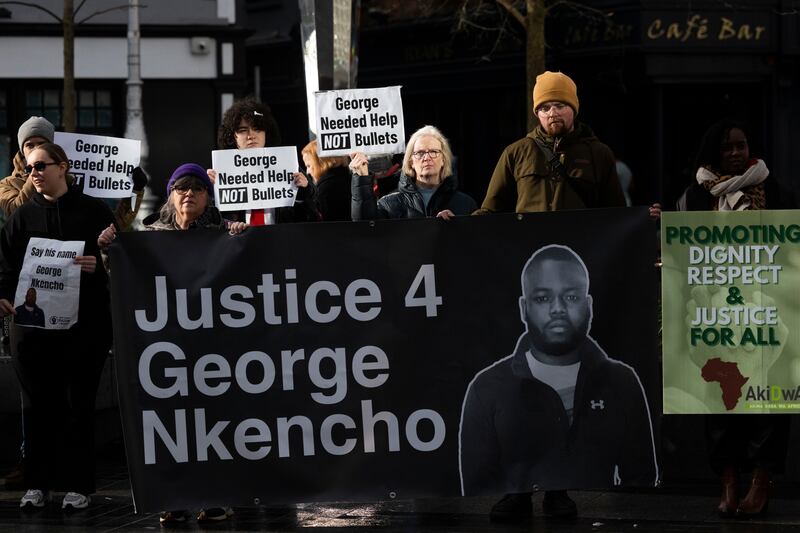
The jury found the shooting of Mr Nkencho followed an incident at a local convenience store in which Mr Nkencho punched a staff member in an apparently unprovoked attack, brandished a knife and then, as he walked towards his home, failed to comply with repeated requests from unarmed gardaí to discard the knife.
The jury noted members of his family sought to inform the armed ASU members at the family home that George was their brother and that he had mental health issues.
In the verdict, the jury noted Mr Nkencho did not comply with the ASU members’ requests to drop the knife, resisted attempts to disarm him and lunged several times at gardaí with the knife.
Having been tasered a number of times, Mr Nkencho was shot six times before being taken to James Connolly Memorial where efforts to save him failed and he was pronounced dead.
A postmortem found that the bullets that struck Mr Nkencho passed through his body in several different directions causing damage to his heart, lungs, liver and spleen, the jury noted. This seemed consistent with a “moving body and dynamic situation”, the members found.
On Friday morning, the jury was told by Dr Myra Cullinane, who oversaw the inquest, that only two options open to them. These were a verdict of death by misadventure or a narrative verdict.

She said the narrative verdict could include observations or recommendations but it was not open to the jury to apportion blame for the death or to exonerate anyone.
Earlier, Dr Cullinane heard an application in the absence of the jury from Eanna Mulloy SC, for the family, asking for the jury to be allowed to consider a verdict of unlawful killing. The application was refused, however.
Charging the jury, Dr Cullinane said the verdict of unlawful killing was not open for consideration. She said the Director of Public Prosecutions had concluded there should be no criminal prosecution in the case and the inquest heard no evidence that had not been considered by the director.


