You only have to look at the photographs of the younger Charles Windsor, rose-cheeked and gauche as he sits beside Richard Nixon in the Oval Office, or the still-startling image of the late Diana, princess of Wales, dancing with Danny Zuko himself in the Reagan White House of the mid-1980s to realise for just how long the British monarch has been out there representing the firm on the world stage.
On Tuesday, British King Charles III stood before a joint meeting of Congress to give what was billed as the most consequential speech since he assumed the throne. It took place against a background of US president Donald Trump’s hectoring and second-hand insults of Britain’s prime minister, Keir Starmer, and during an era when Britain is struggling to adapt to a diminishing role and voice in world affairs.
The event was overshadowed by the leaked, recorded remarks of Britain’s ambassador to the US, Christian Turner, who, commenting on the “special relationship” conceit framed by Winston Churchill, pointed out that “it’s quite nostalgic, it’s quite backwards-looking, and it has a lot of sort of baggage about it.” He then added the headline-grabbing afterthought: “I think there is probably one country that has a special relationship with the United States – and that is probably Israel.”
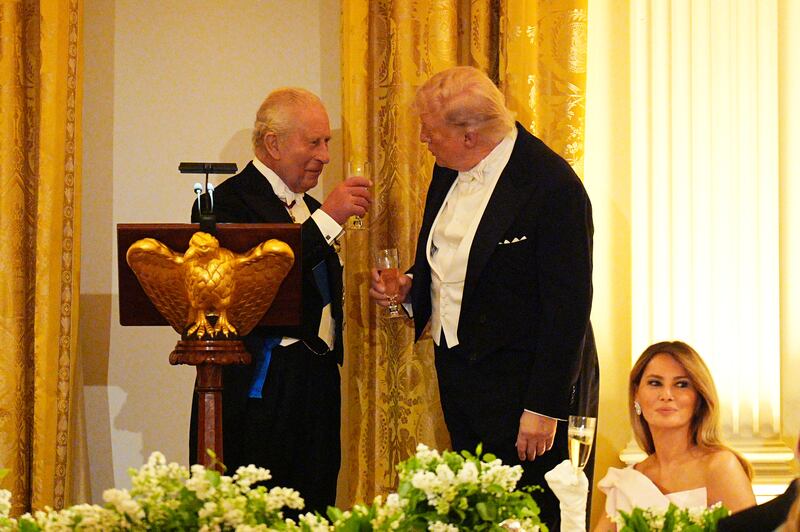
Around the Capitol on Tuesday, many would have agreed. Charles’s address was hailed as an immediate triumph even as the king and queen Camilla made their way back to prepare for a white-tie-and-tails gala dinner at the White House.
READ MORE


But in keeping with the theme of this administration, it was a day haunted by the recollections and voices of the women trafficked by Jeffrey Epstein, the dead sex-offender and billionaire financier who once counted both Trump and Charles’s disgraced brother Andrew as among his friends. The survivors of Epstein’s abuses gathered elsewhere in the Capitol to speak about that connection.
“You would expect this to be a moment for the king to give a message to the world that he stands with survivors,” said Sky Roberts, the younger brother of the late Virginia Giuffre who took her own life a year ago. Giuffre’s accusations of being trafficked by Epstein and sexually abused by Andrew as a minor led to a $23 million settlement paid by the former prince - who denied the allegations - and provoked a true existential crisis for the British monarchy. “We still can’t get that [message] from our own president of the United States,” Roberts added.
Although ambassador Turner had hinted that Charles might address the Epstein survivors in his speech, the king’s acknowledgment of “victims of the some of the ills that so tragically exist in both of our societies today” was carefully opaque.
But his remarks on the abiding links between Britain and the United States were pointed as he engaged in a brief history lesson, telling the gathered American senators and representatives that the Declaration of Rights of 1689 provided the “source of many so many of the principles reiterated often verbatim in the American Bill of Rights of 1791”.
“And those roots go even further back in our history: the US Supreme Court Historical Society has calculated that Magna Carta is cited in at least 160 Supreme Court cases since 1789, not least as the foundation of the principle that executive power is subject to checks and balances.”
It was the line that resonated most strongly, with whoops of approval from the Democratic side of the aisle. The Republicans did stand although Howard Lutnick, the commerce secretary, laughed as though the king had delivered a Jimmy Tarbuck gag.

“This is the reason why there stands a stone, by the River Thames at Runnymede, where Magna Carta was signed in the year 1215,” Charles pressed on.
Judging by the murmurs and nods of approval there was clearly something irresistible about all of this to American ears – Runnymede and ye olde days. Even as Congress grapples with an administration which has vowed protectionism while embarking on imperial adventurism, the king’s slyly provocative speech reminded everyone that the United States remains a shockingly young country.
And at 77, Charles has acquired a kind of general affection that comes with having endured and speaks with an easy humour he lacked as a younger performer. He clearly enjoyed the warmth and frequent standing ovations here. And he succeeded in conjuring up what has, for the past decade, been a seldom heard sound: bipartisan applause – and laughter.
He gave a nod to Oscar Wilde as he set the mood by quoting the Irish writer’s observation that “we have everything in common with America nowadays, except, of course, language!”
Not everyone in the room appeared to get the joke. But it contained a truth in that both countries are engaged with internal debates and anxieties about their role on the international stage. It was bold of Charles to specifically quote Starmer’s own words of last month, when the under-fire prime minister, refusing to bow to Trump’s demands to join in the war with Iran, described the bond between the countries as “an indispensable partnership”.
“We must not disregard everything that has sustained us for the last 80 years. Instead, we must build on it.”
He reminded the chamber, too, that Nato had invoked Article 5 for the first time after 9/11 and drew a thunderous ovation from the Democratic side of the room when he called for the same “unyielding resolve” in defence of Ukraine.
And there was a powerful, understated rebuke in the halls of a Capitol where words fly hot and accusatory, in his closing passage, when he addressed speaker Mike Johnson and vice-president JD Vance, both of whom sat behind him on the dais, saying “America’s words carry weight and meaning, as they have since the Independence.”
Those words were of course primarily aimed at the occupant of the Oval Office. Who knew if Trump was tuning in?
So it was a success for Charles after a few months during which the royal family looked shattered in the wake of the arrest and descent into disgrace of Andrew. There were some notable absentees from the occasion, including New York congresswoman Alexandria Ocasio-Cortez and her colleague from California, Ro Khanna, who organised the hearing of Epstein victims.
“I thought the king owed that to the survivors given his brother’s serious allegations of abuse,” Khanna said.
Elsewhere, Trump’s department of justice launched its latest set of charges against James Comey, the FBI director from his first term, while there were renewed calls from within the administration, led by first lady Melania Trump, for the television comedy host Jimmy Kimmel to be fired from the role following a Saturday night sketch that the administration described as “deranged”.
The pace of political life in the United States moves with feverish pace in this, its 250th year. Even the king must have wondered how long his words will be remembered, or how deeply felt.
The White House released a photo of Trump and Charles standing together with the caption: Two Kings. The joking, and trolling, goes on. And as they stood in tails to pose for ceremonial photographs before the state dinner, where there would be more speeches and historical references, Trump pointed at his guest and jauntily told the cameras: “He made a great speech. I was very jealous.”