

I was traversing Scotland from southwest-to-northeast in dwindling daylight, determined to reach Aberdeen before it got too dark.
As I emerged from the Trossachs I pointed the car in the direction of Dunblane, a town forever associated with unspeakable tragedy. From there I could link up with the A9 artery and then floor it towards Dundee.
Before I reached Dunblane, however, I had to deal with the full effects of one too many daytime coffees. I was anxious to answer the call of nature, and pulled into a nearby village that, until then, I didn’t even know existed. Doune would have to be my saviour.
Doune was empty. Panic began to swell as I lapped the handsome little place looking for any sign of an open bar or restaurant. I could find none. So in desperation, I ditched the motor in a car park not far from a local school and sprinted towards a local green.
READ MORE


I soon realised this was the village cricket pitch and it was also right beside the school playground. A sense of decorum overtook me and so I ran in the other direction. I made it to the local Moray Park where, thankfully, there was an open, free, and remarkably clean set of public conveniences – such things really do exist in countries outside of Ireland.
Breathing huge sighs of relief, I strolled back into the village, stopping to read tourist information boards along the way. They told me that Doune was a European powerhouse in the production of pistols throughout the 17th and 18th centuries.
Sometimes history is wonderfully neat and at other times it is bathed in irony. Doune’s unique industrial heritage seemed incongruous with Dunblane, where in 1996 a gunman massacred 15 school kids and their teacher, just a couple of kilometres down the road. The 30th anniversary of Thomas Hamilton’s infamous crime was last month.
As I returned towards the car, I spotted the turrets of a castle in the distance, just past the cricket pitch. Doune Castle was just about to close its doors to visitors for the day, so I nipped in for a quick look.
Shortly beforehand my thoughts had been occupied by one of the saddest moments in the recent history of the local area. Now I had pivoted to some of its funniest – the well preserved 14th century splendour of Doune Castle was the filming location for Monty Python and the Holy Grail, a parody of King Arthur and Camelot.
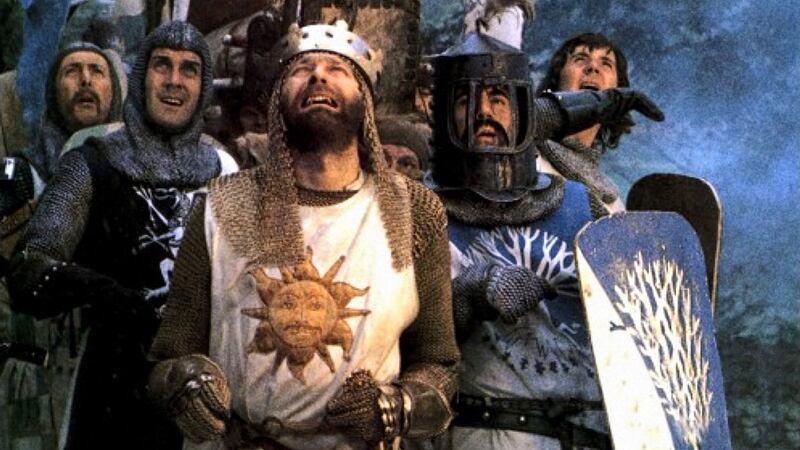
The National Trust for Scotland is not as po-faced as the body’s name suggests. The official audio guide for the Doune Castle tour includes a hilarious replaying of several iconic scenes from the movie.
Perhaps understandably, however, I don’t believe the audio tour included the film’s most famous scene of all: the one where a furious French soldier (John Cleese) shouts from the castle’s turrets down at Arthur (Graham Chapman) and Sir Galahad (Michael Palin), who have approached from below.
“I fart in your general direction,” he taunts them. “Your mother was a hamster and your father smelled of elderberries.”
“Is there someone else up there we can talk to?” replies Palin’s Galahad, meekly.
“No! Now go away or I shall taunt you a second time-ah,” says Cleese’s French soldier.
As I left the castle, my good mood restored, an usher told me to make sure I also viewed the Roman fort nearby. “Just over there,” she gestured.
I walked over there and could find no evidence of any Roman fort. I walked the trails in the forest. I peered down towards the river. I even walked back up a grassy hill towards the school that I had seen earlier in my previously desperate state.
I was just about to give up when a man, presumably a local, walked past with his dog and bid me a cheery greeting. He had a kind, ruddy face.
“It’s unreal, isn’t it?” he said in a soft Pertshire burr.
What’s unreal?
“It’s unreal to think the Romans could just build an entire camp right where we are standing. It was like a little village. You’d never know by looking at it now.”
Of course. The little green on top of the hill that I had been to earlier was once the top of the old Roman fort. The Doune cricket green was later built on its summit. And to think I had briefly considered desecrating the place as I’d skipped from foot to foot in a tizzy.
“They weren’t daft, those Romans,” said the man with a smile, as he continued on his merry way.
They weren’t daft at all. I, on the other hand, had little claim to the same mantle.
I drove off towards Aberdeen through the fading light, thinking of tragedy and comedy. Scotland has its own way of grabbing you like that.