US president Donald Trump on Thursday said in a post on Truth Social the ceasefire between Israel and Lebanon will be extended by three weeks.
Trump also said the US is going to work with Lebanon to help it “protect itself” from Hizbullah.
The post also said he looks forward to hosting Israeli prime minister Binyamin Netanyahu and Lebanese president Joseph Aoun in Washington.
The 10-day ceasefire previously imposed by Trump was due to expire on Sunday. Both sides have accused the other of daily violations.
READ MORE


Hostilities between Hizbullah and Israel reignited on March 2nd, when the group opened fire in support of Iran in the regional war.
Nearly 2,500 people have been killed in Lebanon since Israel went on the offensive following Hizbullah’s attack on March 2nd, according to Lebanese authorities.
Aoun earlier said negotiations would be based on “a complete cessation of Israeli attacks, Israel’s withdrawal from Lebanese territory, the return of prisoners, the deployment of the Lebanese army up to the international border, and the start of reconstruction of the destruction caused by the war”.
Israel argues that Hizbullah must first be disarmed and, in the interim, Israel seeks to maintain a buffer zone 8 to 10km inside Lebanon. Despite the ceasefire, Israeli troops continue to operate in more than 50 villages, destroying what they describe as “Hizbullah infrastructure”. Beirut argues that Israel wants to prevent displaced villagers returning to their homes.

Earlier on Thursday, US forces boarded an oil tanker in the Indian Ocean as the US and Iran continued their struggle to control international shipping despite a fragile ceasefire.
The Pentagon said the vessel, the Guinea-flagged Majestic X, was carrying Iranian oil.
“We will continue global maritime enforcement to disrupt illicit networks and interdict vessels providing material support to Iran, wherever they operate,” the Pentagon said in a statement.
The incident came a day after Iran attacked and seized a number of cargo vessels in the Strait of Hormuz.
In response, Trump said on social media that he had ordered the US navy to “shoot and kill any boat that is putting mines in the waters of the strait of Hormuz”.
The president said US mine sweepers were “clearing the Strait right now”. Insisting that the US had total control over the strategic waterway, he said: “No ship can enter or leave without the approval of the US navy.”
Tehran closed the Strait of Hormuz after Iran was attacked by the US and Israel on February 28th.
Tehran says it will not consider reopening the strait, normally the route for a fifth of global oil and liquefied natural gas, until the US lifts its blockade of Iran’s shipping. Washington imposed its blockade during the ceasefire, which began on April 8th and has since been extended.
Iran has received its first revenue from tolls levied on ships in the strait, the deputy speaker of the Iranian parliament, Hamid Reza Haji Babaei, said on Thursday. The undisclosed amount was deposited into the national treasury.
Iran analysts continue to report significant differences between the hardline Revolutionary Guards and more pragmatic political leaders in Tehran, who are more open to an agreement with Washington.
[ Iran’s hardliners are winning out over pragmatists ]
Israel’s defence minister, Israel Katz, said the country was waiting for the US to allow it to kill Iran’s supreme leader, Mojtaba Khamenei. “We are waiting for the green light from the United States, first and foremost to complete the elimination of the Khamenei dynasty and return Iran to the Dark Ages and the Stone Age,” he said.
More than 30 million people will be pushed back into poverty by the impacts of the Iran war, including disruptions to fuel and fertiliser supplies just as farmers are planting crops, according to United Nations development chief Alexander De Croo.
Fertiliser shortages – worsened by the blocking of cargo vessels through the Strait of Hormuz – have already lowered agricultural productivity, the former Belgian prime minister told Reuters.
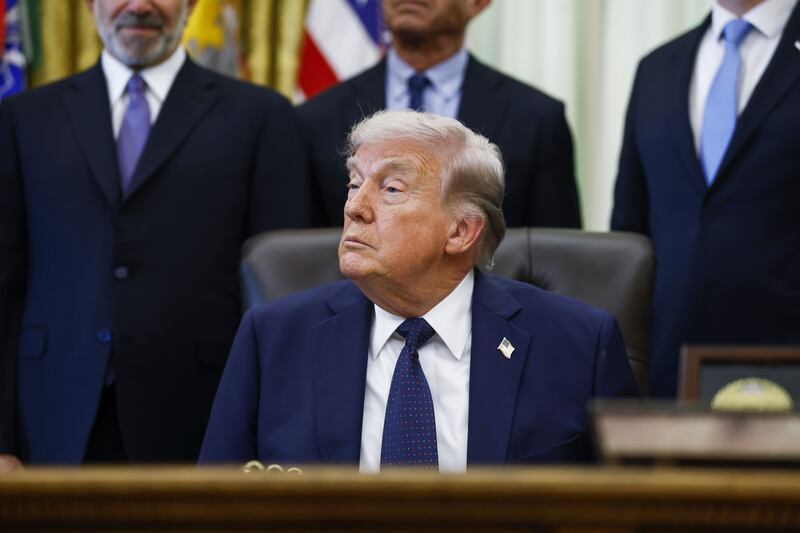
Also on Thursday, Trump said that he would not use a nuclear weapon in the war against Iran.
“Why would I use a nuclear weapon? We’ve totally, in a very conventional way, decimated them without it,” Trump told reporters at the White House when asked whether he would use such a weapon.
“No, I wouldn’t use it. A nuclear weapon should never be allowed to be used by anybody,” he added.
Asked how long he was willing to wait for a long-term peace deal with Iran, Trump said: “Don’t rush me.”
He said Iran might have loaded up their weaponry “a little bit” during the two-week ceasefire, but added that the US military could knock that out in about one day.
“Their navy is gone. Their air force is gone, their anti-aircraft is gone ... maybe they loaded up a little bit during the two-week hiatus, but we’ll knock that out about one day, if they did,” Trump added.
“I want to make the best deal. I could make a deal right now ... but I don’t want to do that. I want to have it everlasting,” Trump said. – Additional reporting: Reuters