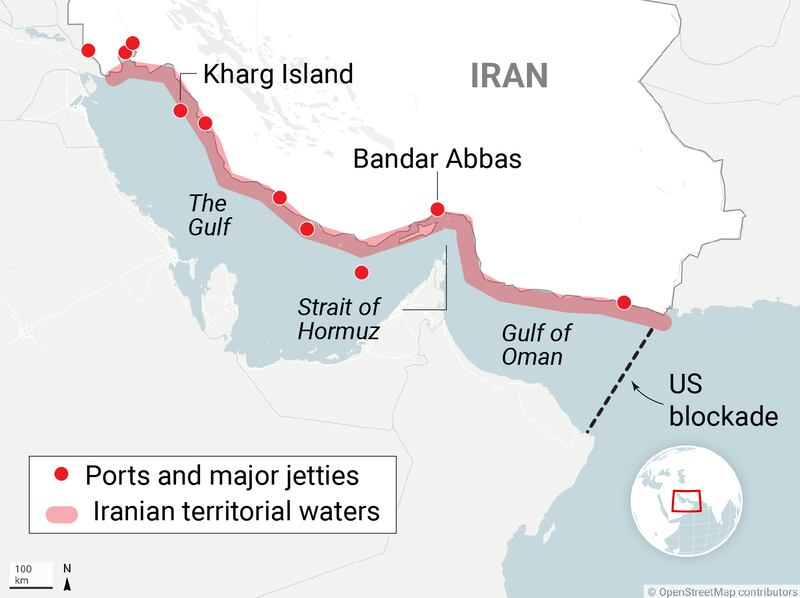
Iran’s foreign minister announced the opening of the Strait of Hormuz for the duration of a 10-day ceasefire between Israel and Lebanon on Friday, raising hopes of an easing of the global fuel crisis caused by the closure of the crucial artery.
“In line with the ceasefire in Lebanon, the passage for all commercial vessels through Strait of Hormuz is declared completely open for the remaining period of ceasefire,” read a post by Iranian foreign minister Seyed Abbas Araghchi on social media site X.
United States president Donald Trump described the passage as “completely open and ready for business” but said that the US naval blockade on Iranian ships would continue until negotiations with Iran had concluded.
However, it remains unclear how quickly shipping can resume on pre-war conditions, and whether restrictions such as tolls will be imposed by Iran.
READ MORE


This was underscored by further comments by Trump that the Iran and the US would work together to remove “all sea mines”, something likely to be a slow and laborious process. It is unclear how much of the strait has been mined, but the possibility of mines is a disincentive to shipping companies and may drive up insurance costs.
In normal times, 20 per cent of the world’s oil supplies transit through the strait, but this had slowed to a trickle as Iran selectively allowed ships to pass through, causing soaring prices of oil, gas and other key commodities, threatening political instability around the world.
The announcement came as the leaders of France, the United Kingdom, Italy and Germany met in Paris to co-ordinate an international coalition committed to reopening transit through the strait on the same terms as before the US and Israel launched their attack on Iran last month.
“The blockage of the strait started by Iran has grave consequences for the whole world,” French president Emmanuel Macron announced after the meeting of 49 countries attended by China, India, Turkey and Gulf countries via video call.
[ What Trump hopes to achieve by blockading Iran’s portsOpens in new window ]
The “simple message” of the 49 countries was “a return to the status quo”, Macron said. “We oppose all restriction including any attempt to privatise the Strait of Hormuz or introduce a toll-paying system.”
France and the UK are leading efforts to gather an international coalition to ensure the safety of shipping in the strait, including through demining and providing security escorts to ships.
“All nations interested in freedom of navigation are invited” to take part, British prime minister Keir Starmer told reporters, saying that a military planning meeting would shortly be held in London to agree to logistics.

The United States did not take part in the conference, which France has framed as an initiative of “non-belligerents” in the war.
Germany has pushed for the inclusion of Washington. Chancellor Friedrich Merz repeated after the conference that the participation of the US would be “desirable”, as well as legal authorisation for the mission by the United Nations.
Stock markets rose and the price of oil on global markets fell sharply immediately following the announcement.
Some residents of southern Lebanon, who fled the recent fighting between Israel and Hizbullah, began returning to their homes on Friday, despite Israeli warnings to stay away from areas south of the Litani river.
Lebanese president Joseph Aoun said the ceasefire with Israel is an “entry point” for negotiations, linking any deal to Israeli withdrawal from southern Lebanon and return of detainees. He said direct talks with Israel are “sensitive and pivotal” adding that the Lebanese army will ensure no armed groups are present in the south after an Israeli withdrawal.
The Hizbullah parliamentary bloc accused the Lebanese government of leading the country into an “extremely dangerous phase” by accepting direct talks with Israel, and stressed the ceasefire must include a full halt to Israeli hostilities.