Following the US-Israeli air strikes, Iran carried out a decades-old threat to close the critical Strait of Hormuz chokepoint. Even after the two-week ceasefire halted hostilities on April 8th, Tehran said it would allow only ships from certain countries through and demanded they pay tolls. In response, US president Donald Trump ordered a complete blockade of all Iranian ports in the Gulf.
The US navy would immediately blockade “any and all ships trying to enter or leave the Strait of Hormuz” and deny safe passage to those paying Iran tolls, Trump announced on Sunday on his Truth Social site.
US Central Command (Centcom) announced late on Tuesday that the blockade was already in place and that Iran’s sea trade was “completely” cut off. “During the first 24 hours, no ships made it past the US blockade and 6 merchant vessels complied with direction from US forces to turn around to re-enter an Iranian port on the Gulf of Oman,” read a post on Centcom’s X account.
Iran’s army warned on Wednesday that it would respond by blocking maritime traffic in the Gulf, the Red Sea, and the Sea of Oman if the US blockade continues. The Wall Street Journal reported on Monday that US ally Saudi Arabia is “pressing” Washington to end its blockade, fearing Iran would escalate.
READ MORE


Steven Horrell, a non-resident senior fellow with the Transatlantic Defense and Security Program at the Center for European Policy Analysis (CEPA), which is headquartered in Washington, stressed the importance of focusing on what Centcom declared on Sunday afternoon and American actions since.
“There is a huge difference between what we are now actually doing and what president Trump posted to social media in the wee hours of Sunday morning,” Horrell says. “Blockading the Strait of Hormuz would be anathema to 250 years of American history and US foreign policy.”
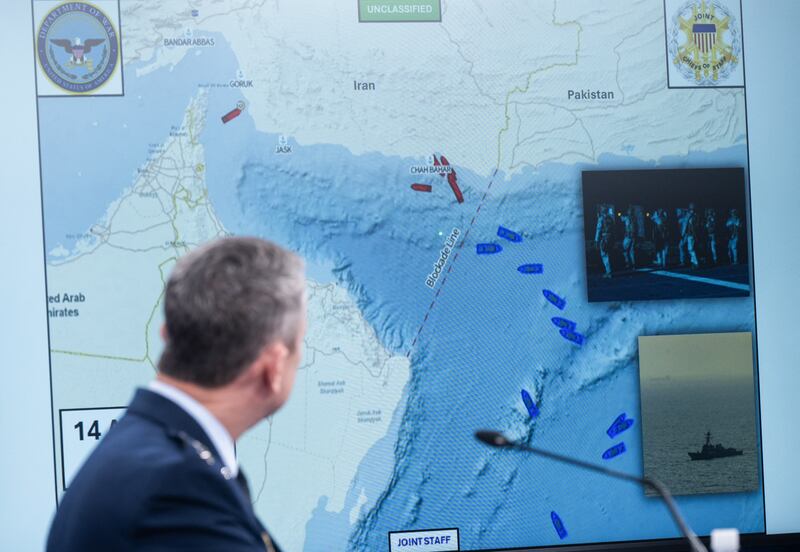
Unlike blockading Hormuz for all shipping, Horrell said the blockade of Iran’s ports is in accordance with international law and the laws of naval warfare.
“The Trump administration’s blockade concept is intended to achieve economic pressure on Iran to undermine the Iranian regime’s belief that it is winning in the current conflict,” Nicholas Heras, interim executive director at the Middle East Policy Council and senior director at the New Lines Institute, says.
“Trump is hoping that the US can use the application of its military power through a combination of sea, air, and land-based assets to prevent Iran from profiting from the free flow of Iran’s energy trade.”
Still, there may be significant limits to what this blockade can accomplish.
“While I have high confidence in tactical and operational level successful execution, I have some doubts about achieving desired strategic goals,” Horrell says.
It is unclear whether this may change Tehran’s calculus on threatening international shipping using the Strait of Hormuz, continuing its nuclear programme, or supporting its regional network of militias.
“Also, the economic pressure is slow – I think Tehran has already demonstrated more strategic patience than the Trump-Hegseth team,” Horrell says, referring to US defence secretary Pete Hegesth.
“Finally, the economic pressure is not limited to national leadership – [there may be an] undesired effect of harming the populace for which we have been purporting support more than the leaders.”
Furthermore, severing Iranian oil shipments to China probably won’t compel Beijing to pressure Iran on the bigger issues.
“The risk for the Trump administration is that it could fail to achieve its goal if the Iranian leadership calls its bluff and isn’t deterred because it believes that the US will not escalate against it through military action,” Heras says.
“Unless Trump is willing to attack Iran’s littoral defence infrastructure, and declaw the regime’s ability to counter US military actions with speed boats, coast-to-sea missiles, and drones, the American blockade will operate in an environment where Iran can counter and even significantly damage US military assets in the Gulf.
“Trump is not seeking to seal Iran’s maritime border so much as he is trying to isolate Iran even further through a military campaign that is designed not for war but for emptying Iran’s coffers to make the Iranian leadership capitulate at the bargaining table.”