
Tuesday: As it happened
- US president Donald Trump said talks between the US and Iran on ending the war could resume ‘over the next two days’
- Peace talks between Israeli and Lebanese officials were held in Washington DC, a month after Israel began its war against Iran-backed Hizbullah militants
- UN secretary general António Guterres said ‘there is no military solution’ to the crisis in the Middle East
- The US has claimed no ships have passed its blockade of the Strait of Hormuz in the first 24 hours of the operation
- Hopes for dialogue to end the war provided some relief to oil markets where benchmark prices fell below $100 on Tuesday
Key Reads
- Keith Duggan: No rest for JD Vance as Trump gets cross with the pope again
- At war with Iran again, some Israelis fear conflict is becoming routine
- Pope Leo vows to continue Iran war critiques after Trump attacks
That concludes Tuesday’s live coverage of the ongoing crisis in the Middle East. Stick with us on Wednesday for more news and analysis on irishtimes.com.
Mark Weiss in Jerusalem recaps the day’s events in his latest article.
[ Talks on ending Iran war could resume ‘over the next two days’, says TrumpOpens in new window ]
Preliminary round of Lebanon-Israel talks reportedly conclude
A preliminary round of talks between Lebanon and Israel have concluded, according to a Lebanese state news agency.
The two countries began talks on Tuesday in Washington, hosted by US secretary of state Marco Rubio. The two nations have not directly negotiated since 1983. – The Guardian
‘No military solution’ to Middle East crisis, says Guterres
In a video posted on X, United Nations secretary general António Guterres has said “there is no military solution” to the crisis in the Middle East and that “serious negotiations” must resume.
He added that the two-week ceasefire between the US and Iran, which began on April 8th, “must be preserved and extended as necessary”.
Talks to end Iran war could resume in next two days, says Trump
Talks to end the Iran war could resume in Pakistan over the next two days, US president Donald Trump said on Tuesday, after the collapse of weekend negotiations prompted Washington to impose a blockade on Iranian ports.
Gulf, Pakistani and Iranian officials also said negotiating teams from the US and Iran could return to Pakistan later this week, though one senior Iranian source said no date had been set.
“You should stay there, really, because something could be happening over the next two days, and we’re more inclined to go there,” Trump was quoted as saying in an interview with the New York Post.
The highest-level talks between the two adversaries since the 1979 Islamic Revolution ended in Islamabad without a breakthrough, raising doubts over the survival of a two-week ceasefire that still has a week to run.
Since the United States and Israel began the war on February 28th, Iran effectively shut the Strait of Hormuz to nearly all vessels except its own, saying passage would be permitted only under Iranian control and subject to a fee.
Nearly a fifth of global oil and gas supplies previously flowed through the narrow waterway, making the fallout widespread.
In a countermeasure, the US military said it began blocking shipping traffic in and out of Iran’s ports on Monday. Tehran has threatened to hit naval ships going through the strait and to retaliate against its Gulf neighbours’ ports.
While the US blockade drew angry rhetoric from Tehran, signs that diplomatic engagement might continue helped calm oil markets, pushing benchmark prices below $100 on Tuesday. – Reuters
Hizbullah said it targeted 13 northern Israeli towns with rockets shortly after the start of Lebanese-Israeli talks in Washington.
In a statement, the group said it targeted Kiryat Shmona, Metula and 11 other towns “with simultaneous rocket salvos” at 6.15pm local time.
The Israeli military had warned it expected a rise in Hizbullah attacks as Washington hosted Israeli and Lebanese officials. – The Guardian
Israel-Lebanon talks begin in Washington

Lebanon and Israel are holding their first direct diplomatic talks in decades following more than a month of war between Israel and the Hizbullah militant group.
US secretary of state Marco Rubio is taking part in the discussions in Washington with Israeli ambassador to the US Yechiel Leiter and his Lebanese counterpart Nada Hamadeh Moawad.
Speaking before the discussions, Rubio described them as a historic opportunity. He said while every complexity would not be resolved in coming hours, he hoped the parties would begin to move forward. – AP
US claims no ships passed its blockade in first 24 hours
The US says no ships have made it past its blockade of Iranian ports and coastal areas in the first 24 hours.
US central command says more than 10,000 military personnel, along with dozens of warships and aircraft, are involved in the blockade.
It says six merchant vessels “complied with direction from US forces” to turn around and “re-enter an Iranian port”.
However, the BBC reports that tracking data shows four Iran-linked ships crossed the Strait of Hormuz after the blockade began.
Central command has said the blockade is being enforced against vessels of all nations entering or leaving Iranian ports, while it says it continues to “support freedom of navigation” for those not travelling to or from Iran.
What has happened so far on Tuesday?

Trump turns on Italian prime minister Giorgia Meloni: ‘I’m shocked by her’

US president Donald Trump told an Italian newspaper on Tuesday he was “shocked” by prime minister Giorgia Meloni and had expected her to be more courageous.
The criticism marks a dramatic change in tone toward Meloni, who was the only European leader to attend the president’s inauguration in 2025.
Meloni had been a vociferous supporter of Trump, but she has criticised his decision to go to war with Iran, and on Monday, denounced his weekend criticism of Pope Leo as “unacceptable”.
Trump responded in an interview with Corriere della Sera, saying Meloni was “very different from what I thought” and denouncing her for refusing to help reopen the Strait of Hormuz, which has been blocked by Iran
“I’m shocked by her. I thought she had courage. I was wrong,” he is quoted by Reuters as saying in the Italian-language article posted online.
Just last month he told Corriere della Sera that Meloni was “a great leader”, but on Tuesday he accused her of failing to back US efforts over energy security and Iran, and said Italy wanted the US “to do the job for her.”
War threatens ‘unprecedented’ energy shock, IMF warns
If there were any doubts over the potential scale of the energy crisis, the International Monetary Fund (IMF) has dispelled them.
In its latest assessment, it says failure to resolve the war in the Middle East could lead to crisis of “unprecedented scale”.
“The ultimate size” of the shock depended on the scale and duration of the conflict, it said.
Assuming the conflict is short-lived, the IMF projects global growth of 3 per cent for this year, a downward revision of 0.2 per cent on its January projections, with headline inflation expected to rise from 4.1 per cent in 2025 to 4.4 per cent in 2026.
Our economics correspondent Eoin Burke-Kennedy has more here.
Macron urges Trump and Iranian president to restart talks
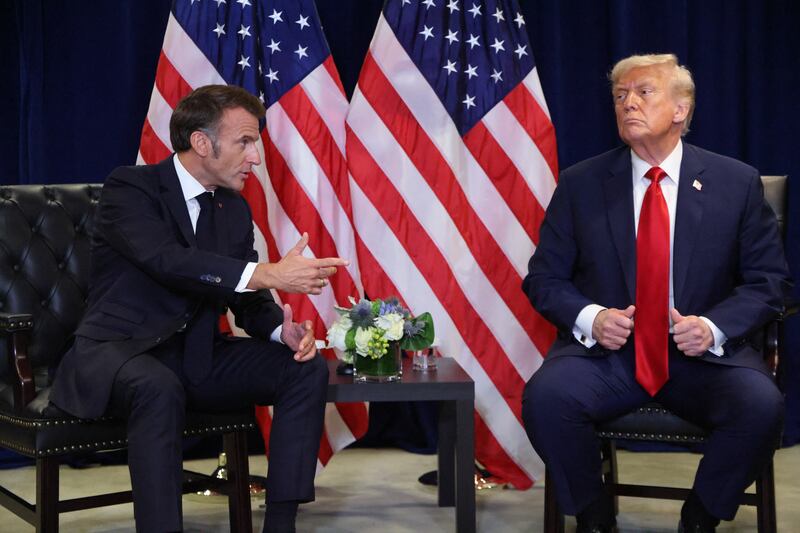
French president Emmanuel Macron said he had urged both US president Donald Trump and Iranian president Masoud Pezeshkian to re-start talks and for possible escalation of the current conflict to be ruled out.
He added in a post on social media platform X that the Strait of Hormuz must be reopened unconditionally as soon as possible.
“Under these circumstances, negotiations should be able to resume quickly, with the support of the key stakeholders,” he said.
Humanitarian groups sending aid overland to Iran
International humanitarian groups said on Tuesday they had sent emergency relief through overland routes to Iran, some of their first deliveries of aid since US-Israeli strikes began in late February.
Aid workers say needs are high in the aftermath of six weeks of attacks on Iran by the United States and Israel. However, they maintained that stocks of emergency humanitarian supplies became stuck in Dubai warehouses as shipping and air routes were blocked by the expanding conflict.
Iranian authorities say more than 3,000 people have been killed in Iran during the war and the United Nations refugee agency says up to 3.2 million have been displaced.
The International Federation of Red Cross and Red Crescent Societies said it had delivered some 200 trauma kits as well as tents and blankets on trucks sent along a new route from Turkey.
The trucks crossed the Iranian border on Sunday and are set to arrive in the capital Tehran on Tuesday, said IFRC spokesperson Tommaso Della Longa.
Italy to suspend defence agreement with Israel

Italy is suspending its defence agreement with Israel, Italian prime minister, Giorgia Meloni has announced.
Italy’s Ansa news agency reported on Tuesday that Meloni said: “In light of the current situation, the government has decided to suspend the automatic renewal of the defence agreement with Israel.”
The Italian Corriere della Sera newspaper reported that the agreement, first launched in 2005 and automatically renewed every five years, was designed to promote trade deals between Italy and Israel, particularly in the defence sector, and to facilitate military research and development.
In further comments, Meloni described as “unacceptable” the lengthy tirade by US president Donald Trump on his Truth Social app against Pope Leo.
Trump maintained that the pope was “weak on crime”.
Meloni said she had expressed and continued to express her “solidarity with Pope Leo”.
Starmer and Macron to host summit on Strait of Hormuz
International leaders will gather in Paris on Friday in an effort to come up with a plan to ensure the Strait of Hormuz can remain open to shipping after the Middle East war ends.
UK prime Minister Keir Starmer and French president Emmanuel Macron will co-host the summit.
A Downing Street spokesman said on Tuesday: “The summit will advance work towards a co-ordinated, independent, multinational plan to safeguard international shipping once the conflict ends.”
Macron has previously said the countries participating in the initiative would work on a “strictly defensive mission, separate from the warring parties to the conflict” which “is intended to be deployed as soon as circumstances permit”. – Reuters
Rubio to attend planned Lebanon-Israel talks
The United States’ top diplomat, secretary of state Marco Rubio, will attend planned talks between Israeli and Lebanese officials in Washington on Tuesday afternoon.
Lebanese militant group Hizbullah has urged Lebanon to pull out of the talks with Israel.
The talks come as Lebanon has reported that 2,055 people have been killed in the country as a result of Israeli attacks over the last month or so.
News agency Reuters has provided details of the talks planned for Tuesday afternoon, which would represent the first time in decades that envoys from Lebanon and Israel, which do not have diplomatic relations, held face-to-face direct talks.
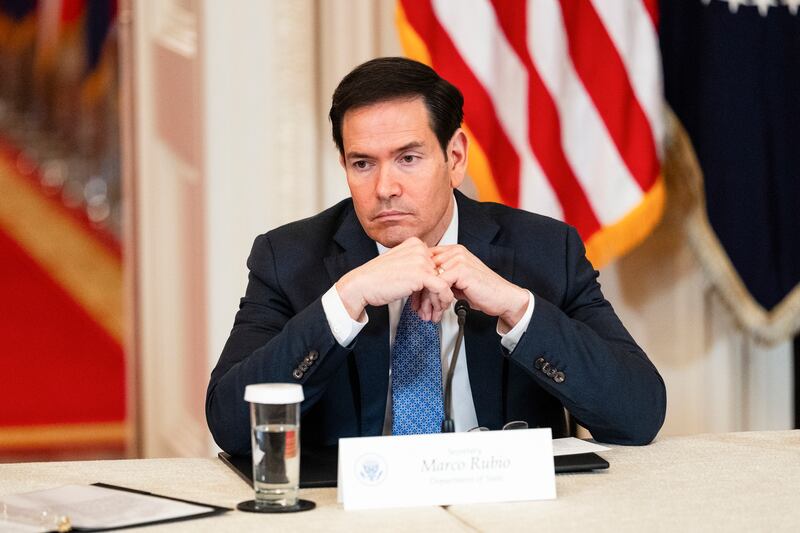
Reuters has maintained that the talks to be held in Washington at 4pm Irish time will involve the Israeli ambassador to the US, Yechiel Leiter, and his Lebanese counterpart, Nada Hamadeh Moawad. Rubio is expected to attend the meeting.
Lebanon, Israel and the US have issued conflicting statements on what the talks would cover. Lebanon’s presidency has said the talks would focus on announcing a ceasefire and setting a start date for bilateral talks.
A ceasefire was the only substantive issue Moawad is authorised to discuss, Lebanese culture minister Ghassan Salameh said on Sunday. Israel would not discuss a ceasefire during the talks, which would focus on disarming Hizbullah and establishing peaceful relations between Israel and Lebanon, Israeli government spokesperson Shosh Bedrosian said on Monday.
Three tankers pass through Strait of Hormuz on first day of US blockade
Reuters is reporting that three Iran-linked tankers have passed though the Strait of Hormuz on the first full day of the US blockade of Iranian ports.
Citing shipping data, the news agency said the three vessels were not heading to Iranian ports, and so they were not covered by the blockade.
The ships included Panama-flagged Peace Gulf, a medium-range tanker that was heading to Hamriyah port in the UAE. The vessel typically moves Iranian naphtha, an oil product that is used for making plastics and chemicals.
Another vessel was the US-sanctioned tanker, Murlikishan, that was sailing to Iraq to load fuel oil. The ship, formerly known as MKA, has transported Russian and Iranian oil.
The third ship was the Rich Starry, a US sanctioned and Chinese flagged vessel. It is carrying about 250,000 barrels of methanol, which it loaded at its last port of call, the UAE’s Hamriyah.
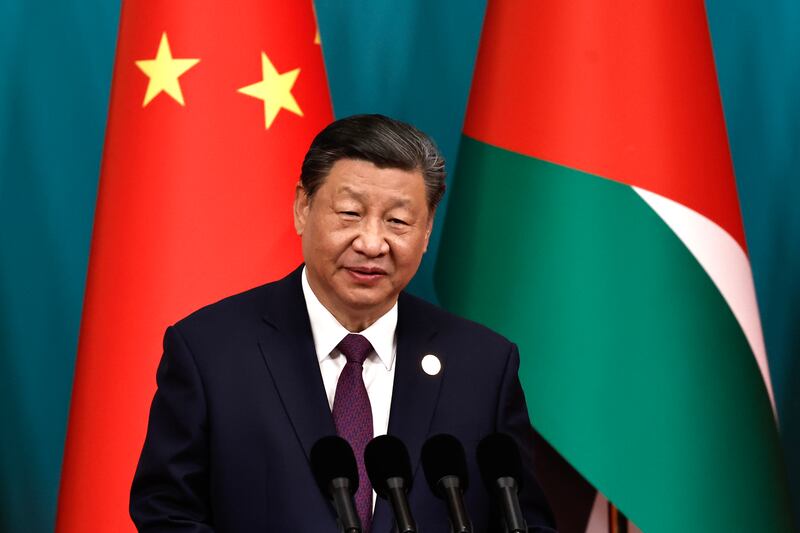
Chinese leader puts forward Middle East peace proposal
The Chinese president, Xi Jinping, has put forward a four-point proposal for peace and stability in the Middle East, as he called for the world not to be allowed to “revert to the law of the jungle”.
In the most significant remarks he’s made so far about the crisis in the Middle East, Xi said China would play a “constructive role” in promoting peace talks in the Middle East.
He made the comments during a meeting with Khaled bin Mohamed, the crown prince of Abu Dhabi, in Beijing on Tuesday, where the two sides exchanged views on the current situation in the Middle East and the Gulf region, according to a readout by the Chinese state news agency Xinhua.
On his four-point proposal, Xi called for: Upholding a “principle of peaceful coexistence” and to “promote the building of a common, comprehensive, co-operative and sustainable security architecture for the Middle East and the Gulf region”.
Xi proposed upholding state sovereignty, including the protection of personnel, facilities and institutions.
He said upholding international rule of law that should not be “used it when it is convenient and abandoned when it is not ... we cannot allow the world to revert to the law of the jungle”.
He proposed that all countries should “integrate development and security” and “create a favourable environment and inject positive energy into the development of the Gulf states in the Middle East”.
New talks planned to resolve Middle East crisis – reports
Reuters is reporting this morning that the US and Iran will return to Pakistan for peace talks.
Citing several sources, the news agency said the negotiating teams from both sides will be in Islamabad for a second round of talks as early as the end of this week.
“No firm date has been set, with the delegations keeping Friday through Sunday open,” a senior Iranian source told the news agency.
The weekend meeting in Pakistan’s capital to resolve the conflict between the US and Iran, held four days after last Tuesday’s ceasefire announcement, was the first direct encounter between US and Iranian officials in more than a decade, and the most senior engagement since Iran’s 1979 Islamic Revolution.
A proposal has been reportedly shared with both the US and Iran to resend their delegates to resume the talks.
Two Pakistani sources with knowledge of the talks said Islamabad was communicating with the two sides about the timing of the next round and the meeting would likely take place on the weekend.
“We have reached out to Iran and we got a positive response that they will be open to a second round of talks,” a senior Pakistani government official told Reuters.
There are a slew of issues on the table, including the Strait of Hormuz, a major transit point for global energy supplies that Iran has effectively blocked but the US has vowed to reopen, as well as Iran’s nuclear programme and international sanctions on Tehran.
US is negotiating an Iran deal that would buy time – again
More detail is emerging on the US-Iran talks, which ended over the weekend, and the landing zone for any potential deal.
Among the slew of issues at stake were the Strait of Hormuz, a major transit point for global energy supplies that Iran has effectively blocked but the US has vowed to reopen, as well as Iran’s nuclear programme and international sanctions on Tehran.
The New York Times reports that the US proposed a 20-year “suspension” of all nuclear activity. This is despite Donald Trump’s public demands that Iran can never build a nuclear weapon.
In response, Iran renewed a proposal that it suspend nuclear activity for up to five years, according to sources. The Iranians had made a similar proposal in February during a failed set of negotiations in Geneva that convinced Trump it was time to go to war.
Days later, he ordered the attack on Iran.
Reuters, meanwhile, reports that dialogue was still “alive”, citing sources familiar with the talks.
One source involved in the talks said the parties came “very close” to an agreement and were “80 per cent there”, before running into decisions that could not be settled on the spot.
Two senior Iranian sources described the atmosphere as heavy and unfriendly, adding that while Pakistan tried to soften the mood, neither side showed any willingness to ease tensions.
They said that by early Sunday morning the atmosphere had shown some improvement, and the possibility of a one-day extension began to take shape.
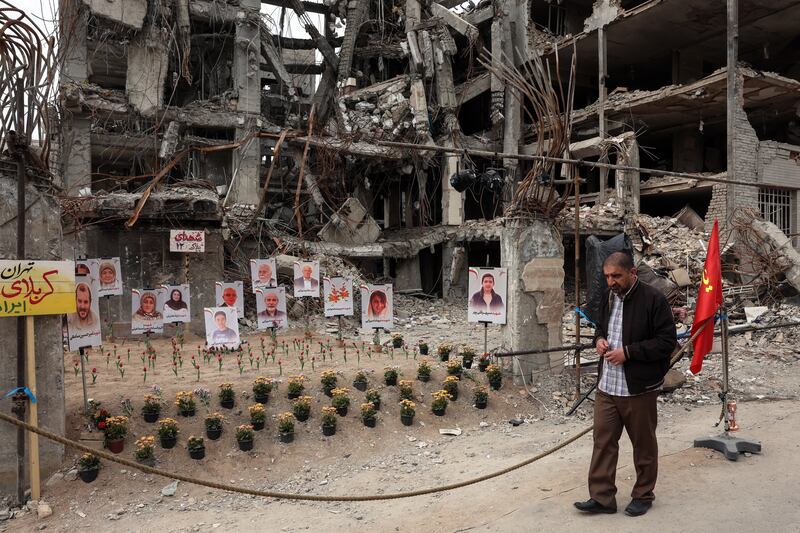
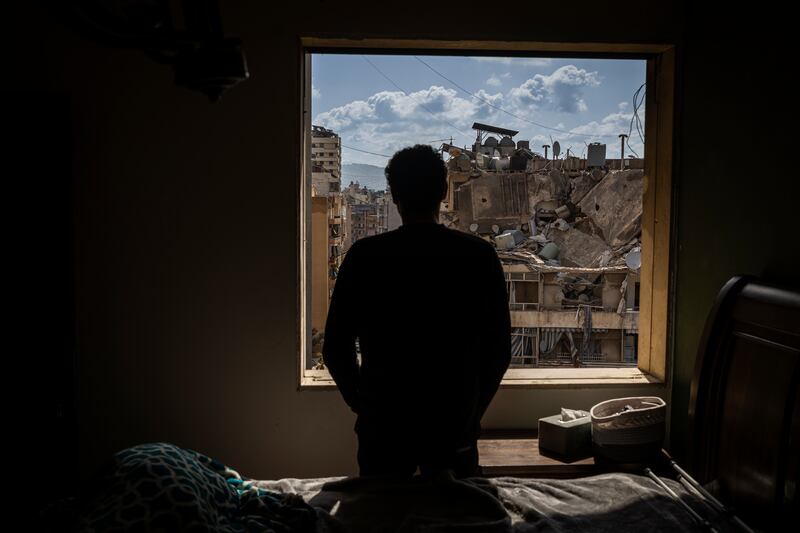
Here are some of the latest images coming in from the Middle East in the seventh week since the war began and amid a fragile US-Iran ceasefire.




‘The hits keep on coming for JD Vance’
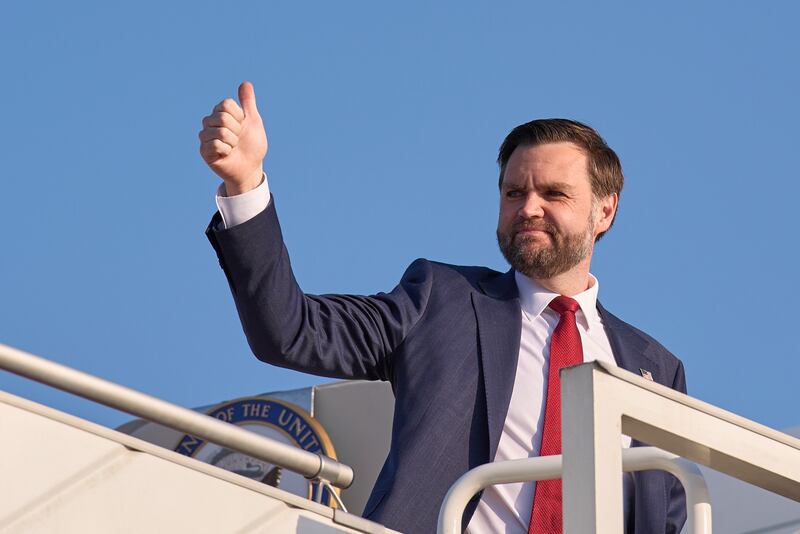
Our Washington Correspondent Keith Duggan is writing today on the trials of US vice-president JD Vance, who returned to Washington on Sunday with little to show for his efforts to deliver on some of Donald Trump’s most high stakes and unusual foreign policy gambits.
Here’s an extract:
“The hits just keep on coming forJD Vance. Having left Islamabad after 20 undoubtedly gruelling hours of conversation with the Iranians that left the US delegation thwarted; having appeared last week at a rally for Hungarian strongman Viktor Orbán in Budapest only to see his re-election campaign after 16 years of rule go down in such spectacular flames that Vance’s star-guest turn was touted as a cause of failure; having recently announced his summer book detailing his conversion to Catholicism, the US vice-president returned to Washington to discover his president had picked another fight. With the pope.”
You can read the full piece here.

Vance accuses Iran of ‘economic terrorism’ in Strait of Hormuz
US vice-president JD Vance, who led the US delegation in the first round of talks, has accused the Iranian government of engaging in an “act of economic terrorism” by blocking traffic through the Strait of Hormuz.
Vance told Fox News that if Iran engages in “economic terrorism” the US will abide the principle that “no Iranian ships are getting out either”.
Vance also discussed the talks with Iran over the weekend, saying some progress was made and that talks had helped clarify red lines.
Asked about the possibility of another meeting, Vance said the question was “best put to the Iranians, because the ball really is in their court.”
He said Iran had to be flexible and accept the “critical things” the US demands – US control of Iran’s enriched uranium, and a verification mechanism to ensure it does not develop a nuclear weapon.
Iran approaches European countries for support
In a move designed to increase pressure on the US to make compromises in its conflict with his country, Iranian foreign minister Abbas Araghchi has been briefing European capitals on the nature of the offer Iran had been willing to make about its stockpile of highly enriched uranium and future stewardship of the strait of Hormuz during the weekend talks in Islamabad.
After the inconclusive talks, Araghchi held phone briefings with the French and German foreign ministers, Jean-Noël Barrot and Johann Wadephul, as well as the Saudi, Omani and Qatari foreign ministers. It is understood he stressed that Iran did not regard the Pakistan-led process as exhausted, even after 21 hours of intensive talks.
Europe has been sidelined on Iran by Donald Trump for more than a year, as the US president focused on working with Israel, while Tehran has largely dismissed European governments, seeing them as backers of the United States.
But the signs of the deepening transatlantic split, and the intense pressure being applied to European economies, has led Iran to review its stance on Europe as a potential lever on Trump.
Pakistan proposes new round of talks
Pakistan has reportedly proposed hosting a second round of talks between the United States and Iran in Islamabad in the coming days, before the end of the ceasefire, the Associated Press has reported.
Pakistani officials, who spoke on condition of anonymity, said the proposal would depend on whether the parties request a different location.
One of the officials said that, despite ending without an agreement, the first talks were part of an ongoing diplomatic process rather than a one-off effort.
The White House did not immediately respond directly to queries about whether new talks were being weighed.
“President Trump, vice president Vance and the negotiating team have made the US red lines very clear. The Iranians desperation for a deal will only increase with president Trump’s highly effective naval blockade now in effect,” White House press secretary Karoline Leavitt said.
Later, Trump said Iran had reached out to his administration. “We’ve been called this morning by the right people, and they want to work a deal,” he told reporters at the White House, without elaborating.
The president repeated claims that negotiations had failed due to Iran’s insistence on maintaining a nuclear programme. Trump said any deal would require Iran to abandon such ambitions.
The New York Times, citing people familiar with the talks, reported, that the US proposed a 20-year suspension of nuclear activity, while Iran countered with a plan to halt it for up to five years, similar to an offer made in February.
Iran blamed the collapse of talks over the weekend on the US, but left the door open for more negotiations. – AP/The New York Times
Hizbullah says it will not abide by agreements from Lebanon-Israel talks
Hizbullah will not abide by any agreements that may result from direct Lebanon-Israel talks in the US, negotiations it firmly opposes, a senior official with the Lebanese militant group has said.
Wafiq Safa, a high-ranking member of Hizbullah’s political council, spoke on the eve of talks expected in Washington between Lebanese and Israeli ambassadors to the US.
It will be the first time in decades that envoys from Lebanon and Israel, which do not have diplomatic relations, meet face-to-face in direct talks.

“As for the outcomes of this negotiation between Lebanon and the Israeli enemy, we are not interested in or concerned with them at all,” Safa told the Associated Press.
Separately, the leader of Hizbullah urged Lebanon to pull out of the talks with Israel. Naim Kassem spoke in a televised address on the eve of the scheduled meeting.
The latest round of fighting was sparked by Hizbullah firing rockets into northern Israel on March 2nd, after the US and Israel attacked Iran.
At least 2,055 people have been killed in Israeli strikes in Lebanon, the health ministry says, among them 252 women, 165 children and 87 medical workers. More than 6,500 others were wounded and a million people have been displaced.
Lebanon’s government – which says it is committed to disarming Hizbullah – had called for direct talks early on in the war. Last week, Israel announced its approval of talks. – The Guardian
Oil prices ease despite US blockade of Iran ports
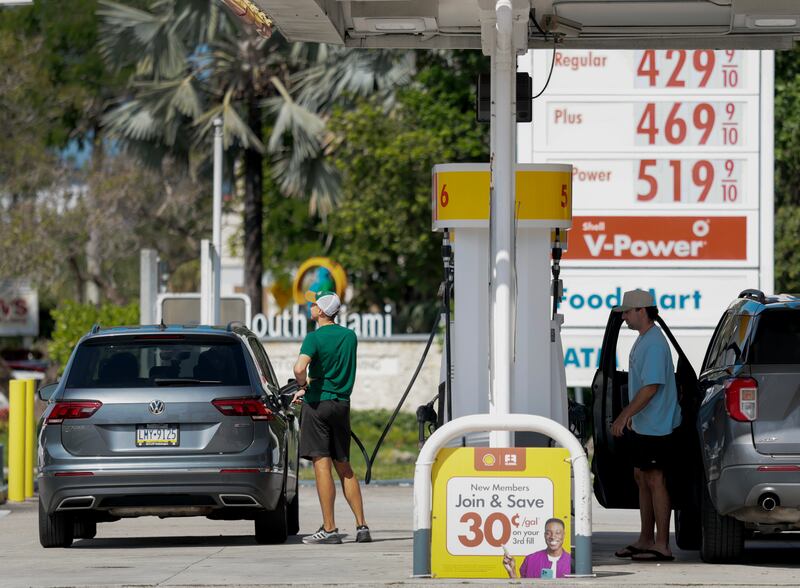
The US military has begun a blockade of Iran’s ports, angering Tehran and adding uncertainty around the crucial waterway, although hopes for dialogue to end the war provided some relief to oil markets where benchmark prices fell below $100 on Tuesday.
After a breakdown of weekend talks in Islamabad between the two adversaries, a US official said there was continued engagement and forward motion on trying to get to an agreement. Pakistani prime minister Shehbaz Sharif also said efforts were still under way to resolve the conflict.
US president Donald Trump said Iran had been in touch on Monday and wanted to make a deal but that he would not sanction any agreement allowing Tehran to have a nuclear weapon.
Since the United States and Israel began the war on February 28th, Iran effectively shut the Strait of Hormuz to all vessels except its own, saying passage would be permitted only under Iranian control and subject to a fee.
The fallout has been widespread, since nearly a fifth of the world’s oil and gas supplies flowed through the narrow waterway before the start of the conflict.
Trump has said Washington would block Iranian vessels and any ships that paid such tolls and that any Iranian “fast-attack” ships that went near the blockade would be eliminated.
Tehran has threatened to hit naval ships going through the strait and to retaliate against its Gulf neighbours’ ports.
Shipping data on LSEG showed Chinese-owned oil-and-chemicals tanker Rich Starry passed through the strait on Tuesday – the first since the US blockade began at 2pm Irish time on Monday.
The vessel, which departed Sharjah anchorage off the coast of Dubai on Monday heading for China, had earlier turned back minutes after approaching the strait.
The US blockade has further clouded the outlook for global energy security and the supply of a vast array of goods that relies on petroleum, and has little, if any, international backing. Natp allies including Britain and France said they would not be drawn into the conflict by taking part in the blockade, stressing instead the need to reopen the waterway. – Reuters


