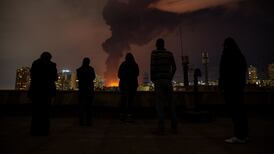
Tehran’s military mounted fresh strikes on Thursday on Iraq’s semi-autonomous Kurdish region, with the objective of deterring Iranian and Iraqi Kurds from entering the US-Israeli war on Iran.
The strikes followed reports that Iranian-Kurdish armed groups based in western Iran have consulted Washington about securing US support for attacks on Iran’s forces.
Iranian Kurds have denied reports that their forces crossed from bases in Iraq into the majority Kurdish region in western Iran and engaged Iranian army units battling the US and Israel.
Aziz Ahmad, an adviser to Iraqi Kurdistan regional prime minister Masrour Barzani, writing on X, said: “Not a single Iraqi Kurd has crossed the border. This is patently false.”
READ MORE


The reports were also denied by senior Iraqi officials as well as White House press secretary Karoline Leavitt, who said US president Donald Trump had contacted Kurdish leaders about the US base in Irbil in northern Iraq but dismissed suggestions that he has agreed to any such plan.
Kurdistan Freedom Party spokeswoman Hanna Hussein Yazdan Pana said: “We cannot move if the air above us is not cleaned. We need to see [Iran’s] weapons depots being destroyed. Otherwise, it would be suicidal.”
Despite the denials, the US and Israel have conducted intense air strikes on Iranian army positions, frontier posts and police stations along Iran’s border with Iraq, seemingly to prepare for Kurdish fighters to enter Iran.
[ US attack on Iran shows Donald Trump’s preference for instinct over strategyOpens in new window ]
According to The Guardian, a US official with knowledge of the discussions between Washington and Kurdish officials said the US was ready to provide air support if Kurdish fighters crossed the border from northern Iraq.
Iran’s Kurds, the country’s third-largest ethnic group, constitute 10 per cent of the population and are concentrated in the northwestern, mountainous regions bordering Turkey and Iraq as well as Khorasan province.
Like Kurds in Iraq, Turkey and Syria, Iranian Kurds have long sought independence in a Kurdish sovereign state and are prepared to grasp any opportunity to achieve this goal.
For more than a century, the Kurds have mounted uprisings in Turkey, Iraq, Syria and Iran to achieve self rule and preserve their distinct ethnicity. In 1991, the Kurdish region in northern Iraq was granted semi-autonomy after the US-led coalition drove Iraqi occupation forces from Kuwait. Kurds refer to territory in Iran they want for their state as eastern Kurdistan, in Turkey as northern Kurdistan, in Iraq as southern Kurdistan and in Syria as western Kurdistan.
An Indo-Iranian ethnic community numbering 30-40 million, Kurds share a common identity, language, culture and history but were not accorded a state when Britain and France divided the Ottoman Empire following the first World War.
Kurds have been used by outside powers to fight their wars in the expectation of Kurdish statehood. They have been successful in achieving autonomy only in Iraq.
Separately, the Sunni Muslim Iranian Baluch people, who make up 2 per cent of the population, have continued their insurgency against Shia Muslim-majority Iran. – Additional reporting: The Guardian