

The difference is striking: one side green, the other brown. It is the result of what local residents in the southern Syrian governorate of Quneitra say was the spraying of chemicals by Israeli planes inside Syrian territory in late January, destroying grazing areas and farmland.
“The plane flew and started spraying all these places,” says a farmer in Kodana village, who asks to be identified as Abu Hussein. “Of course I was afraid. I was afraid for my children. This is the first time [I saw this].”
He witnessed planes spraying on two days: two planes the first day and one the second. His children’s eyes turned red afterwards, he says.
“I am a herder with cows, so I depend on the land for grazing. My source of living is gone,” he says. “Our job is farming. We’ve been doing this forever. Milking the cows. Making yoghurt and cheese. This spraying has affected the land for the next year. What did I do wrong?”
READ MORE


Local officials say the area affected is about 60km long, comprising more than 600 acres of herding land and almost 100 acres of farming land, including land growing wheat and hay.
A statement from Syria’s ministry of agriculture earlier this month said samples taken were found to be “non-toxic, according to the approved acute toxicity tests” and that the spraying does “not pose a risk to the health and safety of citizens and farmers”, though traces of some herbicides were detected in plant samples. But locals say the damage has been greater.

When the Bashar al-Assad regime fell in Syria in December 2024, Israel advanced into Syrian territory.
Abu Hussein recalls Israeli soldiers coming “out with tanks that same night and setting up checkpoints, blocking the road in each direction”. The families spent 20 days hiding at home, before finally venturing outside again.
Local authorities say at least 35 civilians have been killed by Israeli forces since late 2024 in Quneitra, Daraa and the Damascus countryside, including through multiple documented Israeli airstrikes. The Sijil Center, which monitors Israeli human rights violations in Syria, says it has documented more than 1,000 violations since August 2025, including 310 ground incursions. The vast majority were in Quneitra, it says.
Mohammed Rahal, the deputy director of Quneitra’s agricultural administration, says Syrian authorities are conducting proper surveys and waiting for a final report on the spraying, but their work has been limited because employees are afraid to go to some areas.
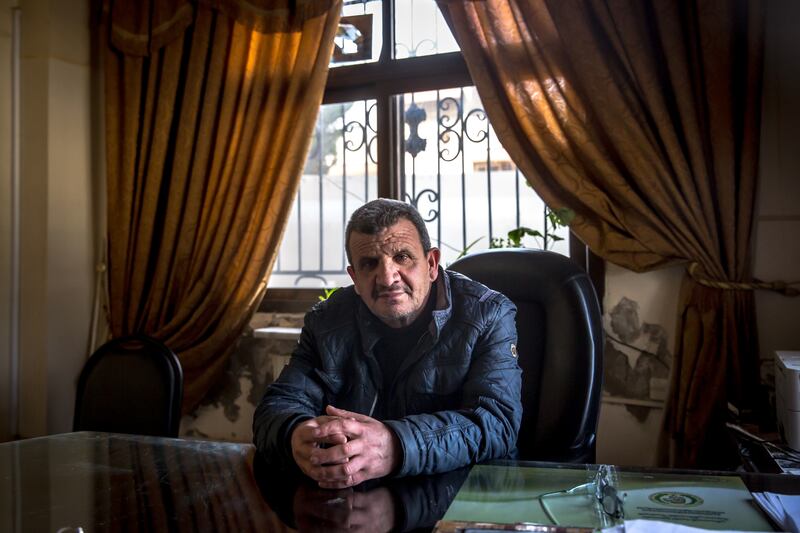
“You know the Israeli occupation is advancing a lot here and doing a lot of incursions, bringing in checkpoints, arresting people,” he says. He believes the goal of spraying was to keep farmers and herders away from certain places.
Similar reports of chemical spraying have been made in southern Lebanon, where Israeli forces have continued to carry out regular attacks and raids, and to hold on to five “strategic” locations, since the ceasefire with Hizbullah in November 2024.
On February 2nd, Unifil issued a statement saying Israeli forces instructed them to remain under cover, because they would be “dropping what they said was a non-toxic chemical substance over areas near the Blue Line [the unofficial border between Lebanon and Israel].” Normal operations could only resume after more than nine hours.
The spraying was in violation of UN resolution 1701, Unifil says. It “raised concerns about the effects of this unknown chemical on local agricultural lands, and how this might impact the return of civilians to their homes and livelihoods in the long term”. This was not the first time that Israeli forces “dropped unknown chemical substances from airplanes over Lebanon”, the Unifil statement said.
Lebanese authorities later said a laboratory analysis found glyphosate in the spray – a herbicide classified as “probably carcinogenic” by the World Health Organisation.
Lebanese president Joseph Aoun called it “an environmental and health crime against Lebanese citizens and their land”, and asked the international community and relevant United Nations organisations to take action.


In neighbouring Syria, Quneitra’s residents were already struggling after almost 14 years of war. Mohammad Alsaeed, the spokesperson for the governorate, said the last census, in 2011, recorded 600,000 people living there. Some 100,000 lived along what is known as the disengagement line, agreed on in 1974.
Many – including Abu Hussein – are descended from families originally displaced from the Golan Heights after it was captured by Israel during the 1967 war. “Israeli actions impact them,” Alsaeed says.
He says the area suffered badly under the Assad regime because it was largely opposition-controlled, with regime forces bombing and destroying infrastructure. Israel’s actions since have affected the development of the area and people’s livelihoods, leading to problems with social wellbeing, he says. There has been a notable impact on water resources as Israeli “military bases and patrols are always next to the dams”.
Alsaeed says about 6,000 acres of land have been closed off to locals, and nine new Israeli military bases have been created beyond the disengagement line. “Israel tried to create a new reality,” he says, which is “putting people under pressure to leave”. At least 19 families had their homes bulldozed by Israeli forces, he says.
A spokesperson for the Israeli military said the Israel Defense Forces (IDF) launched a “defensive operation” after the fall of the Assad regime, which “included establishing forward defensive lines in order to prevent threats to the communities of the Golan Heights and to safeguard the security of” Israeli citizens. This is part of a “new defence strategy formulated in light of the lessons learned from October 7 [2023]” with “the objective of protecting the citizens and territory of the State of Israel”.
[ Syrian government takes over Raqqa: first on the agenda is rubbish collectionOpens in new window ]
Its “activity in the area is conducted in accordance with international law, as it is directed against terrorist activity and tangible threats to the civilians of the State of Israel”, the spokesperson said. “All of this is carried out while taking feasible precautions to mitigate harm to the civilian population.”
There is no command or directive to prevent Syrians from harvesting crops or confiscating livestock, the spokesperson said, and they aim to take “all necessary precautions to avoid harm to the civilian population”. Related “activities” do include “the apprehension of individuals suspected of involvement in terrorist activity against Israeli civilians or IDF forces. Such suspects were transferred for further questioning, screening, and detention at a designated facility in Israeli territory”. The spokesperson said these detentions are subject to judicial review, “as required under Israeli law”.
“This is an existential and a genuine threat to civilians. It’s not a speculative threat, it’s a real threat,” says Alsaeed. He says the best solution would be a political and diplomatic one, being worked on by Syria’s new ministry of foreign affairs.
“There is a hope of course and there is also genuine will from the Americans and Europeans to have a stable Syria and this will lead to a diplomatic solution. Israel cannot build its national security on Syria’s national security.”
In southern Syria, Israel seems to have largely adopted a stick-with-the-occasional-carrot approach. With few resources and little opportunity, rumours swirl about who may be taking Israeli money or food parcels.
One 36-year-old who lives in Kodana, who gave his name as Abu Issa, posted a video of him burning an Israeli food parcel last year. He says he also helped visiting journalists to cover the situation. One night, he says, Israeli forces came to his house, searched it and took him to a military base. The soldiers released him later.

He accuses Israeli forces of filling wells with soil, and sabotaging water pumps, solar panels, electricity and communications networks in Kodana. He says 1,500 of his uncle’s trees were damaged by the recent spraying of chemicals.
“Israel is like that, they’re expansionist,” says local journalist Alaa Alhajji (30). She believes Israeli forces are “trying to create a system similar to the West Bank” in Syria. “Of course it’s an occupation when someone occupies your land, builds military bases and posts, sets up checkpoints in the street, and kidnaps civilians ... These are occupation exercises.”
She also points out that the traditional way of life for those originally on this land may simply become unviable. When shepherds do not have enough space for their animals to graze, they need to sell some to buy feed for the others – impacting them drastically in the long run. She says local apple, cherry and olive farmers were not able to harvest all of their crops last year.
Abu Hussein points to an Israeli military base on a hill in front of his home, which two vehicles begin descending from.
He says Israeli forces drive through his land every few days, in convoys of three or four vehicles, and that soldiers have ordered his family to stay inside when they pass. He gestures towards tracks in the dirt, where his dog lies. “They are as if they are going to a battle,” he says.
Soldiers have searched his home multiple times, once injuring a young family member, he says. On days when they do not see soldiers, surveillance drones fly overhead, which locals call “zananay”, or “the buzzer”.
“We are afraid, we are civilians. We are farmers, not fighters,” Hussein says.
His brother and sister live with him on land their father bought, keeping livestock. About 500 people live in Kodana in total, with about 4,500 in the surrounding area. Life is a “disaster”, Hussein says.
While they can see Israeli wind turbines from their land, he has never had electricity, just solar panels. They pay around €1.20 each week to fill a water tank – a large amount of money for them. His children have already missed out on school because of revolution and war, Hussein says. They can’t read and write and “their future has gone”.
When asked if he thinks they will be forced off this land completely, Hussein said he does not know. But as people with no resources and no strength, they have no option but to do what they are told, he says. “If Israeli soldiers come and say we have to leave, we’ll leave.”
– Hani Alagbar and Nader Debo assisted with this report.


