
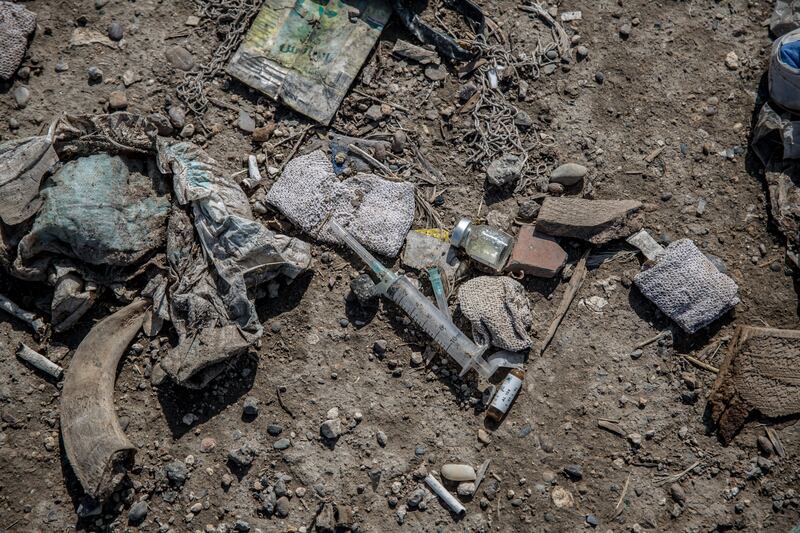
Standing among syringes, food wrappers, plastic bags and the entrails of animals, members of Raqqa’s new authority survey the scene.
Stray dogs wander by. Some of the men cover their noses against the pungent smell. This is a dumping site at the edge of the city, on the banks of the Euphrates.
It has been just over a month since the Kurdish-led Syrian Democratic Forces (SDF) were ousted from Raqqa, northern Syria, by government forces. The new authorities say they are assessing the best path forward in an area pummelled by 15 years of war.
From 2014 to 2017, Raqqa was the de facto capital of what the Islamic State called its caliphate. Locals say the city was very clean under the extremist militant group – though of course there were many other problems.
READ MORE


“All the services were provided,” says one local, who does not want to be named. “They were called Islamic State and they behaved like a state.”

In contrast, the SDF – which controlled Raqqa from late 2017 – did not take care of services or maintain the city properly, many complain.
Some suggest it was because the city’s residents are mostly Arab, saying the Kurdish-led authorities wanted to marginalise or even punish them for the existence of Islamic State (also known as Isis), even though many were not involved or were displaced during that time.
Raqqa was largely destroyed by heavy aerial bombardment during the military campaign to oust Islamic State, and the consequences are still evident.
People are crowded into apartments in half-toppled buildings. Shops remain open, even when the trail of a missile is still visible in the building behind and the overall structure largely collapsed.
Many roads are thick with mud and mounds of rubbish. Top of the new authorities’ agenda is cleansing: starting with clearing 165 illegal dumping grounds around the city.

“I’m laughing because I don’t know where to start,” says Shahoud Abdulaziz, the interim director and head of the Raqqa municipality council.
“All the sectors are collapsed. Let’s speak about the sewage system because it’s a source of medical problems.”
He says the sewerage systems have not been properly maintained and are not big enough for growing neighbourhoods. Authorities, he says, are facing challenges with rubbish collection, including a lack of vehicles and a lack of fuel to transport what they remove.
Abdulaziz comes from Aleppo governorate, where he previously worked in the ministry of economy and industry. He says his outsider status has caused some tensions, but he has the experience needed and will leave the position once there is an election or a suitable replacement is found.
“The needs are really high,” he says.

The new authorities have asked the United Nations agencies for help. They also immediately hired 300 cleaners, he says, to add to the 283 that were already there. The population of Raqqa is about 600,000, he believes.
Huge numbers of Raqqa’s residents celebrated on the streets after government forces took control of the city in January, though some of the city’s Kurdish residents fled their homes.
Abdulaziz believes that Raqqa’s remaining inhabitants feel more motivated now and can begin imagining and building for a future.
Abood Hamam was living in the Netherlands when he heard the regime of Bashar al-Assad had fallen in December 2024 after 13 years of civil war. He abandoned his asylum claim and went straight back to Syria.
After government forces advanced in the north, he stepped in to lead the media directorate in the Raqqa governorate. His phone buzzes as he speaks. “All the ministers are coming to visit,” Hamam says, despite a lack of capacity to receive them. “We don’t have speakers, we don’t have cameras.”
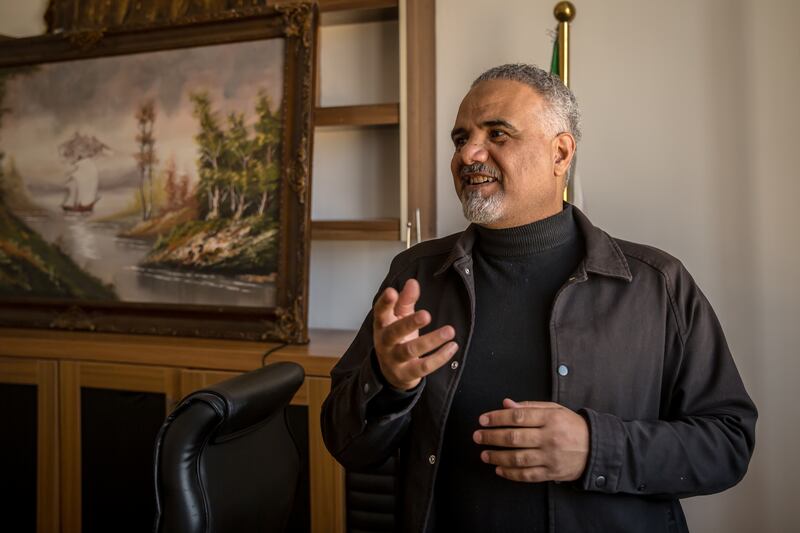
Hamam is a Raqqa native and a photographer by trade. In a previous life he covered Assad and his family for Syrian state media, before documenting the Syrian revolution for international media, using a pseudonym, and then the takeover of Raqqa by Islamic State.
He sees the rubbish around Raqqa as a major emergency.
“This city has been marginalised for over 15 years throughout the war. Nothing has happened for the last 15 years, only destruction,” Hamam says.
“We are in a state of emergency in the city of Raqqa and this campaign is an emergency solution for the accumulation of garbage in the streets.”
The rubbish leads to sickness and diseases, he says.
Authorities are deploying bulldozers and excavators to clear illegal dumping grounds, he said. “Even vehicles owned by the ministry of defence were donated for the period to use.”
They have invited schools, students, citizens, shop owners, NGOs and local administrations to take part in the next phase of the cleaning campaign.
“The citizens are encouraged to clean next to their house and the shopkeepers clean next to the shops. Then the government has to re-establish their role to garden the streets and the people need to not throw the garbage in the streets, they will throw it in the dumpsters.”
In the coming summer the government also plans to put asphalt on all of the roads, Hamam says.

Talal al-Issa, the new authorities’ head of environment in Raqqa, says they need assistance to re-establish water treatment centres polluted by sewage and help to move rubbish and waste to a landfill site 40km from the city as well as trying to combat climate change.
Syria, with a semi-arid to arid desert climate, is considered highly sensitive to climate change. “More greenery is the only way we can tackle it,” Issa says.
– Hani Alagbar assisted with this report.


