Limerick man John Hayes was watching the warheads zip over his head in Dubai as Iran fired missiles on Saturday.
What followed was a cacophony of booming explosions in the sky as the city’s air-defence missile system began taking out missile after missile, drone after drone.
“We thought we would be safe but then we started spotting projectiles above us, and they were being intercepted by the air defence system in place here,” said Hayes.
Hayes (38), a journalist with Al Arabiya English television news channel, said: “In the middle of the day we are watching missiles and drones being taken out in the sky, and then, it just seemed to escalate more and more.”
READ MORE


Hayes described how a “barrage of missiles” hit the city’s coastline, just as Iftar – the evening meal Muslims eat to break their fast at sunset during the holy month of Ramadan – was beginning.
“That sparked the initial phase of panic among the public where there was panic buying, people rushing to the stores, the petrol stations were full, and so then we felt something is going horribly wrong here,” he said.
Just after midnight into Sunday morning Dubai time, warning notifications were flooding into mobile phones “to say wherever you are right now, seek shelter, stay away from windows, get inside and stay safe”.
Dubai hotels, its airport and port were all hit in the Iranian air strike.
“Previously, all thought this was an Iran-US war that would never hit our shorelines, so nobody envisaged this. And now that our airspace is closed, and nobody can get in or get out, it does feel like everyone is on edge ... To be honest with you, it’s a scary place right now.”
Minister for Foreign Affairs Helen McEntee said a large number of Irish citizens, in particular in the UAE, are on the Department of Foreign Affairs registration platform, with several hundred registering on Sunday.
“I would encourage anyone in the region, either resident or transiting, to register. I am also aware of suggestions of consideration of land routes to neighbouring countries, such as Oman. However, I strongly urge citizens not to pursue anything other than a shelter in place strategy for now,” she said.
Following co-ordination across all EU member states, “this remains the common approach at the moment,” she said.
“This is a unique consular situation, with a large number of citizens located in UAE in particular, and with local and regional airports shut and in some cases under attack. As of now, there are no evacuation routes recommended for Gulf countries and so the advice is to shelter in place”.
The Department was maintaining “close touch with the airlines” and in “very close contact with EU partners” as the situation evolves, said McEntee.
On Saturday, Hayes was in the city as the first wave of Iranian ballistic missiles and so-called ‘suicide drones’ entered Dubai airspace.

“You’re watching the trajectory of the missile to see where it lands and hoping that it burns up before it reaches impact – it’s a terrifying thing to see,” said Hayes.
“There is a lot of panic and a lot of people are scared, but there is obviously not a lot one can do because you can’t go anywhere, the airspace is completely closed.”
Hayes, who is primarily based between Dubai and Riyadh, said while he is used to “talking about the news that’s happening in another country” it has been sobering to see “it on my doorstep”.
It was only last Tuesday he waved goodbye to his parents, Ger and Julia, who had visited on holiday.
“Tensions were kind of high last week, and my parents had been here for four months, so I thought, ‘let’s get you on a flight back to Ireland, it seems like things might go south’, and when things go south in this region – very quickly everything closes down, so they are luckily back in Limerick.”
Hayes lives between the coastline, where Iran’s missiles have been entering from, and a military airbase.
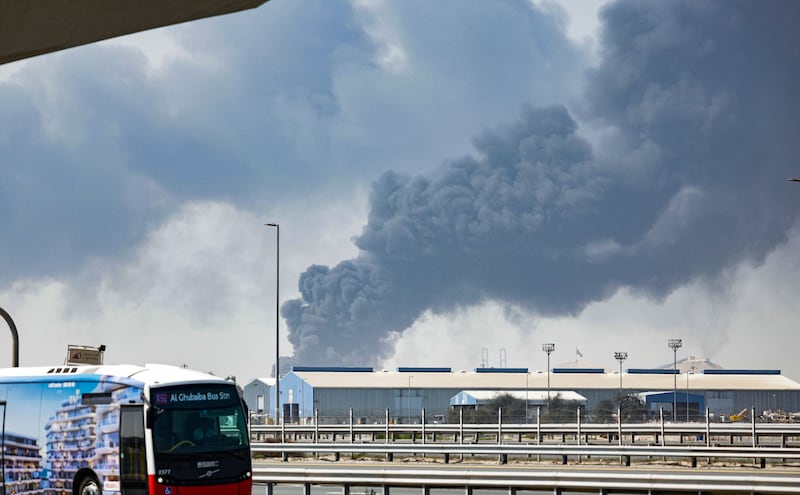
“We will prepare for the next 72 hours and we will see what happens, I’m hopeful that it wanes off, but every 25 minutes my phone receives a warning that more missiles are incoming.”
Siobhán, a Dublin woman who has been living in Dubai for 15 years, said people are “very anxious” in WhatsApp groups she communicates in.
Siobhán, who did not want to give her surname, said she had registered with the Irish embassy but didn’t have any intention to leave at present.
“We’re just sitting it out and hoping it’ll dissipate over the next week or so. We have a home here and everything,” Siobhán said, referring to her partner and one-year-old son.
“I was just at home yesterday and it started to get more serious on the news and we decided to go to the supermarket and get food. We wondered if we were being hyperbolic ... We weren’t stockpiling but just getting some things in case we’d be home the next few days,” she said.
“It started to get a bit scary last night, though, when we kept hearing all the blasts of the missiles being intercepted. Some of them were quite loud. They kind of went on the whole night then stopped and started again in the morning.”
The windows were shaking at her home, though she could “still tell they’re far away so there wasn’t imminent danger”.
“We’re just trying not to panic and trying to stay as calm as possible. There’s nothing else we can do,” she said.
Most companies have told their employees from home for the next few days and avoid travelling unnecessarily, and she intended to stay home for now.
McEntee confirmed on Sunday that, as far as the Government is aware, no Irish citizens have been injured in the bombing of Iran or the retaliatory strikes against other countries in the region. She said that there was a “very small number” of Irish citizens in Iran, many of whom have dual citizenship. McEntee said the embassy had contacted some Irish citizens last summer and offered them assistance to leave Iran, “so anybody who wanted to leave at that time has left.”
She said that she was asking all Irish citizens in the United Arab Emirates, Qatar and Kuwait to register with their Irish embassies “so that we have a complete picture of who is there”. McEntee said the Government is also engaging with airlines to understand how many Irish people would have been scheduled to travel to the region.
It is estimated that there are about 20,000 Irish people resident in the region, many of whom may be emigrants who are teaching and working in the UAE. Irish people living in the region are being advised to contact the Irish embassy in Dublin, as smaller embassy staff in the region may not able to answer as many calls from people with concerns.
Citizens with queries or concerns can continue to contact the Department of Foreign Affairs and Trade consular team in Dublin at +353 1 4082000. To register go online to https://citizensregistration.dfa.ie/
*The Irish Times is aware of Siobhán’s surname but have not published at her request
Are you Irish and living in the Middle East? Tell us your story using the form below or email abroad@irishtimes.com.