When Rory McIlroy teed off in Augusta the chances of him going on to win back-to-back Masters titles were slim.
The probability is that McIlroy, who shot a first-round score of 67 for five-under, won’t join the only three golfers – Jack Nicklaus (1965-66), Nick Faldo (1989-90) and Tiger Woods (2001-02) – who have achieved back-to-back wins since Horton Smith won the first event in 1934.
Last year’s first-time Masters win for McIlroy put him into an elite group of players – alongside Gene Sarazen, Ben Hogan, Gary Player, Nicklaus and Woods – who have won all four major championships.
A historic achievement, and psychologically McIlroy has turned the page on two life-defining moments: a first win in Augusta and a career Grand Slam.
READ MORE


“It’s not every day you get to fulfil one of your lifelong goals and dreams,” he told the PGA Tour in the build-up to this year’s tournament.
Those are now two motivators that are no longer available to McIlroy, accomplishments that have positioned him among the greatest players in the sport’s history, but off the table in terms of being emotional drivers for this year’s event.
Winning back-to-back championships will require a different skill set to clear a different set of obstacles, and unquestionably requires a psychological reset.
Coach Urban Meyer, in a college football podcast last year, explained how difficult it was to win back-to-back collegiate titles.
A team game is different from golf, but there are similar challenges around mental exhaustion, distractions, complacency and motivation.
Meyer described how his Florida team, after winning, were no longer like the prizefighter looking for a knockout punch but became more like a team in a defensive posture, protecting what they had.
“Joe Bannon [college coach] showed me a piece of paper from NHL, NBA, NCA ... all the major sports, how hard it is to repeat. It is low single digits if I remember, it’s like two per cent,” Meyer told Fox Sports.
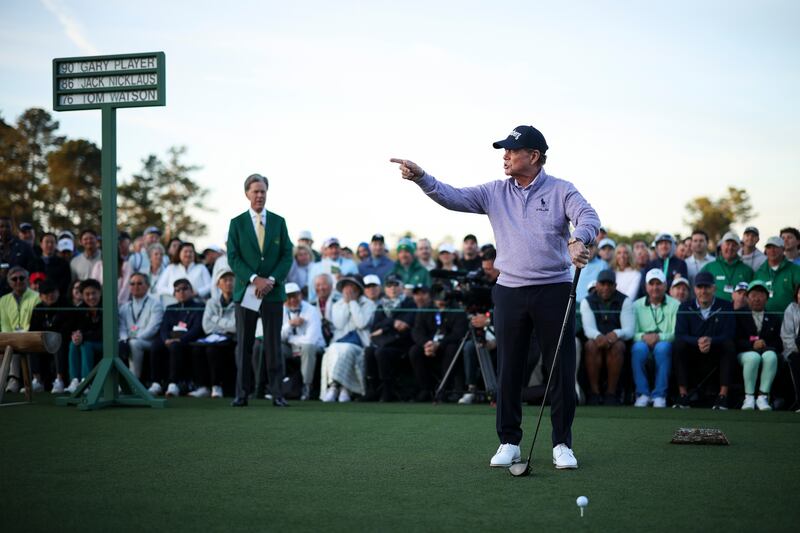
This week, two-time Masters winner Tom Watson explained to Irish Golfer magazine the erosion that takes place due to demands on time from media, sponsor commitments, the fans and Tuesday night’s champions’ dinner.
“Energy levels are fine, it’s taking you out of your routine,” said Watson of the noise around McIlroy. “Everybody is congratulating you and it lets you slip your mind to last year instead of this year. You bring up those emotions where the fans are yelling at you and asking for autographs, like at the par-3 tournament.
“You get your mind to wander away so it makes it very difficult to defend. It takes a strong person, and it takes a person who is mentally focused on the mental side of the week.”
[ The Masters: Five players that could be putting on the Green Jacket next SundayOpens in new window ]
In fairness to McIlroy, he has been talking like a fighter and this week spoke of how he benefited last year from showing aggression and attacking the course when he could.
“When I look back at the final round in particular last year, when I played aggressively, I was rewarded and I played well,” he said.
Psychologists may also talk about the heightened perception of last year’s champion sensing that the rest of the field have put a target on his back.

What they maybe don’t mention enough is luck, or sometimes the lack of it. Luck always insinuates its way into the journey of winning.
Jordan Spieth knows only too well how cruel it can be, especially when the difference in ability between the players is immeasurably small, as it is in the majors. The magnet on the fridge door will say that ability determines who can win, but luck decides actually who does win.
Having won the Masters Tournament in 2015, Spieth was well placed to back it up the following year. He led the event from the first round and had built a five-shot cushion going to the back nine on the final day. The 22-year-old then dropped six shots over three holes, including hitting two balls into Rae’s Creek for a quadruple bogey seven at the 12th hole and signed for a 73.
[ Masters 2026: Augusta’s 12th hole – the psychological test that humbles championsOpens in new window ]
From lording over Augusta, he finished joint second with Lee Westwood, three shots behind winner Danny Willett.
“After four birdies in a row to end the front nine, I knew that even par was good from there and sometimes that makes it hard,” said Spieth afterwards. “You put some bad shots in and all of a sudden I’m not leading any more.”

Last year McIlroy held a two-shot lead over Bryson DeChambeau going into the final round. He found a fairway bunker and three-putted for double bogey at the first hole before his aggression pulled him out of what could have been a downwards spiral.
He was challenged; he met the challenge.
But there is a reason why just three players, representing 3.37 per cent, have been able to successfully defend their titles over 89 Masters tournaments.
Holding a swing together 277 times, McIlroy’s combined four-round score last year before the play-off with England’s Justin Rose is tough even for the best.
A few bad swings over the four days and serious trouble creeps in. Then, as Spieth said after his miserable final round 10 years ago, suddenly you are not leading any more.