

By the beginning of 2006, Armagh and Tyrone had driven each other to a state of hysteria. Everyone belonging to them followed. On the last Sunday of January, they met in a McKenna Cup semi-final in Casement Park, a preseason match that ought to have been a sham. At that time, though, Armagh and Tyrone were incapable of fakeness. Their feelings for each other had no dial and no air conditioning.
“Through various head injuries and concussions, I have a hazy enough recollection of my playing days,” says Enda McGinley, the former Tyrone player, “but I still remember driving into Casement Park along the Falls Road and it was jammed. We were just back from our team holiday. You’re thinking, ‘What are these people at? We’re not really bothered about this.’
“But the sheer fact that there were so many people there meant the pride thing kicked in, so the game itself was played at a level just shy of an Ulster championship match. Then you’re thinking, ‘What are we at?’”
A crowd of 19,631 poured through the turnstiles. In the first 22 minutes, five players were booked. Tyrone won, which mattered only because everything mattered.
READ MORE


Around that time, it was the biggest game in football. Since the turn of the decade, they had met eight times in the championship, and by a process of compound interest, each game was bigger than the last. Along the way there was an All-Ireland final, an All-Ireland semi-final and an Ulster final that was staged in Croke Park because no Ulster venue could hold the crowd.
The Ulster final went to a replay which turned into a brutal and spiteful match. That was part of their relationship too.

“The more we met the more frazzled your head would be going into those games because it was quite claustrophobic,” says Oisín McConville, the former Armagh forward. “There was a genuine needle between the two teams. Familiarity was breeding contempt. I remember people saying to me, ‘I don’t care whether ye win the All-Ireland or not, just beat them.’
“Football is very sanitised now, but at that stage it was still pretty on the edge and sometimes maybe over the edge. You wouldn’t get away with it now. There were loads of hits that were out of order, but you pass no remarks on it and get on with it. I did a piece in my book about some of the verbals that were going on and probably some of them were over the top. But it was actually enjoyable to play in those games.”
All these feelings between Armagh and Tyrone were hard-wired and handed down, and every so often they would go up in flames. When they met in the Ulster quarter-final in 1989, John Lynch, the Tyrone cornerback, was knocked out at half-time in the corridor leading to the dressingrooms in Healy Park. Naturally, there was a free-for-all.
A few months later the teams met in a tournament game under floodlights in Castleblayney and after 20 minutes it descended into a massive brawl. The match was abandoned and the only reporter present agreed not to go to print with his report. Peter Canavan made his debut for Tyrone that night, marking his cousin. By his reckoning, 27 players traded blows.

“It wasn’t the scuffles that you’d see now, with fellas posturing and pushing and grabbing jerseys,” Canavan said to Declan Bogue years later. “These boys were taking lumps out of each other, settling scores from a few months earlier. It remains as ferocious a row as I have seen in football.”
McConville went to that game as a 13-year-old to watch his brother play for Armagh. “The ones that I remember were the Grimley twins [Armagh players],” McConville says, “because they were about 7ft 8in, or whatever size they were. There was a serious amount of flaking going on. For a young fella watching it, I wasn’t sure I wanted to be involved in this thing at all. I talk about the time I played, but you think before that, I mean, some of that was outlaw stuff.”
In the early years of this century, though, their rivalry took on a different dimension. Between 1999 and 2010 they shared 12 Ulster titles and for most of those years, one or both of them were All-Ireland contenders. They were swept in and out by the same tide.
“Tyrone got more out of us and we got more of out them,” says Steven McDonnell, the former Armagh forward.
“In 2002 we won our first ever National League,” says McGinley, “and we were thinking, ‘Right, we’re pushing, we’re ready for the big one.’ And then they [Armagh] won it straight in front of us. Us looking at them took away the illusion that this was some kind of big impossible step. It [winning the All-Ireland] suddenly became not just attainable, it was a case of: ‘we have to be winning it if they win it.’ In some way, they lowered the bar for us and made us go after it that bit harder.”
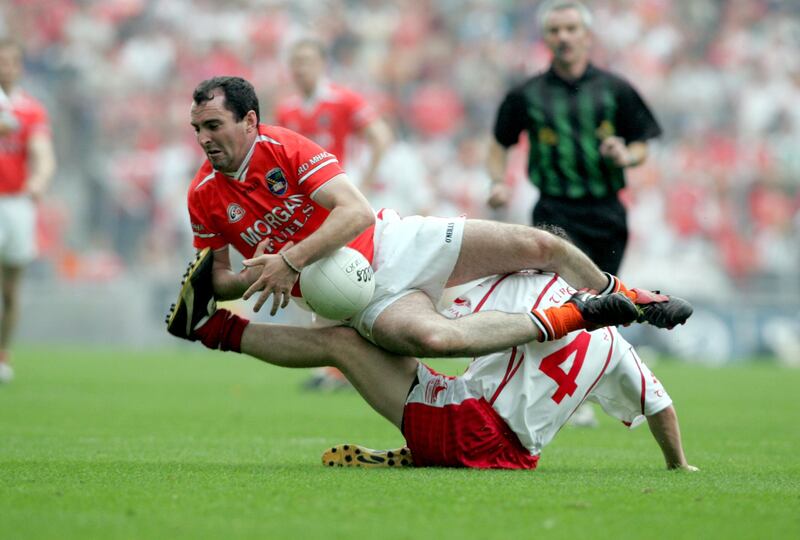
In an extraordinary sequence of events Armagh and Tyrone won their first All-Irelands one year apart: Armagh in 2002, Tyrone in 2003. In Tyrone’s breakthrough year, Armagh were their opponents in the final. It was an intoxicating concoction of the local and the national.
In the course of three seasons, they met four times in Croke Park; each time, the climate was tropical. “In those years, the games weren’t always pretty on the eye,” says Conor Gormley, the former Tyrone defender, “but it was just the ferocity and the intensity. If you got hit, you knew you were hit. Every ball mattered, every play mattered, every step you took mattered.”
“Those games were manic,” says McDonnell. “You knew you weren’t going to get a breath. At that time, I would say there was a hatred between the two teams, even though, off the field, you definitely had a level of respect for each other.”
The 2005 All-Ireland semi-final is still one of the best football games played in Croke Park this century. It was a glorious distillation of everything visceral and tribal and desperate in their relationship.
“As a player, the trilogy in ’05, [two Ulster finals and All-Ireland semi-final] were easily the most physical games I ever played in,” says Gormley, “not in a dirty sense but in the sheer heft of the collisions. There was zero personal safety. Anybody that plays sport, you want that moment when you were really challenged, where you were playing in something that was just massive. You were pushed to your limit, and you knew and all your team-mates knew how big it was.
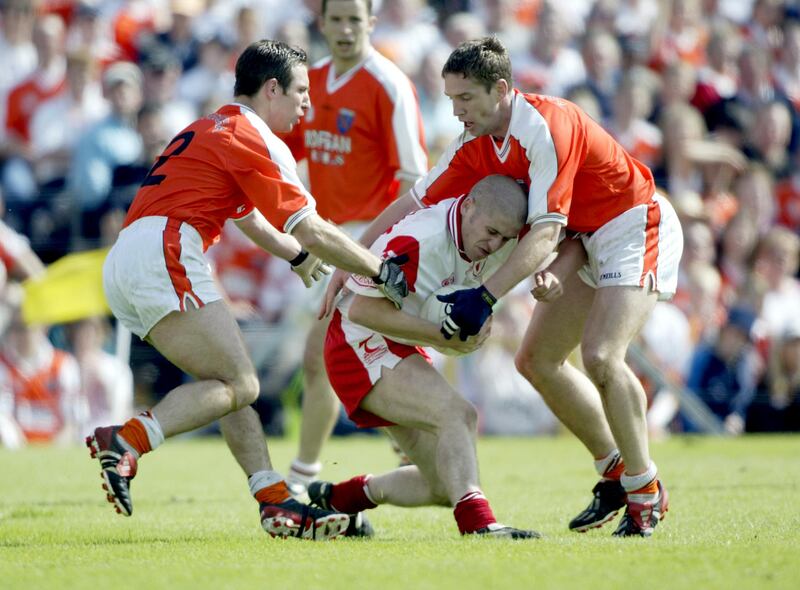
“Those games in Croke Park weren’t sell-outs, but there’s a pressure in the air down on the pitch when Croke Park is full and for those games the air had the same weight to it as a full house. You could see the supporters, and they were going through the wringer every bit as much as the players.”
A year earlier, they had been on course to meet in the All-Ireland semi-final too, until a convulsive day in Croke Park drove them apart: Armagh were ambushed by Fermanagh in the first All-Ireland quarter-final and Tyrone were upended by Mayo.
“Without a shadow of a doubt, both teams were looking at each other,” says McGinley. “You were prepared for the game you were playing, but that big part of the deep down psychology was preparing for the next big battle. It was lined up and suddenly, by the end of the day, neither of us were there. The obsession had reached its damaging point.”
The fierceness between them couldn’t like that indefinitely. Circumstances changed. In the All-Ireland race, both of them fell off the pace, and by the luck of the draw, they met just four times between 2006 and 2017.
And now? Both of them have won All-Irelands in the last five years, but Tyrone have been a basket case since last year’s All-Ireland semi-final and nobody gives them a chance in the Athletic Grounds this weekend.
“The rivalry has absolutely slackened off a bit,” says McGinley. “Tyrone have sort of faltered and not kept up their end of the bargain. It needs the two teams punching at the same level, right at the top, going for the same things and having those big, exceptionally meaningful games. But it would be easy to rekindle it.”
Those feelings never die.


