Think the Premier League is the only systematised and increasingly dehumanised competition returning this week?
Think again, because the second World Humanoid Robot Games are kicking off this weekend in Beijing. The Games do as they say on their brushed aluminium tin: they are a kind of Robot Olympics.
A total of 2,056 robots will compete across five days and 51 events, representing companies rather than countries.
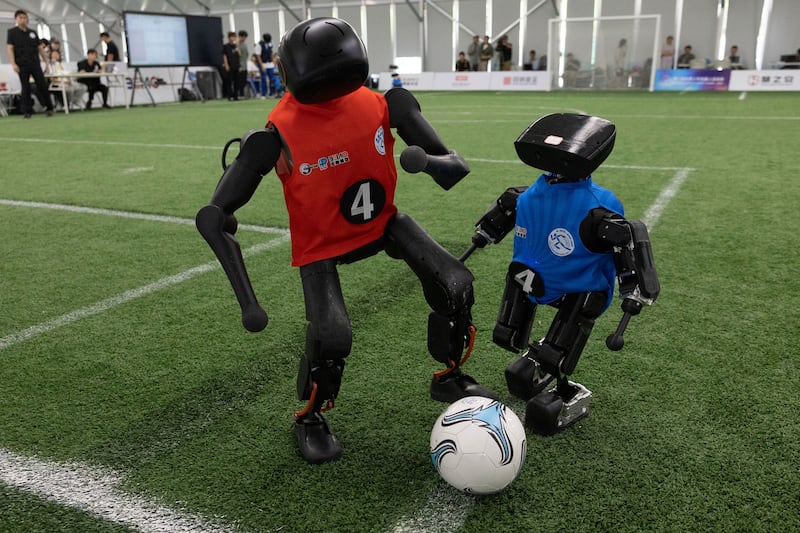
Thirty of these events are standard sports, including running, football, kickboxing, weightlifting, table tennis and tug of war. You may have seen clips from some of these events at least year’s inaugural Games. It is perhaps an insight into the unease of our species that the clips that went viral were those of the robots looking supremely uninspiring.
READ MORE


The football match looked like the All Priests Over-75s five-a-side competition played at 0.5x speed, as robots clumsily tripped over one another and needed to be put back on their feet by a bystanding human. Not a single robot looked sufficiently lithe to stake a claim as the team’s Fr Robo Sensini.
Elsewhere, a kickboxing robot fell over and jerked awkwardly on the ground after missing a roundhouse kick, while a running robot was a DNF in the 1,500m because its head flew off during the race.
That race was won by a robot in a time of 6:34.40, which is more than three minutes slower than the, er, human world record but regrettably a bit faster than this plodding column could cover the same distance. Hence why we like to focus on robotic failures.
Mark O’Connell has recently written on the grown-up section of these pages of how it is life-affirming to watch a humanoid robot malfunction, seeing it “as an antidote to the relentless propagandising of the tech world, with its insistence on AI as an inevitable replacement of human labour”.
This is true, but this column is not worried about robots replacing elite sportspeople. We may be incorrigibly old-fashioned in saying this, but the athletes’ human limits are what makes sport interesting. These limits give us all a shared context and understanding about every achievement, and sport is only interesting for the human virtues needed to overcome these limits. There is nothing interesting about a robot running the 100 metres in six seconds. If that’s the ambition, then why not give the robot four wheels and a combustion engine?
But the purpose of the Humanoid Robot Games is not to design a robot to replace Olympic athletes, but to showcase how they might replace the rest of us. These Games intend to exhibit the potential of robotics in a manner as some past editions of the Tour de France did for pharmacology.
Along with the 30 sports, there are another 21 scenario-based events, which are competitions made from quotidian human life. These include housekeeping, book sorting and office work. The latter tasks the robot with loading a printer, arranging meeting supplies, and operating a paper shredder within 20 minutes. (Anyone who has ever tried to work the office printer will realise this is the Games’ equivalent of an Ironman triathlon.)
There is also a kind of athletes’ village for the robots too, where up to 1,500 robots can be stored and 1,200 batteries can be charged at one time. Organisers say a specific robot can be summoned from this fleet in 30 seconds, supposedly showcasing how these humanoid robots are ready for mass commercialisation. Success in these Games is therefore not measured in medals but in prospective sales.
Beijing hosted last year’s Robot Games too, and the whole show exists to accentuate China’s position at the vanguard of our coming AI age, while declining superpower the United States distracts itself by hosting the lame and stale human Olympics.
There happily does not appear to be a sportswriting category for the robots this week, which is a merciful release from thoughts of imminent obsolescence for a columnist already struggling for self-esteem having recently written the words Fr Robo Sensini.
Not that we aren’t regularly stalked by these terrors. A Swedish broadcaster debuted an AI pundit on a live football broadcast last year, which was a digitally rendered human avatar that ventriloquised the stats and data fed to it while holding banal conversation with the presenter. You might say there are lots of human pundits already doing this, and you’d be right.
Still, unwittingly conniving in our own antiquation does not make said antiquation any less scary. This column often turns to the sober and throbbing mind of historian and intellectual Adam Tooze to explain the world, and on a recent episode of his podcast, he likened AI to an arms race whose forecasts would, if they come true, be the equivalent of “detonating a neutron bomb” on the global labour force. Great.
Everywhere we look nowadays we are seeing signs of the end of some long Age and augurs of a ruptured, uncertain future. Mayo have won the All-Ireland, for example.
So no, we won’t be watching the Humanoid Robot Games and we won’t be assuaged by viral clips of a couple of robots falling over, because we know the terrifying vision of our future is not one in which we watch robots for sport. It’s one in which the robots are watching us for sport.
gavin.cooney@irishtimes.com