
Dublin’s ever-changing skyline can take you by surprise sometimes, even when you think you’re familiar with it.
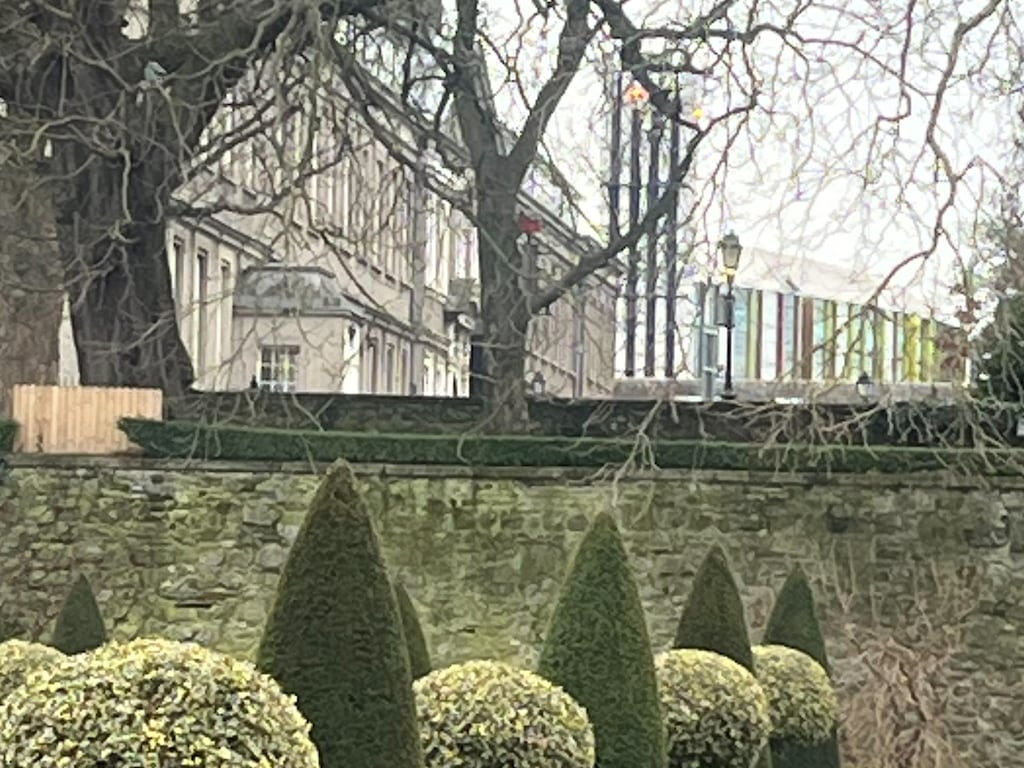
So it was in the grounds of the Royal Hospital Kilmainham recently when, walking around the walled Italianate garden for the first time in a while, I was taken aback to see a new hospital looming over the shoulder of the old one.
It was, of course, the national children’s hospital, construction of which I’ve been watching from different angles for 10 years now.
But, somehow, I hadn’t expected it to be so visible in the Royal Hospital‘s sunken garden and seemingly so close that they appeared to be part of the same campus.
READ MORE



Indeed, as I knew, there were two roads and a river (the Camac) in the valley between. Yet, for better or worse, the opposing hills on which the new and old hospitals sit have long afforded intimate views of each other.
This was intensely the case during Easter week 1916 when the South Dublin Union – near where the children’s hospital now is – was a rebel garrison and suffered heavy fire from a machine gun on the roof (or by some accounts in a gate lodge) of the Royal Hospital Kilmainham.
The new children’s hospital is under fire of a different kind these days, because of cost overruns and inordinate delays. But, as the history of the Royal Hospital (the subject of a miniature museum in the old courtyard) suggests, public projects of this kind are rarely without problems.
The Royal Hospital Kilmainham was built as a home for old or wounded soldiers at a time – the Stuart Restoration period from 1660 onwards – of relative peace, when the British army in general was growing old and in danger, like all old soldiers, of fading away.
Following the French example of Les Invalides, the government sought simultaneously to house broken-down veterans while impressing potential recruits with the treatment they could look forward to, if necessary.
That the hospital in Dublin – a smaller version of the Parisian model – was started before a similar one in Chelsea hints at the historic over-representation of Irish soldiers in English wars.
But, having been completed in an impressive four years from 1680, the project was financially strapped by the time it opened.
It had been financed by a levy of sixpence in the pound on army wages. The first master, Colonel John Jeffreys, nevertheless had to petition King James II to help cover such overheads as his £300-a-year salary.
Inmates were scarce, too, at the start: only 20 in a facility built for 400. But history was about to change that, especially the Battle of the Boyne, which soon contributed generously to the hospital’s need for injured soldiers, albeit only from the winning side.
The Royal Hospital Kilmainham’s architect – William Robinson in his role as Surveyor General for Ireland – is today credited with having created a masterpiece of 17th-century design.
Yet he, too, faced criticisms about cost, or, to be more exact, according to the Dictionary of Irish Biography, “he was later accused of embezzling funds from the construction”.
In a subsequent role as commissioner for army accounts, he was also accused of fraud. When MP for Trinity College, he narrowly avoided expulsion from parliament and spent a brief period incarcerated in Dublin Castle while under investigation.
Still, his hospital stands serenely today, long shorn of its original purpose but now home instead to a collection of abstract sculptures and art installations.
In a hint of its former role, the building today also provides the occasion backdrop to concerts by ageing or broken-down veterans of the rock music industry, including the late Leonard Cohen and more recently – cavorting around the stage with a limp any old soldier would be proud of – Iggy Pop.
Even before the new children’s hospital appeared in its southern horizons, the Royal Hospital Kilmainham was a place replete with historical and architectural drama.
Just across the road from its western entrance is Kilmainham Gaol: once another arm of British rule in Ireland, now a shrine to republican history. That used to be known jocosely as the “Kilmainham Hotel” by inmates. Today, thanks to the humorous Hilton group, an actual hotel stands opposite.
The gaol too is now a museum. And I see from its exhibits that when the prison was built it replaced an older jail at Mount Brown, near where the new children’s hospital now stands.
Ironically, that jail had been condemned by a 1782 parliamentary report for its unhealthy location and conditions, which included over-proximity to the population at large.
Inmates could converse freely with acquaintances in the street outside and even procure “instruments to assist escape”. Not only that, but “spirits and all sorts of liquors were … served to the prisoners who were in a continual state of intoxication”.


