
Fitness for purpose, that’s what it comes down to. Whether a thing – anything, but usually in my head, a car – is actually good at doing what it’s supposed to do. Form should follow function, but equally, function should have defined what form was supposed to be long before the two ever got together.
So it follows that a sports car should be fast and fun; a small hatchback should be wieldy and frugal; a family car should be reliable and roomy; a luxury car should be like a Rolls-Royce.
An SUV, though? Well, that’s where it gets a little trickier. SUVs grew out of off-roaders and 4x4s – the original Land Rover and Land Cruiser, the Willys MB “Jeep” and so on – but they’re usually not what they purport to be.
SUVs try to ape the style of these originals, their height and bulk giving them the appearance of vehicles capable of crossing the Gobi while carrying all necessary supplies, but all too often it’s a sham. SUVs are usually just family hatchbacks wearing Simon Cowell lift shoes and frequently have less cabin and boot space, yet worse fuel economy, than a lower-slung equivalent. Which is why I normally hate them.
READ MORE


The Dacia Bigster, though? That’s a different kind of SUV, one that lives up to being what it’s supposed to be, and is hugely affordable at the same time, undercutting most of its competition by as much as €10,000. For that, I love it.
Now, Dacia has made the Bigster even better, at least as far as I’m concerned. It was already a genuinely rugged car off-road, thanks to the petrol-engined, manual-gearbox’s 4x4 model, but now Dacia has made a Bigster that’s even more capable when the going gets slippery – the Bigster Hybrid 150 4x4.
This is not, surprisingly, based on the existing front-wheel drive Bigster Hybrid 155, with its 1.8-litre engine and fiendishly complex automatic gearbox. Instead, Dacia has taken the standard model’s 1.2-litre three-cylinder turbo engine, and bolted a six-speed dual-clutch automatic gearbox to the back of it (well, actually the side of it). Instead of running lengthy, heavy propshafts down to the rear wheels, there’s a 22.9kW electric motor in the back axle, complete with its own two-speed gearbox, and a 0.84kWh battery to power it.
It’s an unusual layout, but an effective one. Performance on tarmac is fairly leisurely, although it’s adequate. It is noisy – that 1.2-litre engine grumbles and growls like an elderly relative presented with TikTok for the first time when you ask for full power – but the noise goes away at motorway speeds. Meanwhile, the cabin has plenty of cheap plastics, but it’s comfy, spectacularly roomy, and the boot – although slightly smaller thanks to the hybrid gubbins – is more than useful.
[ Dacia’s hybrid Bigster might just be Ireland’s best car right nowOpens in new window ]
It’s even surprisingly fun. The steering wouldn’t even be able to find “sporty” in the dictionary, but the Bigster’s combo of soft springs and – by SUV standards – light weight means that it’s actually quite enjoyable in bends, flowing with a gentle touch from corner to corner.

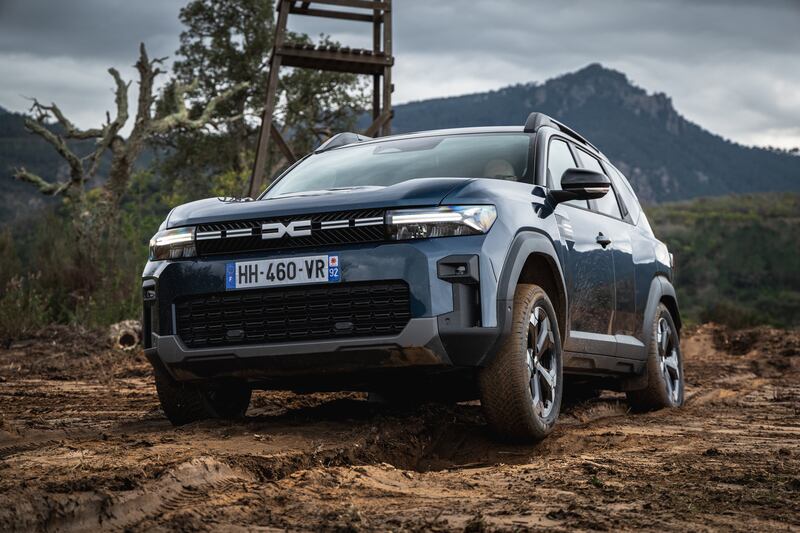
Where the Bigster Hybrid 4x4 is really good is when you leave tarmac in the rear view mirror. Most SUVs wilt at the sight of mud, but the Bigster has a dial which allows you to summon a specialist Mud/Sand mode. Thusly set up, it slithers and slides through slime with enthusiasm. The torque of the rear electric motor – thanks to the low first gear of that two-speed gearbox – means that you can pounce up steep slopes, and the Bigster coped easily with a small river swollen by recent rains to a bigger surge. In other words, it feels like an old-school Land Rover Defender to drive. Cheap cabin, seriously capable, big-hearted.
The real cheat code is in the hybrid set-up, though. Normally, adding four-wheel drive pushes up the CO2 emissions and the fuel consumption to the point where most consumers just don’t see the point. Not here.
Okay, so it’s not as super-frugal as the front-drive hybrid version, which easily averaged 5.3 litres per 100km when I drove it. However, while on the road en route to the off-road section, my Bigster Hybrid 4x4 test car averaged 5.6 litres per 100km, and even with the off-road section completed, it was still returning 6.4 litres per 100km. Impressive.
The real bonus is how cheap it all is, or at least is likely to be. The regular Bigster has a price tag of less than €30,000 in its most basic form. This hybrid 4x4 is likely to slip below the €40,000 barrier when it arrives in Ireland in the second half of the year. As Dacia promises, that’s about €10,000 less than any comparable rival, and all you have to do is put up with some cheap plastics. Well, that and the somewhat poor Euro NCAP three-star safety rating.
On the upside, the Bigster has one simple physical button that turns off the annoying electronic nannies, and the amount of physical controls – as opposed to touchscreen icons – shows Dacia takes some aspects of in-car safety rather more seriously than others who claim shinier safety scores, but who are utterly dependent on their distracting screens to function.


You can, of course, go cheaper. The same Hybrid 4x4 system is also available in the smaller, stylistically similar Duster, which will be cheaper to buy. The Duster, thanks to being slightly smaller and lighter, feels a touch sportier on the road, and is hardly less capable off it, but it also feels a bit less refined, and anyone sitting in the dark and slightly claustrophobic back seats will definitely wish you’d bought the bigger, airier Bigster.
So, yes, I’m actually recommending a chunky, mid-size SUV. The horror. Well, not really horrifying at all. I’m not really anti-SUV, I’m just anti cars that are not really fit for purpose. It’s why I love the Mazda MX-5. The VW Golf. The BMW 5 Series. And now, the Dacia Bigster Hybrid 4x4.


