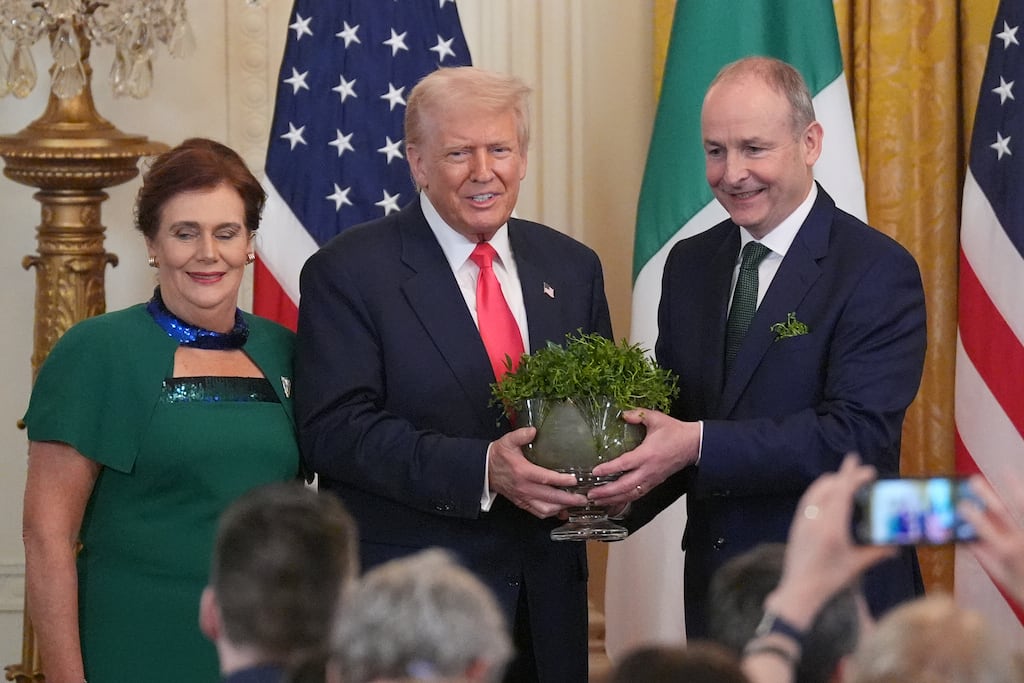
Over the next week, Irish media coverage will ramp up in advance of Micheál Martin’s trip to Washington, DC for St Patrick’s Day.
There will be speculation about whether the Taoiseach can emerge unscathed from his second Oval Office encounter with Donald Trump, along with the customary reminder that the whole green-tinted extravaganza is a soft-power opportunity that other countries can only envy.
That opportunity exists because of the historic connection between Ireland and its diaspora in the United States. What will be less remarked upon is how that relationship is changing, and how much of what each side now knows about the other is mediated through wildly divergent information ecosystems.
The claim that almost 40 million US citizens are of Irish ethnicity was always an overreach; only a small fraction of that number have any real sense of connection with their supposed mother country. And that fraction is shrinking. Three decades on from the last wave of Irish immigration, the proportion of Irish-born people in the US is at a historic low.
READ MORE


Fewer Irish people have siblings or adult children there. Fewer families have the routine back-and-forth that once kept the two societies in touch with each other. In the absence of those direct ties, two very different media worlds have filled the gap.
Liam Kennedy, director of UCD’s Clinton Institute for American Studies, has spent years mapping this territory. His academic essay How white Americans became Irish traces how Irishness, as it has detached from any lived ethnic habitus, has become what he calls a “floating signifier” of white identity in the US, claimed from sharply opposing political directions.
For progressive younger Irish Americans, Irishness offers an attractively anti-imperialist, postcolonial colouring that can differentiate their whiteness from a generic American blandness. For their more conservative counterparts, the same inheritance from famine and colonial oppression has been repurposed as a narrative of grievance, a claim to victimhood that can coexist quite comfortably with positions of privilege.
This bifurcation has obvious consequences for what the diaspora sees when it looks at Ireland, and what it sends back in return. In a recent Irish Times article, Kennedy describes how Steve Bannon’s aspiration to create an “Irish Trump”, represents a particular strand of Irish in the US that has shifted significantly towards Trumpian republicanism.
Bannon’s interest in Ireland reflects what Kennedy describes as the “dystopian, Maga view” of the country: godless, woke, overrun by immigrants, its revolutionary past betrayed by a liberal establishment. Kennedy’s surveys of Irish Americans show that this view is strikingly common on the right, matched on the left by an equally skewed portrait of Ireland as a progressive social-democratic paradise that the US has inexplicably failed to become.
Neither portrait bears much resemblance to the actual country, which is perhaps the point. Ireland has become a Rorschach test for American partisan anxieties. The diaspora now consumes Ireland largely as a media product, and media products are pretty good at confirming what their customers want to believe.

The modern face of Irish America
Meanwhile, Irish audiences follow American politics more closely than ever, but they increasingly do so largely through a particular slice of the US media ecosystem. It is common to hear Irish radio panellists or opinion columnists casually reference essays from The Atlantic or Ezra Klein’s New York Times podcast as if these were shared points of reference (full disclosure: I read Atlantic articles and listen to Ezra Klein).
The deeper point is that Irish audiences now absorb US politics through institutions embedded in a specific American political culture: urban, liberal and overwhelmingly critical of Trump-era republicanism. That is not the perspective that dominates in most places where Irish Americans live.
The circuit between these two media worlds is not always passive. American online networks have been accused of amplifying and directing the Dublin riots of November 2023, providing both a template and an accelerant for disorder on the streets of an Irish city.
The language of American nativist grievance travels with remarkable efficiency online, even when the political institutions it was designed to address simply do not exist here. You could see some of this in the widespread confusion on X last year over how Irish presidential elections, or indeed Irish Government formation, actually work.
The peace process diplomacy that once gave Irish the US a clear, broadly liberal political focus has now largely run its course. The recent US decision to end funding to the International Fund for Ireland ends a long chapter of American governmental engagement in Northern Ireland. The institutional infrastructure that once connected Irish and American political elites along recognisable lines is ageing out and quietly dismantling itself.
What replaces it is still taking shape, which is what makes the present moment so difficult to read. Bannon’s Irish project may well come to nothing, or it may not. Kennedy’s surveys suggest the majority of Americans who identify as Irish remain relatively liberal.
But the media architecture through which Ireland and Irish the US perceive each other is changing fast, and on present evidence it is producing mutual misrecognition on a considerable scale.
The symbolic presentation of the shamrock will go ahead as it always does next week. What that symbolism now represents is considerably harder to say.
Listen to Hugh Linehan’s interview with Liam Kennedy on The Irish Times Inside Politics podcast