

Playwright Colin Murphy is not the first member of his family I’ve interviewed in depth. I spoke at length 18 months ago to his brother Eoghan, the former Fine Gael TD and minister for housing, about his raw, unyielding and remarkable book about his experience and failures as a politician, Running From Office.
Murphy’s other brother Cillian, aka Killian Scott, is a renowned actor with an impressive list of credits. He kickstarted his career as Tommy in Stuart Carolan’s Love/Hate.
I joke with Murphy that he’s the second part of a Murphy trilogy I’m working on, maybe not the most famous, but maybe the most creative.
In a way, Murphy’s work is a synthesis of that of his two younger brothers, in that it combines politics and creativity. All of his writing is grounded in public life, in the main the dramatisations of political events, and featuring real-life characters, many of them still very much alive.
READ MORE


His first major play, Guaranteed, was a dramatisation of the events around the bank guarantee in 2008. He followed it up with Bailed Out, a play revolving around the Troika that came to Ireland’s aid (the European Commission, European Central Bank and International Monetary Fund). Since then there have been dramatisations of the 1921 Treaty, the scenes inside the GPO during the 1916 Rising, and Haughey/Gregory, a play about the famous deal struck between the then Fianna Fáil leader and Independent TD in 1982.
There are notable “political” plays in the Irish canon, plays that take place against the background of historic change. Seán O’Casey’s plays, Freedom of the City and Translations by Brian Friel – even The White House by Tom Murphy are examples. But none are as directly political as Murphy’s, and he describes himself bluntly as a political playwright.
Murphy’s work could be compared to that of English playwright David Hare. He makes no bones about that. “I’d written about David Hare, and I’d interviewed him and I’d written theatre columns saying, ‘Why don’t we have an Irish David Hare?’
“I have ideas as to why we didn’t, you could sort of call it post-colonialism. Hare’s work relied on the idea that there is something glamorous about politics. And I think in this country, we’re very averse to that. Also, our politics is very local. People don’t get overawed if the Taoiseach passes in the street.”
‘A group of men locked in a room overnight trying to solve a life-or-death problem. It sounded like a play. I assumed someone would soon write it. But nobody did’
— Colin Murphy on conceiving his play Guaranteed
We have arranged to meet at the Long Room of Trinity College Dublin, where Murphy is the Rooney Writer in Residence. I come across him sitting on a wall in strong April sunlight outside.
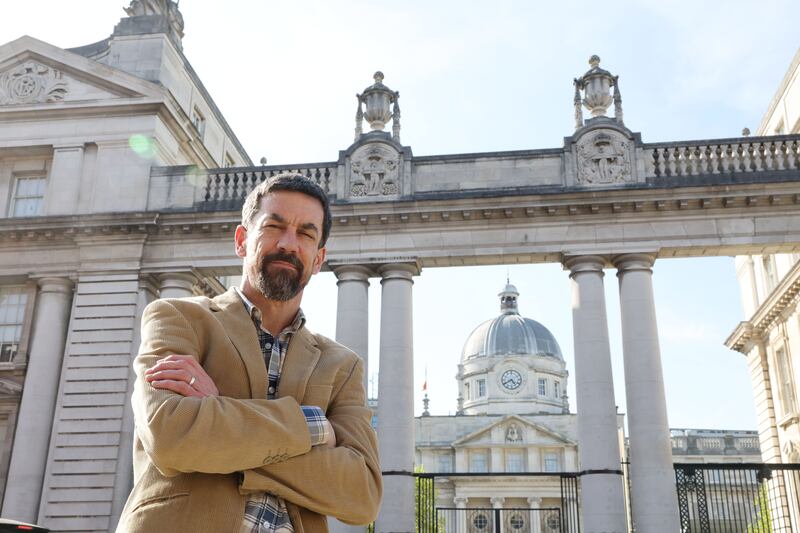
Like his brothers, he is tall with dark cropped hair, sallow skin and a gaunt handsomeness. The cavalier beard makes him look like a figure from a 17th-century Caravaggio painting.
Murphy is from a well-known Dublin family. His grandfather Russell was an accountant who acquired notoriety after his death in 1986, when it was discovered he had embezzled money from clients, including broadcaster Gay Byrne. His father, Henry, was a prominent barrister for 40 years and also wrote novels and short stories, while his mother, Mary, was a keen amateur actor as a young woman.
Murphy is the eldest of six children: the next is his sister, Jenny: and then are four younger brothers: Stephen, Declan, Eoghan and Cillian. They are very close. The family circumstances were comfortable, all went to private schools, but Murphy says there was a huge openness to them doing what they wanted to do. When Murphy was involved in DramSoc, a college drama society, the puppeteer Eugene Lambert came in to give a talk and told the students he had 10 children, none of whom ever had a real job, and it was wonderful.
Reflecting on that, Murphy says it was the same for his family: “My parents never put any pressure on us to follow a conventional path. It facilitated that kind of creativity. I guess Eoghan had that split that I have. You follow the politics route, and it went very well until it didn’t. I think we will see more writing from him.”
So politics and theatre were always in the mix for Murphy. He graduated from UCD with a degree in politics, but his real passion was drama.
“I spent almost all my time putting on plays in the bowels of UCD with DramSoc,” he recalls. “If you’d asked me then what I really wanted to do, I would have said theatre.”
His 20s were “pretty peripatetic”. He taught English in Madrid for a while, but needed something more: “I realised I wasn’t going to get the kind of… edgier cultural experience I was looking for.”
He ended up working in Angola in southwest Africa with the aid agency Concern Worldwide. He arrived just as the former Portuguese colony was pivoting: “It turned out to be the very end of the civil war.” He worked in logistics delivery and helped deliver primary healthcare in devastated regions, spending much of his time in Kuito, a city that had been destroyed during a prolonged siege that happened largely away from the media radar.
He had going out with Ruth Hegarty since college. After two years in Angola, he did a master’s in South Africa, trying to figure out whether he could find a career path there that might work out and also persuade her to move to Johannesburg. But on his visit home to Ireland, he got a call out of the blue from a person he knew in RTÉ who asked him would he be interested in being a researcher for new radio show.
So he stayed home. He and Ruth married only last October after many years together. They have three teenage children, the eldest of whom is doing the Leaving Cert this year.
As it happened, the presenter of the radio programme was Vincent Browne, the mercurial journalist and broadcaster. When Browne later established Village magazine, Murphy moved with him and found a group of friends, including Malachy Browne, who works for the New York Times and is Vincent’s nephew, and with whom he remains close.
“Vincent was a huge mentor. He is always there on my shoulder when I’m writing.”
Murphy continued working as a freelance writer until the late 2000s. He had tinkered with drama, having written a script while in Angola, but the daily writing demands dominated.
Yet he could see the dramatic potential of so many political events. He writes in the introduction to his new book of the bank guarantee in 2008: “A group of men locked in a room overnight trying to solve a life-or-death problem. It sounded like a play. I assumed someone would soon write it. But nobody did.”
At this stage, Murphy took a bit of a detour, taking on a job in 2011 as an adviser to Steven Donnelly, the newly Independent elected TD for Wicklow (later Fianna Fáil minister for health). They had been in college together.
And then another of those turning moments: Fishamble theatre company put out a call for writers to create “tiny plays” of just 600 words.
“I thought, 600 words… if I can find an idea, I can write that in two hours.“
He returned to that single dramatic moment – the Irish bank guarantee during the financial crisis.
The resulting short piece imagined the decision as a coin toss. Murphy sensed the audience responded to it strongly when it was performed live.
He believed he could develop something bigger, and got Fishamble to agree to commission a play. He undertook the project like an investigative political journalist, with extensive research and interviews. The result was his first full-length play, Guaranteed, which premiered in 2013. it was an immediate success. He had found his metier somewhere between politics and drama.
‘The key for any play is that there is a character going on a journey which will change their world, externally and internally. They’re going to have a crisis on the way’
He is conscious that he is often writing about real people.
“I think all the plays walk this fine line between fact and fiction, or journalistic, verifiable fact and imagination. If they didn’t, they couldn’t be drama.”
There were personal sensitivities involved, along with the responsibility of writing about real people. “I was in a taxi driving out to Ballymount [for a TV3 version of Bailed Out] and the driver said, ‘I had Brian Lenihan’s daughter in the car earlier.’ And that just really brought it home to me.”
As he developed as a playwright, he began to seek to write about things that might turn on micro, rather than macro, moments. So while the subsequent plays remained about public and political events – the 1916 Rising, the Treaty, and Haughey/Gregory – the drama is more subtle.
“The five plays in the book are about moments of decision, key events. A decision is made to take over the GPO, but the fulcrum of the play is the decision to evacuate or not. In other words, do we give up, or do we fight?
“And in Treaty, it’s obvious what the decision is, but the key for any play is that there is a character going on a journey which will change their world, externally and internally. They’re going to have a crisis on the way.”
It’s still hard graft. Writing plays he describes as “ephemeral”, and a tough way to earn a living. He supplements it with other journalistic work, including a weekly column in The Sunday Independent. In recent years, he has broadened the focus and locale of his plays beyond Ireland. They are still about public events and issues, but not quite as political.
Miasma, currently touring, was inspired by Murphy’s obsession with the idea of contagion during Covid. He brought the play back almost two centuries to the cholera epidemic in Victorian London and the work of physician John Snow, who proved that cholera was not spread by bad air (“miasma”) but by contaminated water. The style of the play would be familiar to Murphy audiences, although the subject matter is a departure.
Similarly, his play The United States vs Ulysses, is set in New York and features the celebrated 1933 case which tried to lift the ban in America, which had classified James Joyce’s masterpiece as obscene.
He is candid about the impossibility of making a living solely from being a playwright in Ireland. “I’m sometimes a bit exhausted by the small scale of our reach here.
“We got a five-week run in New York. There was a payoff there. I’m more actively pursuing that, that longer life and the bigger reach of plays.”
Alongside theatre, Murphy continues to engage with screenwriting and journalism, though he acknowledges the difficulties of the film and television industry. “The advantage of theatre… is I know how to get a play off the ground,” he says. Film projects, by contrast, often stall, despite significant effort.
Looking ahead, he says he always has a few irons in the fire.
“There’s juggling a few things, which is the nature of the piece. I asked [the TV writer and director] Stuart Carolan about that once when I was interviewing him, and he said: ‘You always need six projects on the go’. So for me now, I have more than six, and they’re all at different stages.”
Specifically, he is working on a new play about Edward Carson, focusing on the years leading up to the first World War and the threat of conflict in Ireland.
Somebody challenged him recently by asking what was the point of theatre? He wraps our interview by making his pitch for it: “It’s the absolute opposite of the fragmentation and outrage fostered by online platforms. You bring a group of strangers together… with no devices… and if these things are engines of outrage, [theatre] is an engine of empathy.”
Colin Murphy’s Political Plays: 100 Years of Irish History is published by Methuen Drama/Bloomsbury


