
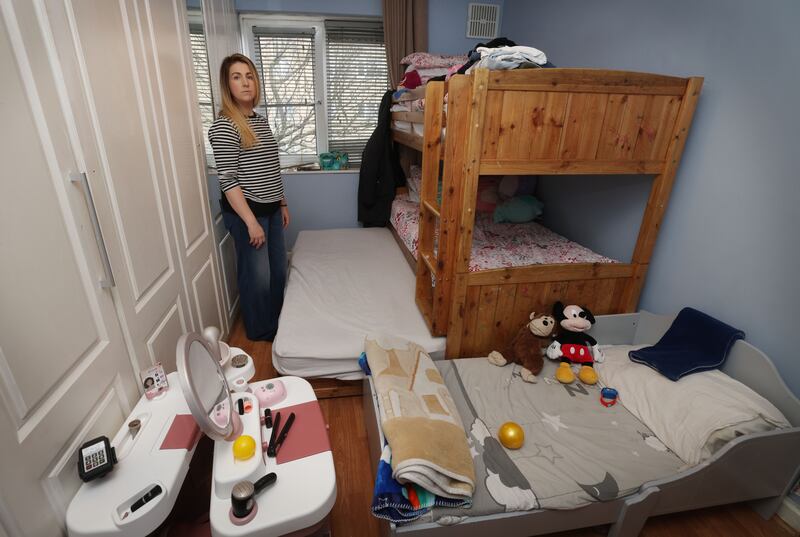
Joanne Lawless shares her two-bedroom apartment with six other people – her husband and five of her six children, aged 19 months to 14.
Their Dublin city-centre home fails numerous minimum housing standards. Black mould is visible around walls, ceilings, and window sills. Damp is causing paint to peel and crack.
“I am always washing the mould with bleach so the kids are not breathing it in. I keep doing it but it keeps coming back.”
The apartment is 43sq m – far below the minimum standard of 73sq m for a two-bed home. Four children, including girls and a boy, share one bedroom. A fold-out table, used for homework and meals, seats four, meaning meals are also eaten from laps.
READ MORE


Space is so tight that shoes are kept outside on a garden storage bench on the balcony. Rodent droppings can be seen around the shoes. “The place is full of rats,” says Lawless.
Neighbour Eileen Nalty, a youth worker, shows a video on her phone of two rats scurrying under a car. She tells how the vermin are making nests in residents’ car engines, damaging them.
Tenants here report persistent problems – mould, damp, and sewage backwash, and more recently an infestation of rats – to their landlord.
“They just tell us to clean the mould, and to report the rats to the HSE. The HSE tell us to report it to [the landlord],” says Lawless. “The whole situation we’re in – the overcrowding, the mould and damp; everything – it’s very mentally draining, especially on the children.”
“We pay our rent. We keep our home best as we can. We are good tenants, but with the stress, we are just about holding it together.”
Those people sitting in the department – they don’t live here. They don’t understand it what it is to live in these conditions
— Neil Maloney
Theirs is the biggest landlord in the State – Dublin City Council. The local authority lets homes to 68,000 households in 26,000 dwellings. About 2,500 of these are flats, of which 345 are in Pearse House, where Lawless’s family lives. Her husband is a secondary-school teacher in a private school.
The 11-block Pearse House in the south inner-city was built between 1936 and 1938. Designed by renowned city architect Herbert Simms, it is a protected structure.
Like more than 100 other old flats complexes across the city, it is acknowledged by the council as unfit for modern living. Regeneration or retrofit has been sought over many years.
Hopes were boosted in 2017 by a ruling from the Strasbourg-based European Committee of Social Rights (ECSR), that the human rights of tens of thousands of local authority tenants across the State were being violated by inadequate, unsafe housing.
Then head of housing at Dublin City Council, Brendan Kenny, put in train plans to either demolish and rebuild, or retrofit the worst council estates, including Pearse House. While some remain on the agenda, none is completed.
Plans for Pearse House include ongoing consultations with tenants. In 2020 a plan to amalgamate flats to make bigger homes, but reducing the number of units to between 215 and 275 units, was accepted by residents.

In its quarterly Housing Delivery Report, in July 2022, Dublin City Council said it had approval from the Department of Housing for phase one, for a “full deep retrofit and amalgamation” of 75 flats into about 45. It anticipated “decanting” tenants to allow access to the flats in 2022, and completion in 2025.
With no progress since, and completion date pushed back to 2028 in later reports, news came last summer that the department would not fund regeneration that resulted in fewer units.
“It was sickening,” says Neil Maloney, a union worker and chairman of the Pearse House Residents Association. “People here thought there was a roadmap. Those people sitting in the department – they don’t live here. They don’t understand it what it is to live in these conditions.”
A Dublin City Council spokesman said a revised “funding and project application” for the regeneration of four blocks in Pearse House was submitted to the Department of Housing in early December 2025.
Dublin City Council was “awaiting a response” and in the meantime was “progressing design development”.
In recent days The Irish Times has visited six local authority estates – five in the Dublin City Council area and one in the South Dublin County Council area, facing similar, ongoing problems.
Local authority tenants are excluded from the protections of the Residential Tenancies Board, so cannot hold their landlord to account for its failings at an independent body. They can only bring complaints to their landlord, or failing that, the Ombudsman.
In the north inner-city, retail worker Syed Kahn, his wife and two young children, have lived in Ballybough House for three years. The Simms-designed estate of 111 flats was built in 1938.
Kahn shows black mould extending a metre up their hall walls, and in their tiny shower-room. “It is so stressful. I try to clean everything but it will be mould again in a few days,” he says.
He has bought dehumidifiers and electric heaters. Still, damp marks are visible throughout the flat which is very cold despite heating having been on “for three hours”.
In one bedroom heating barely functions at all. Kahn sleeps there alone as it is “too cold for the children”.

A young mother who did not want to be named shows black mould “like cotton wool” around door frames and windows. “My daughter is on inhalers and the baby’s breathing is bad as well. He’s only 14 months.
“It makes you feel horrible. It is affecting our health day in and day out. I have complained to the council but I am not getting anywhere.”
Her hall floor is wet daily she says. “Every morning I wake to this dampness at the front door. Our home is destroyed.” Looking over at the river running along the flats’ boundary wall and swollen after heavy rain, she says: “It honestly feels like the flats are sinking into the Tolka.”
In February 2020 Dublin City Council set out plans to “deep retrofit” Ballybough House, amalgamating small flats to create more spacious homes.
In a pilot it knocked two existing flats to create a larger home. Internal walls were lined with moisture-resistant Cork-based lime plaster, old windows were replaced with triple glazing and heat-pump heating installed.
Residents who viewed it said it gave them “deserved hope”. In March 2022 the council reported the cost was €270,000, considerably less than a new build.
Ballybough House has not featured on the council’s list of planned regeneration projects since. Dublin City Council did not respond to queries on Ballybough House.
Back on the southside, Oliver Bond House is the largest complex awaiting regeneration. Located between the Liberties and the Liffey it comprises 397 flats in 16 blocks, and three houses (built originally for caretakers). Simms-designed, they were built in 1936.

Carly Wosser, a sales assistant, lives in a 43sq m, two-bedroom flat with her husband and teenage daughter, paying €400 a month.
Black mould up the walls and across the bathroom ceiling “really depresses” her. “I have the window open all day, but not at night. In the morning you can really smell it.
“I chose the dark grey paint for the walls and ceiling to try and hide the mould ... No matter what you do it comes back.”
There are patches in the bedrooms too. “My daughter has asthma. The mould is not helping.”

A 2021 survey by local Robert Emmet Community Development Project (CDP) found 82 per cent of residents had problems with mould and damp, 73 per cent had draughts and heating issues and more than a third had problems with rats and water ingress.
A 2024 study, from the same CDP and Trinity College, found 18 per cent of Oliver Bond residents had a diagnosis of asthma compared with 8 per cent of people in the wider locality.
Joseph Little, head of building performance and construction at TU Dublin, as part of the 2021 report examined the structure at the flats. Among issues he identified was that gypsum in internal plastering was “food for mould” which could become “impregnated” in the walls.
Like Pearse House, tenants here have been promised regeneration for many years, with exhaustive consultations with the council.
“At this stage residents here don’t believe it’s happening,” says Gayle Cullen, a youth justice worker and chairwoman of the residents’ group. “People are losing trust in the process. The false promises are destroying the community.”
Like tenants in other estates, she expresses her disbelief at rent increases coming into effect in April. Her rent for a two-bedroom flat is €600 a month – “for slum-like conditions”, she says.
My daughter wanted to buy white blinds and make it lovely, but she is losing heart. We are sick of reporting it to Dublin City Council and getting nowhere
— Margaret
The council’s most recent housing delivery report, published this month, says Oliver Bond’s regeneration is at “pre-planning” stage with an anticipated completion date of Q3 2030. Dublin City Council did not respond to queries on Oliver Bond House.
In Tyrone Place flats, 4km away in Inchicore, Maggie Cramp, who works in a local youth project, recently had to throw out mould-damaged baby toys that had belonged to her son who died 28 years ago, aged two weeks. “Teddies and all that. You can’t replace them. That was a huge cost to me emotionally,” she says, becoming upset.
Diagnosed last year with COPD, she no longer sleeps in her bedroom, fearing mould across the walls and ceiling will worsen her breathing. “I sleep on the sofa. I can’t take that chance.”
Jackie Lennon moved the furniture in her bedroom away from the wall in an effort to stop them becoming damp. “But the fur [mould] still grows on the chest of drawers.

“The smell is the worst. My sister comes in saying, ‘Jesus Jackie, the smell of your gaff.’ You open my wardrobes and you smell the damp. I’ve had to throw out clothes and shoes destroyed [by mould].”
Tina Ray has thrown “so many clothes away” and now keeps hers in plastic bags “in the sittingroom.” She struggles to warm her flat despite having heating on for several hours. “Going to bed, I dress this way. I have a high-neck jumper, gloves, so many clothes on, hot water bottles.” The women pay up to €400 a month rent.
Tyrone Place, comprising 96 flats in three blocks, was built in 1965. A 2014 survey by now-closed social justice NGO Community Action Network (CAN) found more than half the residents had problems with mould, damp and sewage backwash, with 73 per cent believing their health was compromised by living conditions.
While some remediation works have been carried out, such as the installation of new windows and air vents, these have not solved issues, says community worker Eilish Comerford.

“Around 2017 it looked like we were to be included in regeneration plans,” she says. “In March 2024 there were some meetings between local councillors and the council, but nothing has happened.”
Located 300m from the site of flagship cost-rental housing project, due to begin construction imminently on lands once occupied by St Michael’s estate, there is a fear that the council may argue “we’ve done enough for that area,” she says.
Tyrone Place was included in as a “regeneration project in development” in housing delivery reports up to late 2024. It is not mentioned in this month’s. Dublin City Council did not respond to queries on Tyrone Place.
[ From the archive: Damp in Dublin council flats blamed on structural defectsOpens in new window ]
It is not just in older, dilapidated estates that council tenants endure unhealthy housing.
Ballymun, in north Dublin, home to more than 2,000 council households, underwent the largest regeneration project in Europe at the time, when 36 blocks of 2,820 flats built in the 1960s, were demolished in the late 1990s, making way for new homes built over the following decade.
Tenants in the Coultry area this week showed damp, mould, water ingress, damaged guttering and large cracks in walls, and described sewerage problems and rat infestations.
I took it for granted it would be up to standard because it’s a council home. But for half a year I had no heating, no hot water. It was not fit for purpose
— Kathleen Gilligan
Margaret, who did not want to give her surname, shows the apartment her daughter and 16-year-old granddaughter recently moved into.
Dark green mould extends across the bathroom walls and ceiling, floorboards are damp and buckling, and handles are falling from internal doors.
“My granddaughter will not bring anyone here. She is embarrassed. My daughter wanted to buy white blinds and make it lovely, but she is losing heart. We are sick of reporting it to [Dublin City Council] and getting nowhere.” Her rent is “about €50 a week”.
Pensioner Helen Edwards lives with her husband Graham, a retired welder, paying €85 a week rent for the house they moved into 25 years ago.
Leaks and water ingress have resulted in kitchen cupboards being taken down – “the food was going rotten inside”. Wall-paper is peeling away from hall and bedroom walls, and skirting boards are rotting.

“I bought good wallpaper when we had a few bob,” says Edwards. “I got so disheartened trying to get the council to fix things it got to the stage I didn’t care any more. I just want them to fix this mess we are left with now,” she says. “People had so much hope with the regeneration. It’s pitiful really.” Dublin City Council did not respond to queries on Ballymun.
Balgaddy, a 400-dwelling estate in Clondalkin, was built between 2004 and 2007, winning architectural awards at the time. Two decades on, issues remain with damp, mould, water ingress, collapsing roofs, cracks and defective heating systems.
Kathleen Gilligan, a creche worker and single mother, moved into her home in the Foxdene area in March last year, from homelessness accommodation.
“I took it for granted it would be up to standard because it’s a council home. But for half a year I had no heating, no hot water. It was not fit for purpose. At times it felt like a losing battle trying to get [South Dublin County] council to fix the heating. It was draining.”
She has repainted the small house and had laminate floors laid. These are “bubbling up” and damp. “And the walls, if you touch them, they’re damp.”
Noting significant numbers of houses are boarded up in the area, and in the nearby playground the only two swings are broken, with just a climbing frame beside them, she says the council “could invest in Balgaddy and make the place nice ... There is nothing for the people.” She has applied for a housing transfer.
[ Living in cold, mouldy, damp council homes in south DublinOpens in new window ]
A spokesman for South Dublin County Council said Balgaddy “continues to be a priority area for planned maintenance”. Significant works had been delivered, he said, including energy retrofits and mechanical ventilation upgrades.
Nine years on from the ECSR ruling against Ireland, tens of thousands of local authority tenants remain in housing that violates their rights, with little sign of that changing, Prof Aoife Nolan, ECSR president, said at a seminar hosted by CAN in May last year.
“Our committee has not seen evidence that measures have been taken to improve the situation,” she said.
The delegation of housing as a function to local authorities does not serve as some kind of get-out-of-jail-free card
— Prof Aoife Nolan,
Prof Padraic Kenna, of the University of Galway’s School of Law, believes the “fundamental problem” is that “the local authorities don’t have the resources” to respond adequately to the plight of their tenants. Legally, he adds, “an awful lot more could be done to recognise housing rights in Irish law”.
A spokesman for the Department of Housing said: “The management and maintenance of local authority-owned social homes is the statutory responsibility of local authorities. Local authorities must ensure tenanted social homes comply with the Housing (Standards in Rental Houses) Regulations 2019.
“The department provided some €200 million as a contribution towards the remediation and maintenance of local authority homes through various funding programmes in 2025, and this is expected to increase to around €260 million this year. However, department funding merely complements local authorities’ own investment in their housing stock, drawing on rental income and other sources.
“Ultimately, the onus is on local authority elected members and officials to ensure adequate funding is allocated through the annual budgetary process for the upkeep of their housing stock.”
Rejecting this argument last year, Nolan said: “The delegation of housing as a function to local authorities does not serve as some kind of get-out-of-jail-free card for states ... The ultimate responsibility for policy implementation ... lies with [central] Government.
“And responsibility for non-achievement of adequate housing lies with central Government.”
Groups such as CAN and CATU (community action tenants union) believe “fundamental change” is needed in how both public housing and those who live there, are respected.
“We need a really broad-based, big and powerful as possible housing movement, a tenants’ union independent from the State and landlords,” says Fiadh Tubridy, organiser with CATU.
Back in Pearse House, its residents’ association chairman Neil Maloney and resident Joanne Lawless lay the blame at the department’s door.
“The council, they see the good in this regeneration. They want to do it,” says Maloney. “It’s the Government that is pulling out the money. It’s the Government that holds the purse strings. It’s the Government who decides whether this gets done, or not.”


