“I’ve been teaching for over 20 years, and I don’t think this would have been revealed in a survey two decades ago,” says Tom Noone.
A history teacher at Naas CBS in Co Kildare, Noone was “shocked” by a survey which found almost one in 10 young adults (9 per cent) in Ireland believe the Holocaust is a “myth”.
The survey of 1,000 Irish adults aged over 18 was commissioned by the New York-based Conference on Jewish Material Claims Against Germany.
It also found that almost a fifth (19 per cent) of the same age cohort believe the death toll of the genocide, which saw six million Jews murdered by the Nazi regime, has been “greatly exaggerated”.
READ MORE


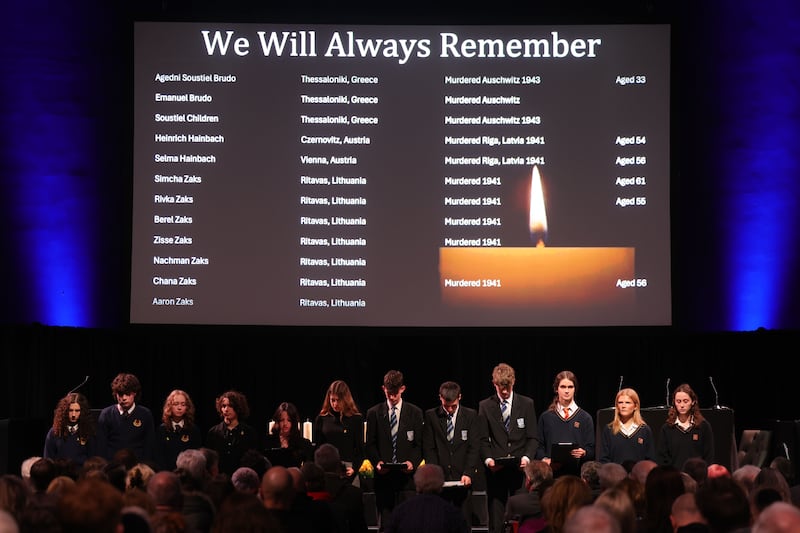
The Holocaust is often first introduced to pupils at primary level, Noone says, before being covered in more detail during the Junior Cycle at second level.
He notes social media as a potential contributory factor to the beliefs held by some survey participants. He says “conspiracy theories” that spread online can make teens think they can opt to “disbelieve the evidence before their eyes”.
“I suppose the realisation that what teenagers believe, and how they can refute the truth so easily, reminds us that we don’t have the influence that these spurious or debatable characters on social media have,” he says, adding that it’s a “really worrying” trend.
While disappointed by the “mind-blowing” and “silly” beliefs held by some survey participants, Shuna Hutchinson-Edgar, a history teacher and religious education coordinator at High School in Rathgar, Dublin, was not entirely surprised.
[ Almost one in 10 young Irish adults believe Holocaust is a ‘myth’Opens in new window ]
“There’s the lack of surprise in the sense that people now are just not interested in really delving in to find the truth. They just accept what they’re told.”
Hutchinson-Edgar has taught history for 25 years including a compulsory transition year module on the Holocaust.
“We talk about the fact that there are people who are Holocaust deniers,” she says, adding that critical thinking skills are “so important right now”.
In a “polarised” online world, she says algorithms reinforce ideas such as Holocaust denial and that this is what some young people are “buying as truth”.
Labelling the Holocaust a myth is “really dangerous”, she says, as it discredits the suffering of millions of people and devalues a major event from which lessons should be learned.
Alongside the widespread use of social media platforms and their algorithms, there has been a “drop” in young people engaging with “legitimate media sources”, says Marie-Claire Tuite, a history teacher in South Dublin.

“That is a huge problem for us as educators because you cannot assume they have any context on what’s going on in the world.”
Tuite says the “nuance of the world” is lost online and this is “hard for young minds who are perhaps struggling to decipher”.
She said social media algorithms feed people “what they have previously expressed an interest in” and this means some young people “are far more siloed in terms of their interests and in terms of their exposure”.
This allows views that are “anti-Semitic, anti-women” and “all of the negativity that exists on the internet” to spread freely.
“We need to be better at identifying and removing it, so it doesn’t get to reach so many individuals,” she says, particularly “vulnerable minds”.
Tuite, the History Teachers’ Association’s representative on the Observatory on History Teaching in Europe, says Ireland is curriculum and the qualification level of its history teachers is well regarded internationally.
In 2018, the subject’s revised Junior Cycle specification placed a greater emphasis on learning history through evidence, rather than through a narrative approach.

Deirdre Mac Mathúna, who taught history for more than three decades before lecturing in history pedagogy at Trinity College Dublin, says more must be done at Government level to combat online content which can give rise to the belief that the Holocaust is a myth.
“There’s only so much we as educators can do,” she says.
She describes a “distortion of knowledge and facts” on social media, where fact-checking is becoming more and more difficult and people are “in a sense becoming indifferent”.
Mac Mathúna, the public relations officer and a former president of the History Teachers’ Association, believes the survey could be an argument for making history compulsory at Leaving Cert level.
“ ‘Compulsory’ is a controversial word, but obviously we would champion history being taught right up to Leaving Cert level. But we’re also realistic, we’re aware of the difficulties that might pose for schools in terms of timetabling.”
Describing the survey findings as “horrific”, she adds: “I don’t doubt for a moment that there is an awful lot of ignorance out there.
“As history teachers, we’re navigating that very delicate path of history being weaponised and used to push a certain agenda.”
Mac Mathúna notes that the survey found 93 per cent of participants believe teaching the Holocaust highlights that it is a “crucial part of history”.
“The old adage ‘so that mistakes can’t be made again’ is wearing very thin these days,” she says. “But still, I and my colleagues would take heart that there is an acknowledgment of the importance of teaching history and passing on the knowledge of the past.”