
John McGahern has always been associated as a novelist and short story writer of rural Ireland, more specifically the lanes and fields of rural Leitrim and north Roscommon where he spent his childhood.
Yet his first two novels, The Barracks (1963) and The Dark (1965), were written in an upstairs room at 57 Howth Road in Dublin.
He was still living there when the two episodes that would define his status as an artist in Ireland – the banning of The Dark in 1965 and his subsequent dismissal from his position as a teacher at the Belgrove National School in Clontarf, Co Dublin – occurred.
The idea of erecting a plaque to McGahern at 57 Howth Road came from the writer’s biographer Frank Shovlin, the author of John McGahern: A Writing Life.
READ MORE


He wrote to the present owners, Una and Robert Mullins, more in hope than expectation that they would allow a plaque to be erected.

They agreed, and the plaque was unveiled on Saturday morning by the Lord Mayor of Dublin, Daryl Barron.
“The themes he wrote about have not gone away – the violence in the home, the abuse of authority and failures to protect children,” Barron said.
“Literature matters because it gives us a way of seeing through things clearly before society itself is ready to see them.”
McGahern died in March 2006, and 20 years after death is the minimum time period before a plaque can be erected to honour an individual by Dublin City Council.
Shovlin, who is professor of Irish literature in English at the University of Liverpool, said McGahern’s 1979 novel The Pornographer is set entirely in Dublin and the narrator of that book is clearly writing in the upstairs room at 57 Howth Road.
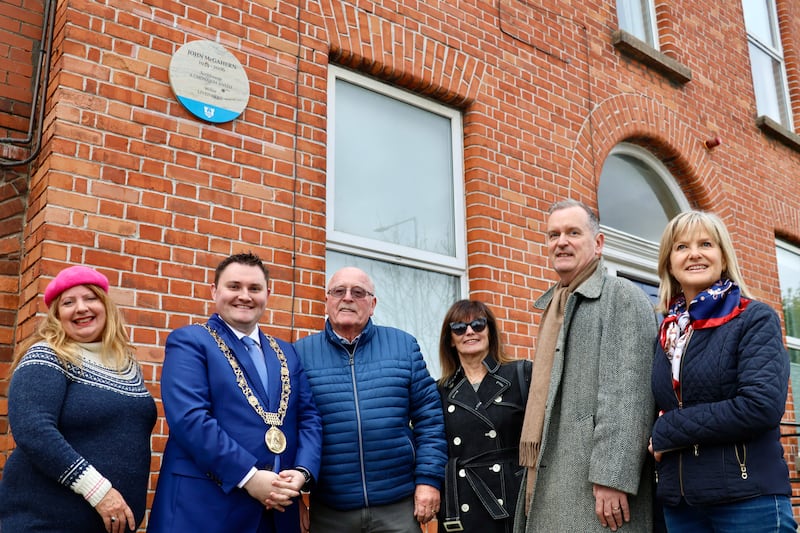
“John McGahern is a Dublin writer as much as he is a Leitrim writer or a Roscommon writer,” Shovlin said.
“I have been working on this project for 20 years, editing his letter and writing his biography, and this is the culmination of this work.
“Long after I am gone, people will be able to point at that plaque and say, ‘Who was that man?’”
Cllr Donna Cooney, who is the chair of the council’s commemorations and naming committee, said it was particularly fitting given what happened to McGahern at the hands of the State.
“As a resident of Clontarf, a lot of us felt very ashamed, though we weren’t responsible for his dismissal from Belgrove School,” she said.
“It goes a little bit of a way to undoing a wrong that was done to him.”


