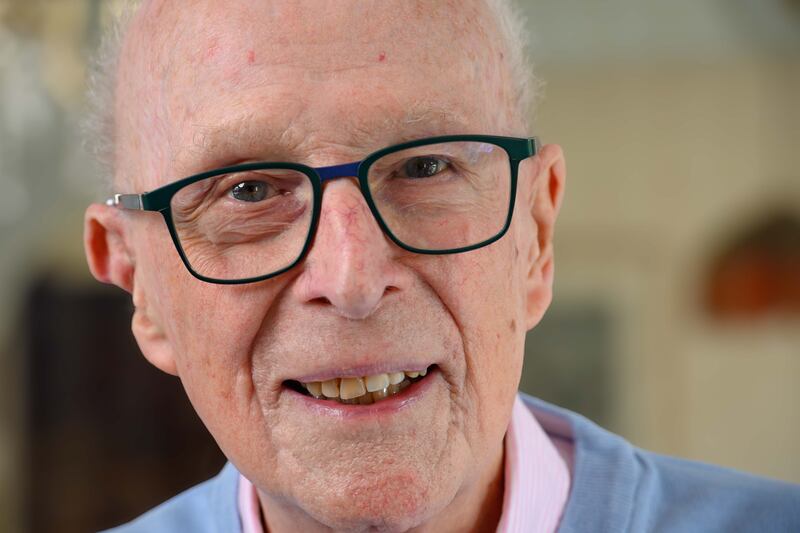
The publication of the 1926 census has taken Joe Davis by surprise.
“I never thought I would be reading about myself in a census from 100 years ago,” says the 103-year-old of the 100-year-old census that will be released tomorrow.
“But isn’t it marvellous for people to be able to read about their grandparents?”
Davis is one of 48 “centenarian ambassadors” announced by the National Archives of Ireland in advance of the release of the 1926 Census of Population records, the first census taken after the foundation of the State in 1922. The 48 were alive at the time of the census, born between 1920 and 1926.
READ MORE


The Civil War was still raging when Davis was born on March 19th, 1923. The middle of three children of Frank and Annie Davis, Joe grew up in a house on Gardiner’s Hill on the northside of Cork city.
When I was growing up, you would send a letter to someone abroad and wait weeks for a reply; this morning I was on my mobile to my grandson in Australia
— Joe Davis
He recalls the day the second World War broke out, having journeyed as a 16-year-old from Freshford in Co Kilkenny to Croke Park in Dublin to see Cork lose to the Cats by a point in the 1939 All-Ireland hurling final, dubbed “the Thunder and Lightning Final” owing to the day’s bad weather.
“It was a very, very bad day; it would be abandoned today,” he says.
Davis began work as a tyre builder for Dunlop in Cork in 1943 and worked his way up to be the plant’s managing director, later working for the company managing factories in India.
He married his late wife, Pat, in 1955, and the couple had three children.
Almost as old as the Irish State itself, Davis looks back on his life and thinks the various Irish political parties have made a decent enough fist of running the country.
“The 1920s were very unstable and they were difficult, but the 1930s became very stable in my view and we have had a very stable political system since. We have been very lucky with the people who have run the country,” he says.
Surveying the changes over his 103 years on the planet from his home in Rochestown on Cork’s southside, Davis doesn’t hesitate in naming what has changed the most: communications.
“I have an iPad and everything is on it; I hardly turn on the TV at all, except maybe for a match,” he says.
“But when you look at the changes ... when I was growing up, you would send a letter to someone abroad and wait weeks for a reply; this morning I was on my mobile to my grandson in Australia.”

Similar to Davis, Sister Miriam, a member of the Sisters of Charity religious order, is in awe of all the changes she has witnessed in her 102 years.
Born on March 14th, 1924, as Eileen Twohig at Coolavokig, near Macroom, the fourth of the eight children of teacher John Twohig and his wife Mary, she remembers hearing about the outbreak of the second World War.
“My father was listening to the radio and he came into the kitchen and said: ‘Mother, the war is on, the war is on.’ I will never forget it,” she says.
Twohig remembers cycling as a young woman with friends to sports days in Fermoy, and to dances in Cork city such as the Farmers’ Union Ball – which went on all night, with revellers catching Sunday morning mass before heading home.
Twohig became a teacher and taught for a number of years as a lay person before joining the Sisters of Charity at the age of 32. The vocation took her to Rome for a year’s study and gave her a chance in her 80s to travel to Australia and New Zealand to visit other convents.
Now resident in Marymount University Hospital and Hospice in Cork since suffering a broken hip in a fall four years ago, Twohig says the most dramatic change she has witnessed is the improvement in travel.
“I was thinking only the other night how different things are now for my nieces and nephews and their children, going everywhere by car or flying all over the world, whereas when I was growing up, we used to cycle everywhere – you would pull out your bike, hop on it and off you went,” she says.
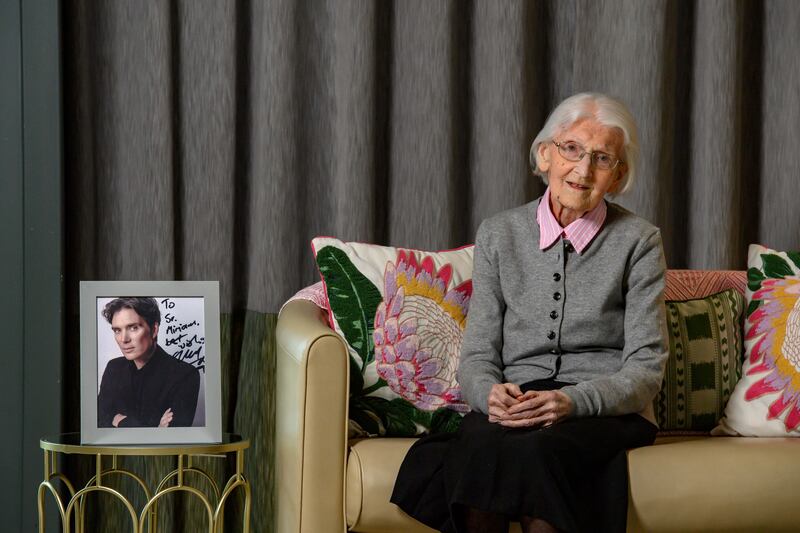
A distant cousin of Cillian Murphy, Twohig is a big fan of the Oscar-winning Cork actor and was delighted when he sent her a signed photo of himself with best wishes to mark her 100th birthday in 2024.
“My grandmother and his mother’s grandmother were first cousins; he’s very good. I saw him in Breakfast on Pluto. I’m very proud of him – you’d have to be proud to have a cousin a film star, and when I tell people that I’m related to him, it pushes me up in the world,” she says, smiling.
Pauline Kearns, another centenarian ambassador, was 13 years old when the second World War broke out. She remembers clearly the day she heard the news that Hitler and Nazi Germany had invaded Poland in 1939.
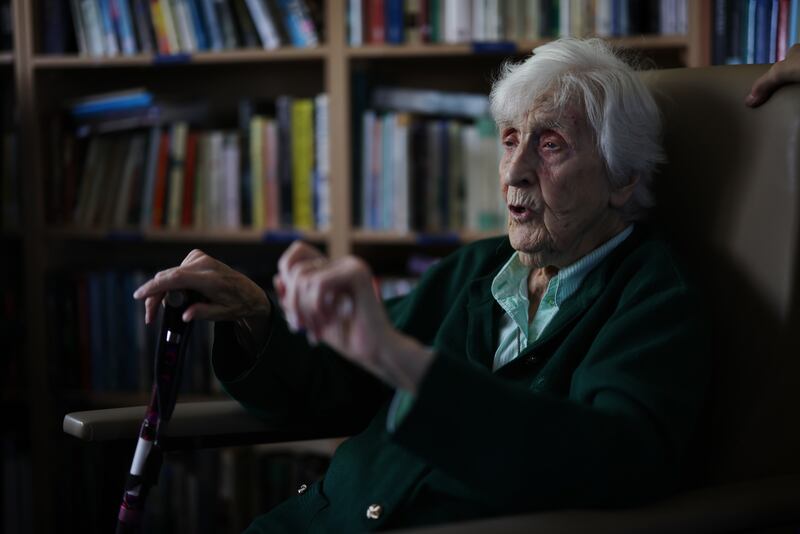
“We were coming from mass on a Sunday morning, and I always remember the feeling I had about it, not knowing it was going to be as bad as it was,” she says.
She recalls her father listening to war reports on the radio; she and her father “loved listening to Churchill”.
“You’d think he was going to arrive at the front door; he had a wonderful way of encouraging people at the time ... His voice had that effect,” she says.
We’d no cars or anything. There was one family I knew who had an old-fashioned car
— Pauline Kearns
In her 101 years, she has seen a lot. In recent weeks, as the US and Israel attacked Iran, she says she thought to herself: “I hope these things are more sensible this time and they’re not jumping in behind him [Trump].”
Speaking from the library in Leopardstown Park Hospital in Dublin, where she now lives, Kearns was reflecting on her long life as one of the few people born before the date of the April 18th, 1926, census.
Kearns was born in June 1924 in a Protestant area of Belfast but her family later moved to the Republic. She was eight years old when she first attended school, as “we had to walk a mile to get there, and my mother thought that was too much for us girls – she thought we were too young”.
“We’d no cars or anything. There was one family I knew who had an old-fashioned car,” she says.
Kearns recalls when former president Éamon de Valera introduced compulsory Irish language learning in schools, having struggled with the language at the time.
However, she was an avid learner and went on to become a Montessori teacher, including at Willow Park Junior School, a private primary school for boys, where she taught pupils including broadcaster Ryan Tubridy and Dr John Hillery of the Mental Health Commission, former president Patrick Hillery’s son.
“I liked the age group I had: seven-year-olds,” she says fondly of that time in her life.
Asked about the secret to her longevity, Kearns said she was not sure, as she ate “very ordinary food” and even “awful” black bread due to wheat shortages during war times.
“There was no fruit or sweets or anything. But in ordinary times we used to get 20 sweets for a penny,” she says, though she adds that she never drank alcohol.
[ 134 Irishmen killed at sea added to official roll of second World War fatalitiesOpens in new window ]
In her younger years she played card games, including poker, “but we didn’t gamble,” she says, laughing; “we just played the game”.
She was also musical and a talented recorder player. Her sister, with whom she lived in Dalkey for several years before moving to the nursing home where she now resides, was a music teacher.
Nowadays, her eyesight is going and she says she is less able to read or make phone calls, but she has plenty of people calling her, with seven grandnieces and nephews, and a wider family, with whom she is very close.
Tomorrow, she will attend a lunch with Taoiseach Micheál Martin to celebrate the launch of the 1926 Census records, with two of her nieces joining her.


