Leinster counties face heightened flood risk once again as Met Éireann warned of heavy rain on saturated ground for Monday.
The forecaster issued status yellow rain warnings for Carlow, Kilkenny, Wexford, Cork and Waterford beginning at 6pm on Monday and continuing until 12 noon on Tuesday. It issued a similar warning for Dublin, Wicklow and Louth starting from 3am on Tuesday and running until 6pm.
The areas in question have been those worst hit by flooding over the past week.
The warnings highlight localised and river flooding with difficult road conditions.
READ MORE


Met Éireann issued a general advisory, statingthat “spells of heavy and persistent rainfall” will continue in the coming week, “particularly in southern and eastern coastal counties”.
“Rain will fall on saturated ground where river levels are high with high tides expected this week. This will lead to further flooding along rivers and in coastal areas.
“Close monitoring of local weather conditions via www.met.ie and river gauge data www.waterlevel.ie is strongly advised.”
Taoiseach Micheál Martin and Minister of State Kevin “Boxer” Moran are set to visit areas severely affected by flooding in Wexford, Carlow and Kilkenny this week.
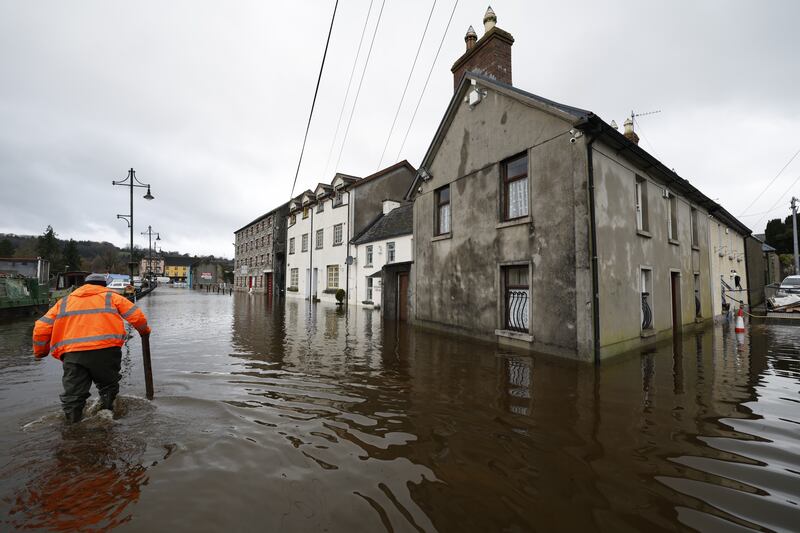
Callan, Graiguenamanagh, Inistioge, Thomastown, Rathvilly, Carlow, Enniscorthy, Bridgetown and others fell victim to flooding when rivers including the Barrow, Duiske, Nore, Burrin and Slaney burst their banks.
Ministers are also expected on Tuesday to sign off on emergency supports for flood-hit businesses during a remote Cabinet meeting.
Under the plans businesses affected by Storm Chandra, but which do not have flood insurance, may be able to apply for funding of up to €100,000.
Previously businesses could only claim up to €20,000, but the scale of the damage of the storm has prompted a rethink by the Department of Enterprise.
Under the proposals from Minister for Enterprise Peter Burke the definition of small businesses has been updated to include enterprise with a maximum of 50 employees. It had been 20 employees.
Money will be made available through the Emergency Humanitarian Flooding Scheme (EHFS) to cover damage incurred from January 26th to early February.
In a statement on Sunday Tánaiste Simon Harris warned of a significant chance of flooding in the coming days.
He said he had been briefed by the chairman of the National Emergency Coordination Group on the flooding situation and the outlook for the days ahead.
“Sadly, it seems that despite a very sustained period of rain and flooding so far – particularly in the southeast and east of our country – it is highly likely that more is on the way.”
He said: “The coming days, particularly Monday through to Wednesday, will see a significant chance of further flooding in Ireland, most particularly in the southeast and up to the east.”
He said “high tides this week could add a further complication in relation to flooding”.
The full Cabinet is due to meet on Wednesday. The timing of a special Cabinet subcommittee on floods and storms remains unclear.
There was Opposition criticism of the Government’s preparedness and response to floods on RTÉ’s The Week in Politics programme. Sinn Féin TD Louise O’Reilly said flooding in certain areas is “not just predictable, but it is preventable and the Government have been found wanting and come up short on this time and time again”.
Labour TD Conor Sheehan said the introduction of a flood warning system for Ireland – of the kind seen in European countries and the US that can give “a more accurate pinpoint” in terms of when to plan for flooding – is taking “far too long”.
Parts of Leinster already badly hit by floods were warned by councils to take care in coming days as rains resume.
Carlow County Council said the potential for further flooding remained “very serious”.
River levels across the county dropped slightly overnight on Saturday into Sunday, with the Barrow and Burrin still extremely high and at near record levels.
Waterford City and County Council issued guidance to drivers ahead of renewed flood risk as further rain from Monday night meets higher tide levels. It asked drivers to turn around and avoid entering flood water, and to be conscious of vulnerable road users such as pedestrians and cyclists.

In Graiguenamanagh, Co Kilkenny, Doran’s Supervalu supermarket has been in business for more than 40 years and over that time its owner Michael Doran has witnessed many floods.
The worst occurred almost 11 years ago when the rivers Barrow and Duiske burst their banks. “But there is the very real chance of the flooding getting even worse”, he said.
The town was promised a flood relief scheme in the aftermath of those floods. Project planning permission was sought from An Coimisiún Pleanála last December.
Parts of the town were once again badly hit by flooding from Storm Chandra last week and are again under a status yellow rain warning from Monday. Flood waters that hit last Tuesday only receded from the quay on Sunday afternoon.
Mr Doran said: “The main question that must be answered is why is planning permission only being sought for the flood relief scheme now, 10 years after it was promised?
“The Duiske river is the main problem as it does the damage when it floods, it runs down the Main Street and feeds into the river Barrow. It would cost very little to solve the problems with the Duiske river, a few tractors, trailers and digger would be able to dredge it in a short period of time.”
The Kilkenny man recalled that during the last severe flooding, Tánaiste Simon Harris, who was then a minister, visited the town in 2015 acknowledging that the town needed a relief scheme urgently.
“Eight years ago Kevin “Boxer” Moran made funding available for the scheme but we are still in the same position,” saidMr Doran.
[ Five-year delay to flood scheme shows how local politics can delay big projectsOpens in new window ]
The ESB has said it is focused on bringing down water levels in the Poulaphouca reservoir on the Liffey near Blessington in Co Wicklow, to create capacity for expected rainfall in the coming week.
The move is aimed at avoiding having to make a sudden discharge of large volumes of water via the Liffey during the anticipated rain, which could lead to the Liffey bursting its banks downstream.
In November 2009 the ESB was criticised for a sudden discharge of a large volume of water from Inniscarra Dam in Co Cork, which led to the river Lee bursting its banks downstream and extensive flooding in the western reaches of Cork City. The estimated cost of the damage was about €100 million.
Towns and villages along the 70km route of the Liffey downstream of Poulaphouca include Ballymore Eustace, Kilcullen, Newbridge, Sallins, Clane, and Celbridge, in Co Kildare. The river enters Co Dublin at Leixlip before continuing through Lucan and Chapelizod into Dublin city centre, discharging into the Irish Sea.
The ESB needs to keep discharging water from its dams to prevent overtopping, a process in which the water flows over the top of the dam, which could destabilise the whole structure and lead to catastrophic flooding in towns and villages downstream.
The authority said its attempts to reduce water levels in the reservoir “may increase the risk of flooding along the course of the Liffey, in particular in the Clane and Newbridge areas.”
On Sunday the ESB said the situation was being closely monitored in co-operation with local authorities. It said its position was one of “vigilance rather than alarm”.


