
Ireland and almost every part of Europe experienced abnormal temperatures last year, a period of record-breaking heatwaves, wildfires and worsening marine conditions.
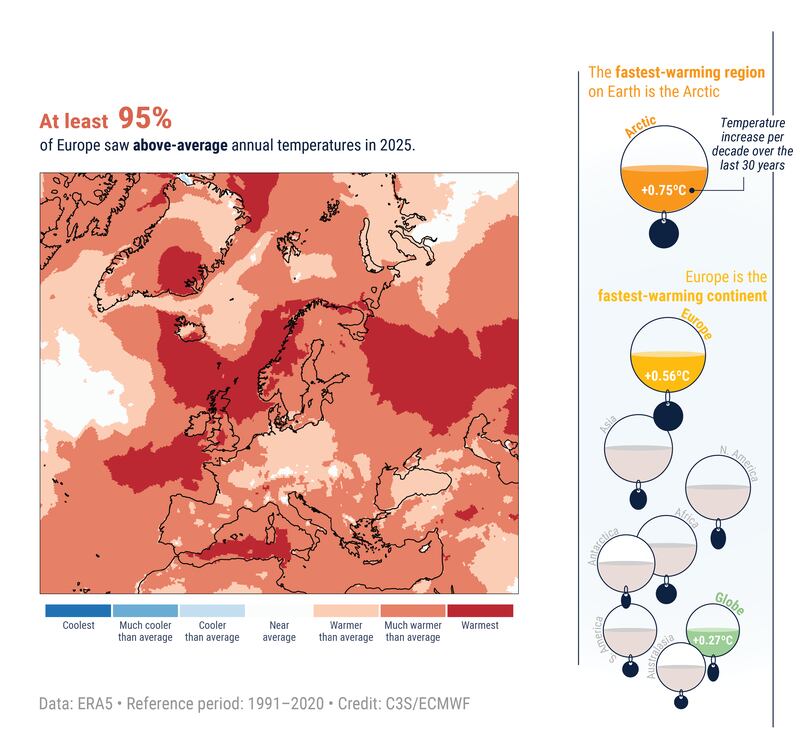
At least 95 per cent of the continent’s land and 86 per cent of its seas had above-average temperatures with heatwaves recorded from the Mediterranean to the Arctic.
The most northerly regions, traditionally the coolest, suffered some of the most extreme heat abnormalities.
The data, compiled by more than 100 scientists from the World Meteorological Organisation and the European Union’s Copernicus climate change service, shows Europe is warming twice as quickly as the other continents, with air temperatures becoming “dangerously high”.
READ MORE


Turkey recorded an all-time high temperature of just over 50 degrees and the popular holiday spots of southern and eastern Spain had months of gruelling heat with up to 50 extra days of ‘feels-like’ temperatures above 32 degrees.
Even more startling was the unprecedented three-week heatwave that struck Norway, Sweden and Finland where temperatures exceeded 30 degrees inside the Arctic Circle.
The Greenland ice sheet shrank substantially during the year, losing 139 billion tonnes of ice – more ice than is contained in all of Europe’s mountain glaciers combined.
Snow in those mountain areas and across Europe, generally, was 30 per cent less than normal, leaving less white cover to reflect back the sun’s rays.
More than 70 per cent of rivers had lower than normal levels with flows below average for 11 months.
Wildfires burned more land than ever before, affecting 1,034,550 hectares – an area roughly the size of Dublin, Wicklow, Kildare, Meath, Louth and Wexford combined.
Ireland had its second-warmest year on record with peculiarly stubborn summer night-time heat that made daytime almost indistinguishable from night. A marine heatwave off the west and southwest coasts was classified as “extreme”.
It was not the worst year for storms across Europe but Ireland and the UK were hit by their strongest wind storm ever, Storm Éowyn.
The European State of the Climate Report is an annual update to inform policymakers and the public of the continent’s climate change trends. This year’s places a special emphasis on biodiversity loss, stressing climate change is destroying nature and habitats and undermining the ability of natural landscapes to absorb carbon, shield people from and buffer land against storm surges and flooding.
“Biodiversity is vital for life on Earth. Climate change is a major cause of its degradation,” said Dr Claire Scannell, principal meteorologist at Met Éireann, which contributed to the report.
“This decline of biodiversity weakens nature’s ability to both regulate the climate and adapt to climate change, creating a reinforcing cycle,” she said.
An example is marine heatwaves that trigger mass die-off of seagrass – the underwater meadows that capture carbon and help absorb the impact of storm surges before they hit land.
“Addressing the challenges of climate change and biodiversity decline together is absolutely essential,” Scannell said.
John Hyland, spokesman for Greenpeace Europe, said: “It feels like we are standing at the edge of catastrophe.
“All the emergency warning lights are flashing red,” he said.
“Either governments take swift and effective action to cut carbon pollution right now, or they can continue irresponsibly rolling back protections, placing countless people’s health, homes, jobs and livelihoods at risk.”
The report highlights one positive trend – renewables supplied 46.4 per cent of Europe’s electricity last year with solar power reaching a record of 12.5 per cent.

However, El Nino, a naturally occurring temporary warming of the planet that occurs every few years, looks to be developing again. It was last in effect in 2024, resulting in Europe’s hottest year on record, so a similar impact would be expected this year.


