
In the heart of Connemara, there is a tug of war taking place between people and nature.
Metres from the world-famous Kylemore Abbey, in the shadow of the Twelve Bens mountains, the Polladirk river crosses the main N59 road that runs between Clifden and Leenane at Kylemore Bridge on its way to the ocean at Ballinakill bay.
At this intersection of road and river, flash floods have become a serious and unpredictable problem.
Although many parts of the country have experienced flooding for the first time recently, particularly during Storm Chandra last month, one area affected more regularly is Kylemore Bridge on this busy rural thoroughfare.
READ MORE


The area can flood up to a dozen times each winter; floods affected the area around the bridge twice this January.
When heavy rain falls on the Twelve Bens and nearby Maumturk mountains, thousands of gallons of water are diverted into the Polladirk, transforming the stream into a raging torrent in a matter of minutes. The results can be devastating.
According to John Mortimer, who operates Mortimer’s Garage close to Kylemore Bridge, more than 300 cars have been caught by the flash floods over the past 20 years.
The fields on either side of the road are littered with car parts, as dozens of licence plates and entire car undertrays have been ripped from vehicles by the fast-flowing water.
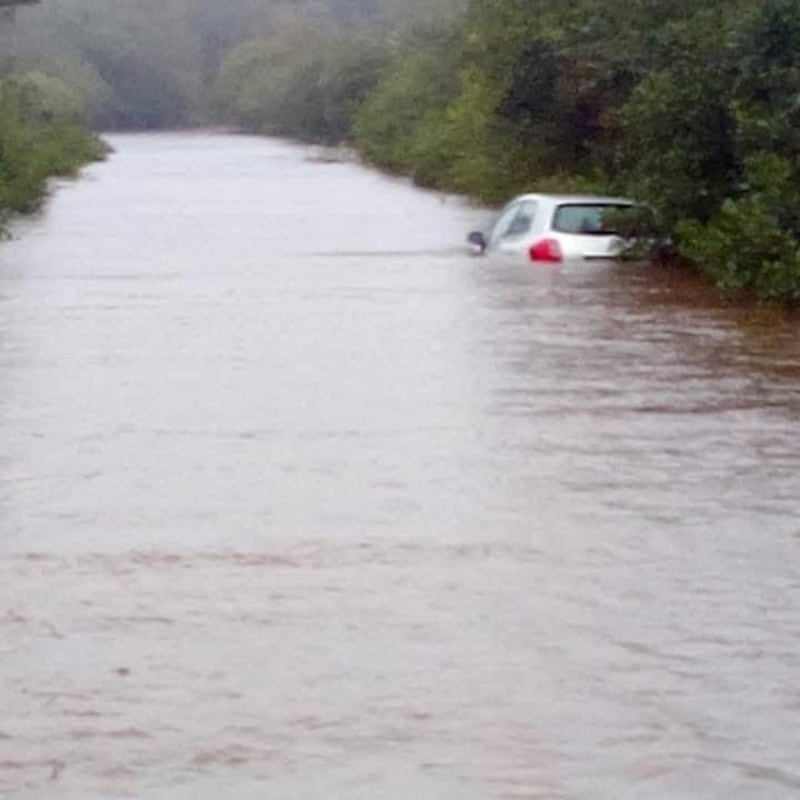

“Hundreds of cars have got stuck in it. It’s so dangerous,” says Mortimer.
He recalls one occasion where three men were required in the back of a tow van to stop the car from slipping and being washed away.
“The flood water will take a car and just sweep it away,” he says.
There have been many near misses at the bridge over the years, with people being forced to abandon their vehicles and swim to safety.
Phone reception in the area is also poor, meaning that trapped people often have no choice but to leave their vehicle rather than call for help.
Local woman Rose Rima, who narrowly escaped from a flash flood some years ago, says it is only a matter of time before someone loses their life at the bridge.
“We crossed the bridge on our way to Mass and everything was fine. There had been a heavy downpour while we were in the church, we could hear it hitting the roof. When we left Mass the rain had stopped, the ground was still wet, but we didn’t think anything of it,” she says.
“I was in the front [seat] of the car and when we came around the corner we were straight into the flood. We didn’t know what to do. Straight away the water was up around my thighs, I knew we had to get out of the car.
“I can’t swim so it was very scary. We managed to get out of the car safely but the car was a write-off.”
Local residents call the Polladirk the “new” river, and there lies the origin of the problem. The course of the river was diverted to its current location more than 100 years ago, creating an extremely fast flow at times of heavy rain.
This flow drags gravel and silt from the mountains, which then gathers underneath Kylemore Bridge.

For years, local people or Galway County Council have cleared away the debris from underneath the bridge, preventing the flooding from taking place.
However, the Polladirk river is a tributary of the Dawros river, a noted habitat of the protected pearl mussel, and in 2022 Friends of the Irish Environment successfully took the council to court to stop works taking place at the bridge.
“Years ago, people would come here in their horse and cart, and if they needed gravel, this is where they would get it,” said local resident Brendan Ridge.
“In later years people would come with tractors and trailers, but then the environmental groups came in and they put a stop to it.
“I was there at the bridge the day it happened.”
He recalled how the Friends of the Irish Environment told contractors for the council that they would take them through every court in the land. So the work stopped right there on the spot.
“We had nearly three years after that completely flood free, but the silt and rubble built up again,” he says.
[ Why are flood defences taking so long to build? Don’t blame the pearl musselOpens in new window ]
Local people say they have been ignored since the 2022 court case and have called for all stakeholders to come together to find a solution.
“It’s been going nowhere for years, so last October we asked the council to arrange a meeting of all the relevant bodies; environmental, the council, the National Parks and Wildlife Service, the whole lot, to find a solution to all of this,” said local resident Patricia Keane.
“They completely, totally and utterly ignored us. We have been ignored right through.
“We need a meeting between everyone to trash it out and find a solution. We are the people caught in the middle. There is a process going on, but this is our lives.”
Local people say they have “nothing against the pearl mussel” and that other solutions, such as diverting the overflow water into an abandoned nearby quarry, should be examined.
Tony Lowes of Friends of the Irish Environment says his organisation would be happy to take part in a meeting with all stakeholders.
“The description of the locals being left in limbo is absolutely correct. The idea of bringing all of the stakeholders together is the only way that we can go forward,” he says.

“If we are really going to accept the science of flood control, we are going to have to start putting in swales and places for water to be stored, like the idea of the quarry.”
A spokesperson from Galway County Council said it did “not accept that the local community has been abandoned” and that the local authority is continuing to consider how the flood risk can be managed in a way that is “environmentally compliant”.
The spokesperson said the council has just completed an assessment of the river that “found no evidence of adverse effects on water quality or on protected species, including freshwater pearl mussels” and that any further works would be subject to the “appropriate statutory processes and environmental assessments”.


