

Kathleen Molloy doesn’t blame the floods for the loss of her home of 15 years. She lays that responsibility firmly on officialdom.
The waters may have put her out of the house, she explains, but repeated hold-ups with flood protection works have kept her out.
“I won’t be going back, no,” she says of her acceptance that after 8½ years away, she’s unlikely to put her key in the front door again.
Molloy’s former neighbours from seven other houses in the small local authority estate of Páirc An Grianán in Burnfoot, Co Donegal don’t know if they will be back either.
READ MORE


“Some had to leave the village completely. Some were rehoused in Buncrana and Muff,” Molloy says.
“We were neighbours and friends. The children grew up together. Now you might bump into someone in the supermarket and you’d run out of conversation after five minutes.”

Long after belongings were replaced and floorboards dried, the impacts of the flood of August 2017 live on.
Of all the experiences and emotions shared by flood-hit communities across the country over the past few weeks, frustration at the length of time it is taking to make their homes safe rang out loudest.
In Enniscorthy, Co Wexford, local people recalled 25 years of flood protection proposals, promises, plans and dead ends.
In Rathfarnham, Dublin, residents spoke with frustration of how close they came to escaping unscathed only for the last leg of a long-running, multiphase flood relief scheme to drag on years behind schedule.

In Midleton, Co Cork, sighs of relief at avoiding inundation this time were mixed with renewed reminders that there has been painfully slow progress with their planned scheme since the devastating floods of 2023.
In Aughrim, Co Wicklow, a cold sense of dread built as the flood waters receded.
The village doesn’t even have a coveted place on the flood relief scheme list.
Despite being categorised by the Office of Public Works (OPW) as an Area of Potentially Significant Flood Risk, it failed a scheme viability review last year.
Put simply, that means the cost of putting in place a major flood relief scheme would outweigh the benefit.
[ ‘No one was pumping the water’: Rathfarnham deals with Storm Chandra aftermathOpens in new window ]
It’s not necessarily the end of the line for Aughrim as it may be eligible for works deemed “minor” which, up to recently, meant works costing up to €750,000 which can alleviate some of the risk. The ceiling has now been raised to €2 million.
“In conjunction with this, the outcome of the scheme viability review for Aughrim will now be reviewed in the aftermath of the Storm Chandra flooding impacts,” Minister with responsibility for the OPW, Kevin “Boxer” Moran told the Dáil this week.
A review of a review is not exactly a fast-track approach, however.
Even for projects that do make the list, there is no speedy route to delivery.
Of 54 major projects prioritised for development in 2018 following a national flood risk assessment, 31 are still at stage one of a five-stage process.
Stage one means they are in the preliminary design phase when various solutions and routes are whittled down to a preferred option. The Burnfoot scheme is still at stage one.
Stage two is the planning and consenting process. Ten of the listed projects are in that phase.
A phase of detailed construction design follows, taking into account any issues that have arisen during stage two. Three are in that phase.
Ten are at stage four, the construction phase, and none are at stage five, the hand-over phase when various components of a project – such as gates, diversion channels, dams, demountable barriers, storage tanks and designated flood plains – are gradually put to work and tested in real-world conditions.
Target timelines vary but few envisage getting from stage one to five in under a decade.
The OPW said the average time taken by completed projects is 11 years but most of the 56 completed projects were built before 2020, some as far back as the 1990s, so that may not reflect current conditions.
Why exactly flood relief works are so slow to materialise long after flood risks are identified and repeated flooding suffered is not an easy question to answer.
Before anyone says “pearl mussel”, the much-maligned mollusc that has been the target of many outbursts and soundbites in recent weeks is defended by Minister of State for nature, Christopher O’Sullivan.
“I am kind of getting sick of the finger being pointed at nature and biodiversity when it comes to delays with schemes,” the Fianna Fáil TD for Cork South West told the Seanad this week.
“The freshwater pearl mussel had absolutely nothing to do with the Enniscorthy flood relief scheme not being delivered.”

Before it ever got close to being submitted for planning, the scheme was revised several times after objections from local people to the concrete walls proposed for the historic town centre.
Various technical issues subsequently arose in what is a complex engineering project involving long stretches of river, and multiple features including bridge replacement.
The pearl mussel, a protected species that acts as a vital water filter to clean rivers, was referenced in the last review of the Enniscorthy scheme in 2022 when then minister for public expenditure, Michael McGrath, sent it back to the drawing board.
[ Farmers have a vital part to play in the fight against floodsOpens in new window ]
His concern was that the scheme did not adequately consider environmental impacts or how they might be mitigated, including the fate of the pearl mussel.
Despite being worked on in various forms for 20 years, the scheme had what he described as “significant shortcomings in the biodiversity assessment”. He said it would breach multiple pieces of legislation before its engineering and flood protection merits were even assessed.

Current Minister for Public Expenditure Jack Chambers offered up another culprit for delays, pointing the finger at judicial reviews.
But of the 110 major flood schemes completed and in train, the OPW said four had been subject to judicial review.
One, the now-complete Morell river scheme in Co Kildare, was held up for a year and a half until negotiations with a landowner succeeded in getting the proceedings withdrawn.
The Morrison’s Island and river Bride/Blackpool schemes in Cork and the Whitechurch scheme in Rathfarnham also went through judicial review.
Morrison’s Island is almost complete, and Whitechurch is well under way but there is anger there and in Blackpool over flooding that occurred while the legal wrangles played out.
A scheme proposed for Lough Funshinagh in Co Roscommon is not on the major works list but the OPW pointed out it was also challenged by judicial review and is halted while alternative solutions are considered.
It is not possible to predict how many of the 31 stage one schemes could be challenged when they move to stage two.
[ Try explaining to the people of Enniscorthy why it’s hard to get things doneOpens in new window ]
But if failing to have full consideration of the environmental impacts is a ground for judicial review, it raises the question of why this work has not always been adequately conducted before a scheme goes to planning.
When asked about the main factors causing delays, the OPW emphasised the need for “extensive and wide-ranging surveys to understand the topography, hydrology and environment”.
“Market demand and competition for these necessary surveys for flood relief schemes and other developments has resulted in an extension of the period of time needed for these surveys to be completed,” a spokesperson said.
Damien Owens, director general of Engineers Ireland, agrees there is heavy demand for specialist skills.
The organisation has run promotional campaigns since the end of last year to try to entice this year’s Leaving Cert students to apply for engineering courses.
“Flood schemes are often more complex than they appear and they require a lot of engineers,” he says.
He has a concern about overseas interests buying up Irish engineering consultancies needed to carry out the preliminary works.
“A lot of consultancies were bought up after the crash which is a strategic issue for Ireland,” he says.
“It might seem like we have lots of companies here but if the decision-makers are overseas, their priority might not always be Irish projects.
“If we’re to get moving on flood projects, they’re going to have to be prioritised and picked off one after another. That’s not a simple decision. You might say we’ll go for the biggest but a smaller scheme is going to be a very big deal to the homeowners who are being flooded.”
The Burnfoot scheme is one of the smaller projects on the 2018 priority list but local Sinn Féin TD Pádraig Mac Lochlainn says the knock-on effect is immense.
“We have a housing crisis all over this country and in Donegal we have the defective block crisis too,” he says.
“To have homes lying empty anywhere is a disgrace but to have them lying empty here for 8½ years is exasperating.
“I hear people saying you can’t build flood defences because of objections but there’s no objections here. It’s wanted and the sooner the better.”
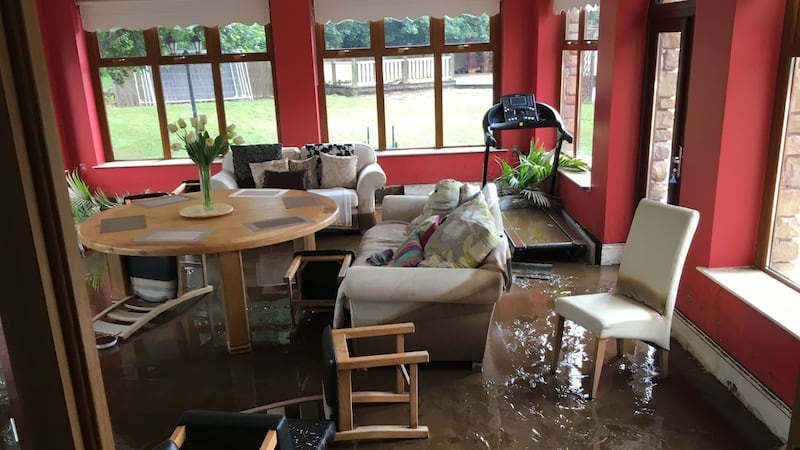
Kathleen Molloy will turn 70 this year and says she doubts she’ll see the Burnfoot flood scheme in her lifetime.
Although she doesn’t like to dwell on it, she’ll carry the memories of losing her home forever.
“My granddaughter was here the night of the flood and she was only five or six. A while ago she had to write for school about the best day of her life and the worst.
“The best day was when she got her dog. The worst was when granny’s house got flooded. She remembers all that and she was only a wee thing. It’s hard to forget an experience like that.”


