Nine years ago, at the end of a period living and working in Hong Kong, Choy-Ping Ní Chléirigh-Ng decided to mark a journey that had been as inward as it was outward, one searching for deeper connection. She decided to get a tattoo.
Ní Chléirigh-Ng was raised in the foothills of the Wicklow Mountains. Her father had lived in a secluded village in Hong Kong before moving to Ireland as a teenager. Ní Chléirigh-Ng grew up telling people that she’s “really more Irish”.
During her time in Hong Kong, the young theatre artist worked as an English-language teacher and spent time with relatives. She practised speaking Cantonese and watched films starring Leslie Cheung, the Hong Kong pioneer of refined, cool Cantonese-language pop music – aka Cantopop – whose immense charm and good looks allowed for a seamless transition into film acting.
In the 1990s, at a time when a stifling society smothered such depictions, Cheung gave performances that defiantly bent gender and made bold allusions to queer desire.
READ MORE


Ní Chléirigh-Ng chose for her tattoo the name of a song by Cheung that translates as I Am What I Am.
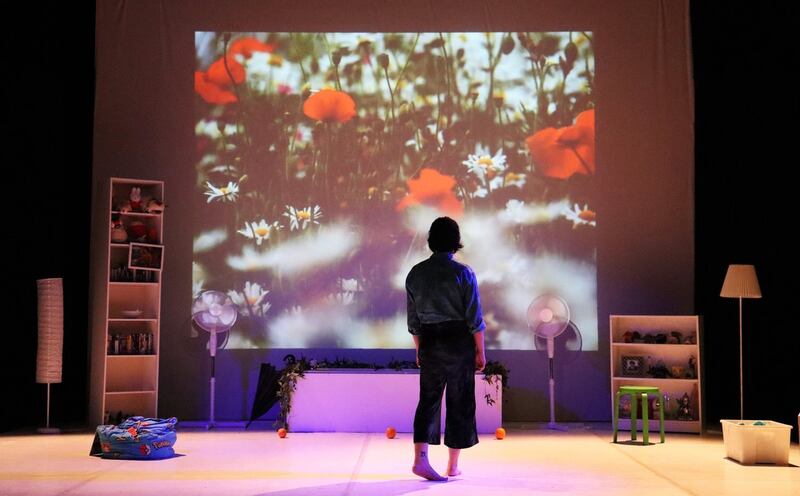
She documented her mind-expanding discovery of Cheung’s artistry in her play Where Are You From?, from 2019. In Ní Chléirigh-Ng’s beige Hong Kong apartment, Cheung appeared in grainy YouTube clips alongside footage of the high-concept singer-songwriter Mitski and the deep-thinking pop star Rina Sawayama. “A music video can’t change the world, unfortunately,” Ní Chléirigh-Ng said onstage, “but it can help make a mirror”.
Ní Chléirigh-Ng describes that play as a kind of starting point. “Where Are You From? was maybe the first step back to reconnecting with my identity, to reaching into that a bit more, and also maybe being proud of that identity which I pushed away for many years, or wasn’t proud of for a long time,” she says.
Intriguingly, her new play, The Madonna of Asia, about a fictional pop singer turned film star, is concerned with the dark side of that golden age in Hong Kong music and film during the 1980s and 1990s. “It’s funny how things come back around,” she says.
In Where Are You From?, a slick work of documentary theatre about her Hong Kong pilgrimage, Ní Chléirigh-Ng was unflinchingly honest about making a trip in hope but finding herself sunk into a depression.
She was seen hiding her depression from Hong Kong relatives. In one standout scene in a restaurant, her Cantonese-speaking aunt began to cry, upset by the language barrier. (Another wonderfully well-meaning Hong Kong aunt would appear in Ní Chléirigh-Ng’s later work Window a World, in 2022.) Ní Chléirigh-Ng was moved by her emotion: “I wanted nothing more than to fully connect with her, this person I love and who loves me, but I couldn’t.”
We saw Ní Chléirigh-Ng then leave the restaurant and receive a text from an English-speaking cousin: “We will always love you, no matter what.”
She tells me that she tries to capture such emotions in her theatre. “I’m interested in outsiders, I guess. It’s that feeling of in-between, and trying to find peace in that.”
In 2022 Ní Chléirigh-Ng contacted Willie White, who was director of Dublin Theatre Festival at the time, to talk about ideas. To her surprise, he was prepared to offer a slot in that year’s festival. That spurred her to synthesise different ideas for Window a World, which would be her next work.
Ní Chléirigh-Ng had been admiring the drag performances of the Drogheda-based performer Hansun Lamb and wanted to collaborate with him. “I wrote it around him, which is often how I work,” she says. “Some people assume there aren’t any Asian actors [in Ireland], but that’s not true. I like to get to know actors first, then shape stories around them.” (Similarly, she has conceived The Madonna of Asia around Mai Ishikawa, a Japanese performer who moved to Ireland from the United States.)
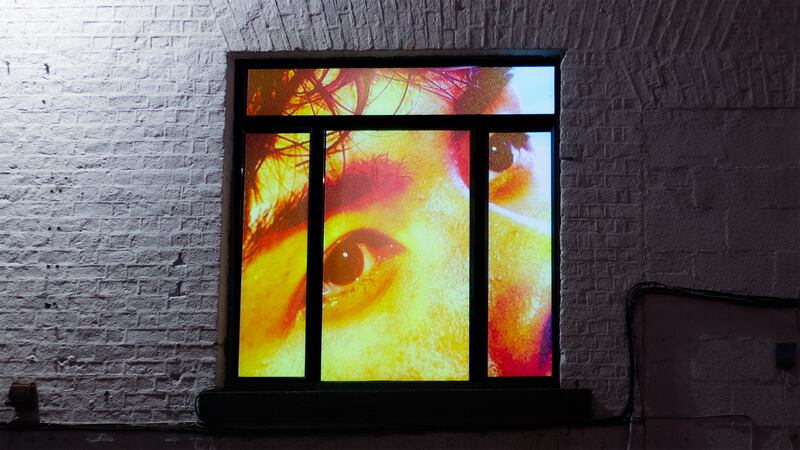
With many venues for that year’s Dublin Theatre Festival already filled, Ní Chléirigh-Ng responded resourcefully, conceiving Window a World as a streetside installation that concluded with a live drag performance by Lamb. A blacked-out window above a shopfront in Temple Bar became filled with dreamlike neon-blue light. Within the video projection, Lamb appeared as Knife, a Hong Kong-Irish costume designer in Belgium who, burned out by work and travel, is considering focusing more on their drag.
At the time, work had begun to scatter Ní Chléirigh-Ng and her friends in the industry far and wide. (She temporarily decamped to Bristol during the Covid-19 pandemic.)
One scene showed Knife on a phone call with a friend who is stage-managing a play in California. She tells a story about a lighting designer working on the production who suspected they were a diversity hire and made the decision to quit.
Knife sighs and says: “I hate that I’m expected to know the answers. It’s not my fault the system’s broken.”
Knife is privately reckoning with feelings of rootlessness. He carries around a voicenote from his Cantonese-speaking Hong Kong aunt, but his grasp of the language has slipped to the point where he can no longer understand her.
Towards the end, he encounters a restaurant waiter who translates the message for him. His aunt is heard gushing over photos of Knife’s costumes, and imagining him bringing his art to Hong Kong someday.
Standing at her apartment window in Ní Chléirigh-Ng’s video projection, the aunt looks up at a rooftop across the street. The audience below eventually look up in the same direction. There appears Lamb’s Knife, in person, wearing a Cantonese opera singer’s robe and headdress, lip-syncing to the gazey dreampop of This Mortal Coil’s version of Song to the Siren: “Did I dream you dreamed about me? Were you here when I was forsook?”
[ 2026 on stage: 20 headline plays to see this yearOpens in new window ]
Another long-distance correspondence appears in The Madonna of Asia. An Irishwoman long living in Hong Kong (played by Clare Barrett) makes a phone call to Dublin and recognises the voice on the other end of the line. She realises it belongs to Rin Asari (played by Ishikawa), a teen Cantopop sensation in 1980s Hong Kong who transitioned into film acting. She disappeared from Hong Kong public life in the mid-2000s and moved to Dublin to keep a low profile.
“I’m very proud in lots of ways of Hong Kong cinema and music history,” says Ní Chléirigh-Ng, who’s thinking about how video design and costuming can recreate onstage an “essence” of Hong Kong cinema – an aesthetic most will associate with the director Wong Kar-wai, and the dreamy night-time of cigarette smoke and city neon immortalised by his film In the Mood for Love.
“But it’s interesting to dive into the reality,” Ní Chléirigh-Ng continues. Rin is a composite of different real-life stars who, like Cheung, worked in Hong Kong when it had the world’s third-largest film industry, after the United States and India. “There were effectively round-the-clock film studios, for example, in order to make the amount of films to meet the demand. That had a less pleasant side to it,” she says.
An earlier era of artistic expression also intrigues Ní Chléirigh-Ng. Her father missed the arrival of Cantopop in the 1980s; he had already left Hong Kong for Ireland. But his rural village was reached by Cantonese opera troupes on tour, who would build temporary stages with bamboo.
Widely considered a working-class art form, Cantonese opera surged in popularity in the middle of the 20th century. Its vibrant world was famously depicted in the Cheung film Farewell My Concubine, from 1993.
[ At last, Ireland has lost its fear of new writing for the stageOpens in new window ]
“A lot of Hong Kong cinema was influenced by Cantonese opera,” Ní Chléirigh-Ng says. “Basically, they wanted to film Cantonese opera, so they started making films of famous opera performers. They always have these fight sequences that are beautifully choreographed and really exciting to watch. People started thinking, ‘What if we made films that just had that?’”
That suggests a tempting rethink by Ní Chléirigh-Ng, who couldn’t resist dragging up Knife as a Cantonese opera singer at the conclusion of Window a World. That art form is considered democratic, its artists working together without directors, a world apart from profit-hungry studio executives.
“The roots are there. We’re reaching towards Cantonese opera in this piece,” she says about an art form that gave Hong Kong cinema its foundation and was later excised.
What if someone were to restore it?
The Madonna of Asia is at the New Theatre, Dublin, from Tuesday, April 28th, until Saturday, May 2nd