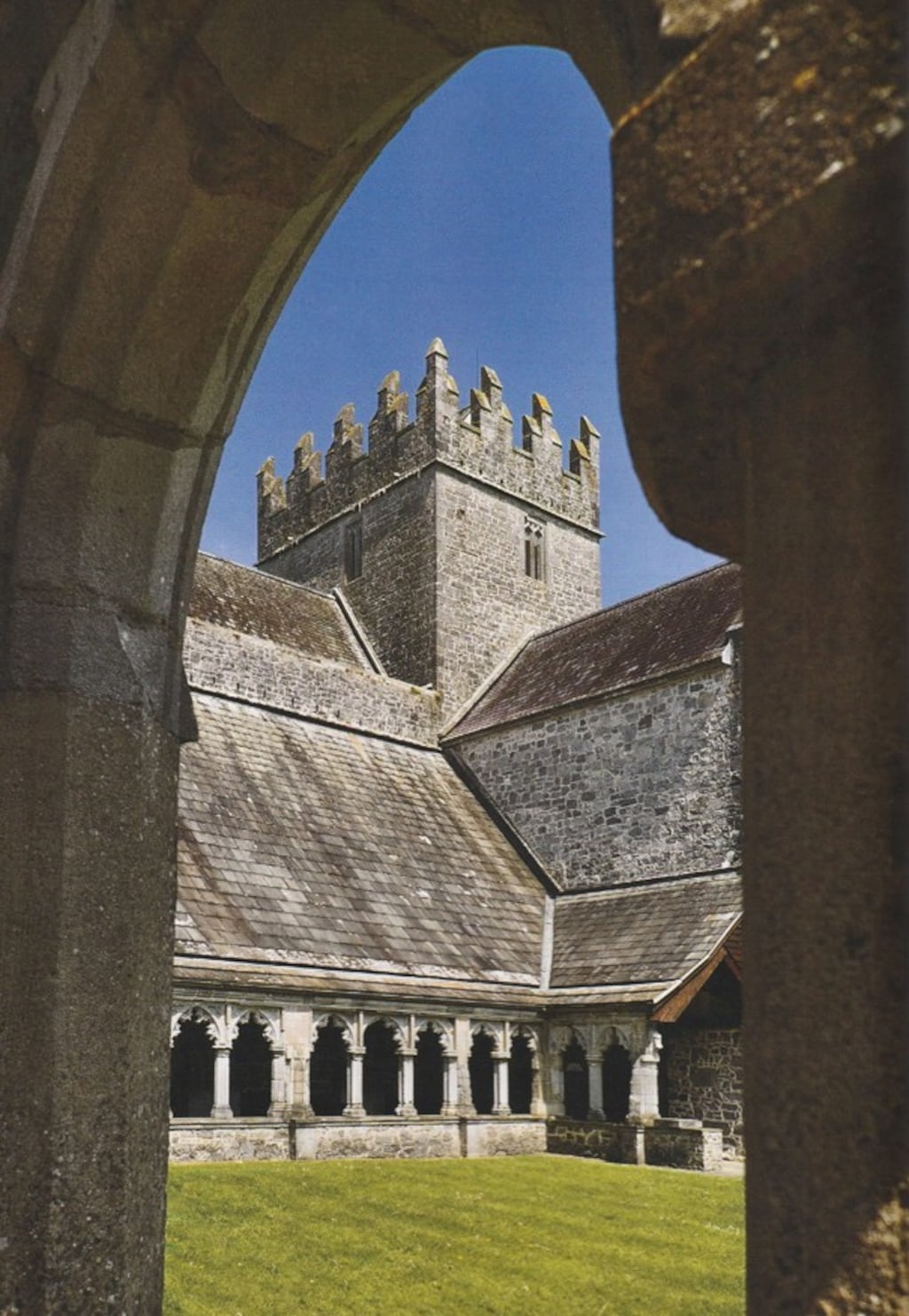
Stylishly produced journals continue to reflect local history scholarship. The long-standing Clogher Record 2025, Volume XXIII, No 3 (Clogher Historical Society, €20), whose pedigree dates to 1953, is edited by Larry McDermott and has resurfaced after a gap of several years due to the Covid pandemic. The society covers Monaghan, Fermanagh, Tyrone and a tiny part of south Donegal, with a wider membership across the diocese.
William Nolan writes about the paper war between Charles Gavan Duffy and John Mitchel in the second half of the 19th century, while Michelle McGoff-McCann delves into the subject of Managing and Investigating Pauper Death at Monaghan Gaol (1847-49). Jack Johnston contributes a fascinating paper on the Cork architect John Hargrave, who left a little-known but deep footprint in Co Tyrone early in the 19th century. He was responsible for the design of several manor houses throughout Ireland, while in Tyrone he concentrated on Ballygawley Park, Favour Royal House near Augher, and Clogher and Omagh courthouses.
Hargrave secured other commissions including three churches in Longford and private houses in north Donegal. His life was cut short when he drowned in a freak storm after his yacht was dashed to pieces in Cardigan Bay off the Welsh coast. The family lived at Ballynoe House and are commemorated by a wall plaque and coat of arms in St Anne’s Church at Shandon.
Ten papers – five in English and five in Irish – make up the latest volume of Dúchas, The Duhallow Historical Journal, Volume III (Cló Chnoc na Graí, €15), edited by Aogán Ó hIarlaithe. In the barony of Muskerry West, the history of Killaclug townland and its surroundings, as well as its land ownership over a prolonged period, is discussed by Paul MacCotter, and includes a section on recently excavated water mills. Archaeological evidence, he states, indicates that the mill at Killaclug was a multi-phase water mill complex, with at least two mill buildings. The original is thought to date from the late 15th century and was followed by two phases of stone-built mills.
READ MORE



In his essay From Revolutionary Soldier to National Politician, Eamonn Duggan profiles the later career of Seán Moylan as a Fianna Fáil TD and minister in several governments. The Crown and the Cronins: Landlords and Middlemen in Eighteenth-century Duhallow by John O’Regan discusses the so-called Rockite rebellion (1820-24). This was a large-scale insurrection of up to 2,000 rebels threatening the towns of Newmarket, Mallow and Macroom, repulsed only after prolonged fighting resulting in hundreds of casualties.
[ In an era of misinformation the study of history has never been more relevantOpens in new window ]
The Roundwood & District Historical, Folklore & Archaeological Society, No 33 (€10), edited by Therese Hicks, boasts 23 contributions covering diverse subjects such as the 1798 Rising and its aftermath, the management of the Powerscourt Estate, and Roundwood sheep sales and shows. Oscar Bryan explores the history of the Magheramore estate, near Wicklow town, revealing a complex tapestry of ownership, development and transformation. The earliest references to the townland date from 1606. Once a bastion of the O’Byrne chieftains, the area was ultimately subsumed into the grip of Dublin Castle, paving the way for the gradual resettlement of the county.
Other intriguing stories feature the Roundwood connection between Ernest Gébler and Edna O’Brien, as well as profiles of Erskine Childers, nurse Catherine Hayes Magee (1904-1986) and John Timmons of Parkmore (1934-2017), known as the “gregarious grocer”.
Familia, Ulster Genealogical Review, No 39 (Ulster Historical Foundation, £9.99), edited by Trevor Parkhill, is brimful of essays, articles and reviews. Diverse subjects include reflections on a century of archiving by the Public Record Office of Northern Ireland, street-naming in Belfast, and four 19th-century Co Down pioneers in British Columbia.
Alan Parkinson considers the life of the press baron, Alfred Harmsworth (later Lord Northcliffe), who was born in the Dublin suburb of Chapelizod in 1865. After forging an early career in journalism writing freelance articles for popular magazines, Northcliffe controlled the Times and Daily Mail. He reported on the Home Rule crisis of 1912-14 when Ireland, especially the North, was on the cusp of civil war. Arguably the greatest newspaperman in British history, he left an enormous fortune to his wife. The author suggests that Northcliffe was a Jekyll-and-Hyde-type character, a volatile mix of petty cruelties, rages and kindnesses to many, but who once pulled a gun on a close friend who he thought was planning to kill him.
[ Local history round-up: From fairy mischief to the good and bad of GalwayOpens in new window ]
Architecture, biography, museum collections, family history and storytelling are among the 14 topics in The Bann Disc, Volume 31 (Coleraine Historical Society, £15), an attractive hardback edited by Aaron Callan. The Gaelic Place-Names of the Causeway Coast and Glens by Dr Niall Comer explores how Irish, which for many centuries was the dominant language spoken throughout the area, shaped people and their surroundings.
Delicate watercolours by Manus Deery illustrate his article on the built heritage, and include the Giants Sconce, Camus High Cross, Mount Sandel Motte and Dunluce Castle. Another sketch shows the dramatically sited Mussenden Temple, built about 1783 on a cliff-top by the Earl Bishop, Frederick Hervey, to house his library. The circular building, now owned by the National Trust, is used occasionally for events and included a recent performance by the famed Renaissance Chamber Choir of Belfast.
The Lecale Review, A Journal of Down History, No 23 (Lecale & Downe Historical Society, £12), edited by Ken Dawson, brings together 12 essays from the distinct coastal region of east Down. Dónal McAnallen contributes a fascinating essay on John McKay (1852-1923) from Cargagh near Downpatrick, a journalist and joint founder of the GAA whose career spanned Belfast, Dublin, Cork and London. Other essays consider the life of the antiquarian JW Hanna, the story of Judge Michael Ward (1683-1759) of Castleward Demesne, and successful archaeological excavations at the monastic site of Erenagh.
Irish Heritage Studies, Volume 1 (OPW and Gandon Editions, €20), edited by Caroline Pegum, is a new annual research journal of the Office of Public Works. Nine scholarly essays showcase critical research rooted in the built heritage, history, artistic, literary and scientific collections, as well as the material culture managed by the OPW.