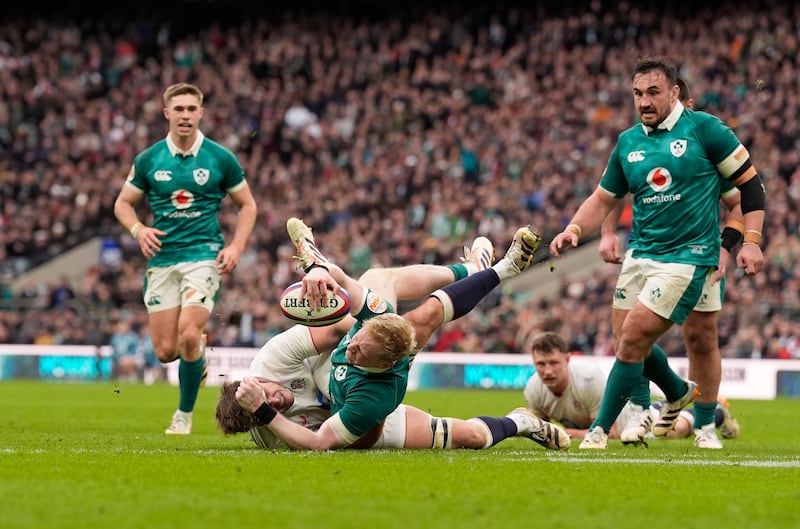
Set piece. Ireland’s challenge was to improve at scrum time. Tick. Spectacularly. Only one tiny aberration in the opening 40 minutes. The inestimable Tom O’Toole, he of the 21 tackles, was pinged for a head-on-head set-up before the put-in. It came late in the half when referee Luke Pearce was going through a navy-blue phase in his officiating.
Otherwise, the Irish scrum resembled a bastion, not only immovable but able to “get a shoulder up” here and there, when looking to play off the scrum. Two minutes in, the first scrum, the collective in-take of breath from the home supporters was almost palpable. The roar came on the exhale.
Scotland had brought back Zander Fagerson at tighthead prop for this game. This was his moment. A Scottish put-in. The Irish scrum knew the stakes. The first skirmish and a chance to persuade Pearce to allocate the roles of “saints and sinners”. The Scots were penalised. The animation on the faces of the Irish players spoke volumes.
Ireland denied the title by France's late act
And so, it continued. The next scrum, Ireland won a freekick as Scotland were pinged for stepping through the mark. The home side aced every test, whether they were looking to robustly defend their own patch or looking for a stable launch further afield. The scrum; a rock. Chapeau tip as they’d say in Paris to assistant coach John Fogarty.
READ MORE


The scrum’s sibling, the lineout, had a subplot all its own. Scotland’s figures had been slightly ropy in the tournament, a success rate down in the lower reaches of the 80s. The pregame patter was whether Ireland would go after the Scots there because 10 of Scotland’s 17 tries in the tournament to date had come from lineout launch plays.

The early indications were no and that decision didn’t really change throughout the 80 minutes. Ireland contested just three of the opposition throws from 13, disrupting and winning possession from two when they got in the air. Only once did the Scots survive a proper contest.
Joe McCarthy made a mess of one throw by contesting powerfully and the home side snapped up the loose ball. On another occasion, Ireland stayed down and as soon as the Scottish player came to ground, he was surrounded and corralled in a fiery embrace. Many hands made light of the work that led to an Irish turnover as they kept him aloft and isolated. Scrum turnover.
The visitors opted for trick plays, a short throw to a prop at the front, tried to go quickly another time but were called back, and gambled with the long throw over the back inside their 22. Losing starting hooker George Turner after just 18 minutes to friendly fire – he took an accidental belt to the head from team-mate Zander Fagerson – was a setback.
Ewan Ashman was a brilliant replacement and despite the lumps and bumps made it all the way through the rest of the game. There were times when the Scots benefited from there being “no contest” out of touch because of throws that went askew, crooked but no competition means no jeopardy.
Paul O’Connell’s work on the Irish lineout in association with the players produced a fantastic platform from which to play.

McCarthy (four) and Beirne (four) were the primary targets on the Irish throw, but it was only a small slice of their overall workload. Beirne was a colossus in defence and despite Pearce’s at times bewildering refereeing of the breakdown, he still managed some crucial turnovers.
There were so many times that an Irish player managed to lift cleanly, only to be jerked around as Pearce waited an eternity to decide; most of the time he abdicated. The final scoreline ensured that it was a minor quibble from an Irish perspective.
Ireland head coach Andy Farrell has played 34 players during a campaign in which Ireland bounced back from losing to France to win four straight matches. His husbandry of the resources has been remarkable, his judgment impeccable.
Tommy O’Brien returned and scored his seventh and eighth tries for Ireland. Dan Sheehan had his best game of the tournament, so too Joe McCarthy. Josh van der Flier was a marauding presence and at times shut down the spaces that threatened to open for the visitors.
O’Toole’s switch to loosehead and the upward graph in quality, Nick Timoney’s impact off the bench, so too that of Rónan Kelleher, and the decision to entrust a position in the matchday 23 to Darragh Murray was inspired. A try for the Roscommon man on his first Six Nations start. Farrell’s intuition, his ability to extract the best from players is remarkable.
Ireland finished the tournament strongly. There were passages of play that were up there with the best of days. And Farrell, the coaches and players found solutions; the set piece a prime example.
Follow our rugby WhatsApp channel