In 1999 Vanessa Veselka wrote an essay, The Collapsible Woman, in Bitch magazine. In it she welcomed the growing public language around sexual violence while bristling at the narrow emotional scripts that accompanied it.
In our desire to take rape seriously, she argued, we had begun to tell women that sexual violence was a kind of soul death, the worst thing that could ever happen to them, an experience from which no intact self could emerge. Survival was permitted, but only in one form: complete breakdown. This was expected, even demanded, and anything else was suspect. If a woman did not collapse publicly, she must be repressing. If she did not disintegrate on cue, she was accused of denial. The acceptable victim, Veselka wrote, was the collapsible woman, permanently damaged, visibly fragile, her fragility functioning as proof of innocence and virtue.
More than two decades later, the essay reads less like a provocation than a diagnostic tool. It is impossible to read Gisèle Pelicot’s A Hymn to Life without hearing its echo. Pelicot’s memoir arrives freighted with one of the most harrowing sexual abuse cases in recent French history. For nearly a decade, her husband, Dominique Pelicot, drugged her into unconsciousness, raped her and invited dozens of men to do the same in their home. He photographed and filmed the assaults, uploaded the images online, and meticulously catalogued them. The case would eventually involve more than 50 convicted men, with another 30 visible in the footage but never identified.
And yet A Hymn to Life is not, finally, a book about collapse. Nor is it a story of triumphant overcoming. It is something more complex and necessary: a work about memory, identity, fracture and the quiet violence we enact when we demand that survivors perform their pain in ways that make the rest of us comfortable.
READ MORE



From its opening pages, Gisèle Pelicot resists the roles others try to assign her. During the trial, journalists repeatedly described her as “dignified”. She is unsure what to make of the word. “It is perfectly reasonable to collapse,” she recognises, but public crying is simply not available to her. Instead, she understands herself as a Russian doll, carrying inside her generations of women trained to endure. “I hold myself together,” she tells the judges, not as a moral stance but as an inheritance.
That inheritance matters. Her childhood is shaped by loss and discipline. Her mother dies when she is nine, an event that becomes the emotional gravity around which the rest of her life orbits. Her father remarries, to a cruel woman who makes Gisèle and her siblings feel unwanted. Out of this early devastation, Gisèle forms a fierce commitment to joy. She resolves not merely to be brave or resilient but happy, to build a home where children feel loved, where damage does not replicate itself.
This context is essential to understanding both her marriage and her refusal to let that marriage retroactively annihilate her sense of self. When she meets Pelicot – himself damaged from an abusive family environment and incidents of sexual violence – she believes in the redemptive promise of mutual healing: together they will escape their pasts, break cycles, cure each other. That belief is deeply human. It is also, in hindsight, catastrophic.
This memoir does not sentimentalise their relationship, but neither does it flatten it into a single, erasable narrative. One of the most painful tensions in the book is her insistence that her own memories of happiness were real, that their family life mattered, their children were loved. This insistence isn’t to protect Pelicot, but to hold on to her own identity, her experience of her life, her sense of self.
“You don’t get a second chance at life,” she writes. “If I erased everything, it would mean I was dead. And had been for years.” And yet this insistence places her at odds with her children, who experience the revelation of their father’s crimes as an obliteration of all shared history.
Nowhere is this fracture more devastating than in Gisèle’s relationship with her daughter, Caroline, who was also directly harmed by Pelicot: he photographed her without her knowledge and uploaded the images online. Mother and daughter are bound by trauma but divided by response. Caroline screams and smashes objects in the family home, desperate to erase all remnants of a life that has betrayed her.
“What can you possibly want to keep from that life?” she cries. Gisèle understands the impulse. She also cannot follow it. The result, heartbreakingly, is separation. “Each of us locked inside our own grief, as if we were being borne off on two opposing currents, with very different survival strategies.”
The tragedy is not that their responses differ. It is that our culture so often insists one of them must be wrong.
Throughout A Hymn to Life, Gisèle returns to the language of memory and dissociation. Images of submersion recur. As a child, after her mother’s death, she fears that falling asleep will be the same as dying. Later she will spend years being rendered unconscious by drugs she does not know she is taking. When she learns the truth, she struggles to reconcile the body she inhabited with the body that was violated in her absence.
“My body did not remember anything; it was my body, but it was also not quite mine, the way you have no memory of the scalpel cutting into flesh when you come out of the operating theatre.” Her estrangement becomes literal. “My body was a piece of evidence.”
Photographs haunt the narrative. Gisèle reflects that without them, memories might not exist in sufficient detail to feel alive. That belief becomes grotesquely inverted when photographs and videos supply memories she never consented to have. The descriptions of the sexual violence inflicted on her are visceral but never gratuitous. She does not aestheticise violence. She allows facts to speak, and they are chilling enough.
What makes the case still more horrifying is how much of it hid in plain sight. Pelicot’s sexual entitlement surfaces again and again in incidents that were minimised, excused or dismissed. He is caught upskirting women years before the abuse is discovered and is fined a mere €100. Gisèle is never informed. Doctors dismiss her escalating symptoms with a shrug at menopause and age. Medical misogyny operates quietly, efficiently, allowing abuse to continue uninterrupted. “Low level” sexism, the book makes clear, is not separate from extreme violence – it is the soil in which it grows.
When Pelicot is finally arrested, time itself seems to fracture. Nothing moves at Gisèle’s pace – not the justice system, not the media, not even her children. There are too many versions of her story now, filtered through reports, articles and testimony. In other people’s eyes, her life is reduced to victimhood. She alone must hold its totality. “I didn’t recognise my life as it was summed up by other people. I had been happy, I was sure of it. I was more than just a victim.”
The trial exposes the full grotesque nature of misogyny. Rapes are referred to as “sex scenes”. Defendants claim consent from an unconscious woman. Pelicot continues to describe the videos as pleasurable. The entitlement is total. It is impossible not to read these scenes alongside the release of the Epstein files, another supposed reckoning with male sexual power that already threatens to dissolve into spectacle without consequence. Once again we are invited to gape at monsters while the structures that produced them remain intact.
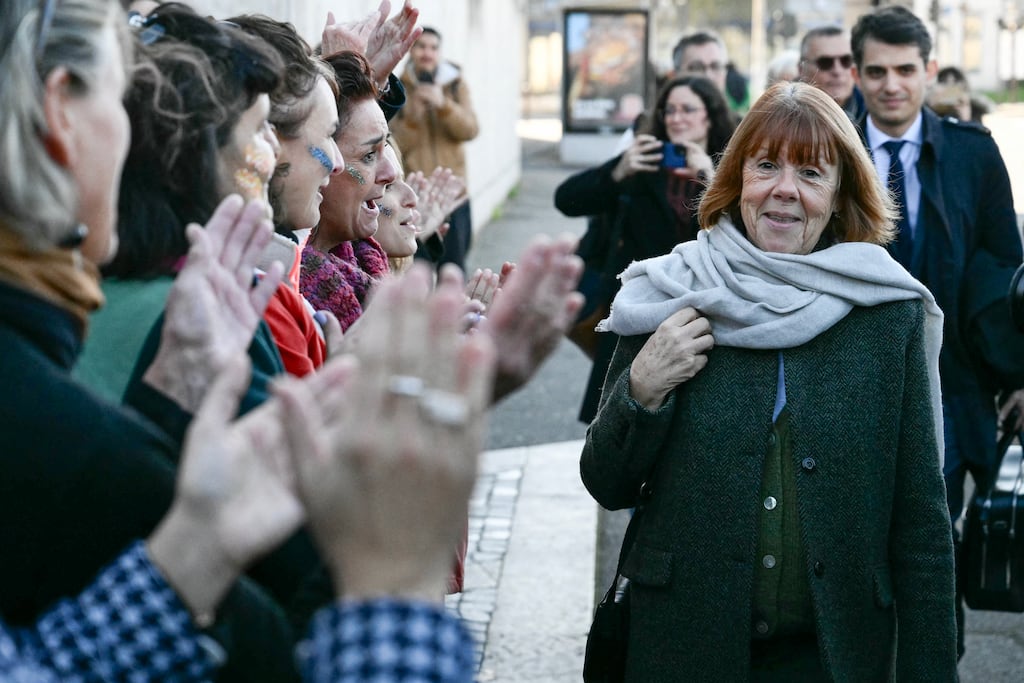
Gisèle understands this danger. Her decision to go public is anchored in a single sentence: “shame has to change sides”. Yet she is clear-eyed about the cost of becoming a symbol. Supporters gather outside the court, forming a guard of honour. “This crowd saved me,” she writes. But she also confesses, “it was all too much for me ... I was no more than a reflection, the object of public discussion. I was exhausted.”
What A Hymn to Life ultimately offers is a refusal of that reduction. Gisèle does not ask to be exemplary. She asks to be allowed complexity. To hold joy and devastation at once; to love again if she chooses; to remember without being consumed. To insist that Pelicot’s crimes do not erase the life she built in spite of him.
Pelicot perpetuated generations of violence. He absorbed it, normalised it, amplified it. Beside him, Gisèle did the opposite, building a family out of her love, treating her children with care, offering them safety, embracing joy. She broke the cycle before the abuse began, and she continues to do so now. Not through martyrdom, but through living; through refusing to let herself be annihilated by someone else’s crimes.
These differing choices highlight the one facing society: continue to perpetuate cycles of violence, or stop them. We can continue to demand collapsible women and performances of acceptable suffering, reckoning after reckoning that leaves structures untouched. Or we can take seriously what this powerful memoir insists upon: survivors owe us nothing. Not coherence, not collapse, not inspiration. The responsibility lies elsewhere, with systems that dismiss, cultures that excuse, men who feel entitled, and with all of us if we are willing to imagine a response that does not require women to disappear in order for us to believe them.
Gisèle ends where she began, with faith in love. “Love is not dead. I am not dead. I still have faith in people. Once, that was my greatest weakness. Now it is my strength.” That insistence is not denial, but defiance. “Because if I do not love, the void has won and I am nothing.”
Further reading
Mad Wife by Kate Hamilton
Beacon Press, 2024
An unflinching memoir told under a pseudonym, whose author explores how damaging, misogynistic ideas of consent, duty and sexual obligation within heteronormative marriage led to the normalisation of abuse and coercion within her relationship for years. Interweaving personal narrative with cultural critique, Hamilton examines how societal expectations can distort desire, autonomy and self-worth before she ultimately finds a path to self-liberation.
Women Talking by Miriam Toews
Faber, 2019
In this powerful novel inspired by true events in a Bolivian Mennonite colony, a community of women who have been systematically drugged and assaulted meet in secret to decide how to respond: do nothing, stay and fight, or leave. Through collective dialogue, Toews interrogates patriarchy, faith, community, and the moral choices women make in the face of violence.
I Choose Elena: On Trauma, Memory and Survival by Lucia Osborne-Crowley
Indigo Press, 2019
Osborne-Crowley’s memoir reflects on her life after surviving a violent rape as a teenager. Blending personal narrative with research, she explores how trauma reshapes mind and body, the failures of social systems, and the long, nonlinear work of recovery. The book honours memory, resilience, and the search for language to articulate deep pain.