

There’s a bedtime story in which a prince goes looking for the Land Where People Never Die. In one particular city, he meets people who live as long as their works survive. A stone carver has been there since the dawn of civilisation, while a housebuilder speaks of his long-gone wife: “We ate every morsel of her food. There was nothing left.”
The thought haunts: who are we? Is it we what we do, how people remember us, what we leave behind?
These questions hang over our lives. At significant times we may experience a feeling of pre-nostalgia, the mourning of a loss yet to come. It can settle with an intensity that colours the ways we view and value others as well as ourselves.
Such feelings are further sharpened when we, or the people we love, begin to lose themselves through diseases of the brain such as Alzheimer’s and the wider forms of dementia.
READ MORE


The actor Chris Hemsworth recently made the documentary A Road Trip to Remember (it’s available on Disney+) to explore how re-creating connections can help with memory retrieval, but the programme is as much about the Hollywood star’s pain at the slow loss of his father to Alzheimer’s as it is about the science of the diagnosis.
The Dublin-based artist Mick O’Kelly has been working with people with cognitive impairment since he met the US neurologist Bruce Miller, founding director of the Global Brain Health Institute. O’Kelly took up a research fellowship at its base at the University of California in San Francisco, during which he explored the patterns thought creates in our brains, as revealed by EEG (electroencephalogram) tests, which involve attaching electrodes to a person’s scalp.
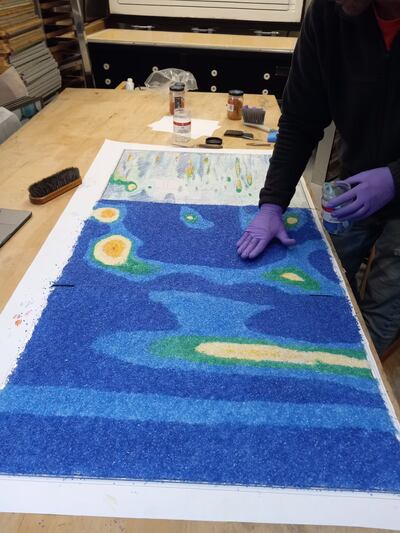
Teaming up with Miller’s fellow neurologist Jon Kleen and a San Francisco glass artist named John Lenox, O’Kelly has made stained-glass windows that are facsimiles of a moment or memory in the mind of someone to whom such things are becoming increasingly precarious and precious.
I meet O’Kelly on a chilly winter’s day to visit a window in Dublin’s south inner city. The coloured glass glows in the stairwell window of a narrow and comfortably chaotic family home, and the kettle is constantly on as family members come and go. Photographs fill the walls, and the friendly dog that prominently features in many of them jumps on my lap, settling in for the chat.
Over tea, we talk about life, love and the window in which reds and yellows change in shade as daylight moves from sunrise to dusk.
The Global Brain Health Institute embraces a wide network of partnerships, including with Trinity College Dublin, the Alzheimer Society of Ireland and St James’s Hospital, where Alice (we have changed the family’s names) received her dementia diagnosis two years ago. She subsequently volunteered to be part of O’Kelly’s Mapping the Space of Dementia project.
“It’s actually quite funny,” says Alice, who is in her 50s. Having been asked to recall a particularly happy or meaningful time, and to hold the memory throughout her EEG, she immediately came up with her favourite band: “I got them to put Bon Jovi on. They want you to think happy, so I was singing away.”
As You Give Love a Bad Name blasted out, the patterns of Alice’s brainwaves were captured in a series of three images, which were then cast in stained glass.
“The thing I love about it is this,” says Alice’s partner, Brendan. “You can never replace it. You can’t make another one. You could make it, but it would never be the same as that particular thought, at that particular time. It’s absolutely brilliant.”
There’s a moment’s pause as we embrace the idea of the uniqueness not only of a moment’s thought but also of the irreplaceable person who embodies it. The unspoken consequences of this settle sadly before I ask about some of the family photographs around us.


A series of cheerful reminiscences follow – about the cousin’s wedding where the couple met, the extended family, stories of generations of Dubliners. Brendan frequently refers to Alice for clarity, and she promptly supplies both places and names, filling in gaps to weave a full picture. “I have good days and bad days,” she says. This is clearly a good day.
O’Kelly’s art project is as much for the families as it is for the “owners” of the brainwaves themselves. “It was an intriguing experience, navigating the hard-nosed rigour of science and the more fluid space of art,” he says. “I think science and art are two distinct methods of producing knowledge. How do we distinguish what makes them different, and what happens when we bring them together?”
O’Kelly is a fascinating artist who has no issues with crossing boundaries, although he always does so with sensitivity and tact.
Previous projects have included such diverse interventions as An Artwork for an Imperfect World, in which he invited homeless people to Temple Bar Gallery for dinners during a residency in 2003; and a collaborative project where bee hives were built to resemble the Ballymun tower flats in a Breaking Ground commission between 2005 and 2007.
Before that, in the 1990s, his Genus saw large black-and-white photographs of people with barcodes on their shaved heads installed at Heathrow Airport, in London.

“I had the privilege of attending live clinical assessments between doctor and patient,” he says, coming back to the present. “Frequently the focus is on loss, what is missing. My proposition was how to create an art-neuroscience collaboration, an intervention that might also limit the impact and burden on people living with dementia and their caregivers.”
Maybe it’s because of the end-of-days miasma that colours the news, or perhaps it’s the result of technological advances promoted by the live-forever dreams of tech billionaires, but questions of what makes us who we are, and how much of this is wrapped up in an idea of posterity, are creeping increasingly into the arts.
This is not entirely new, as O’Kelly notes. “I am split between the urgency to hold on to one’s identity versus creating new identities and new memories.” It is, he says, “a crossing of positions” between Krapp’s Last Tape, the play by Samuel Beckett, and James Joyce’s novel Finnegans Wake.
Art nips at the edges of all this. In 2023 Louise Lowe directed Deirdre Kinahan’s An Old Song, Half Forgotten at the Abbey Theatre. The play had been written for, and was performed by, the actor Bryan Murray, who had been recently diagnosed with Alzheimer’s. In it, Murray’s character revels in the glories of his past life and loves.
Then there’s Life of Chuck, the Mike Flanagan film that was released in Ireland last summer, of a Stephen King story in which the decline of a seemingly minor life ends up earth-shattering.
From the particular to the universal – and apocalyptic: at the 2025 Dublin Fringe Festival, Arinola Theatre’s The Deadline Project saw two musicians attempting to upload as much of their music as possible before the end of the world to an AI model designed to immortalise humanity before humanity disappears.
We like to think of ourselves as complete at a moment, with life building up to it and then declining from it. In Konstantin, at Dublin Theatre Festival last autumn, family and friends gather at the bedside of a young writer who is in a coma after a suicide attempt.
“I was thinking,” says Lauren Jones, its writer, “of Tom Sawyer being present at his own funeral. About how there are swathes of your life you don’t have access to, like people’s impressions of you, the memories of other people. There is the age you stop. You might look in the mirror and find an 80-year-old woman looking back, but inside your head you’re 27 or 32.”
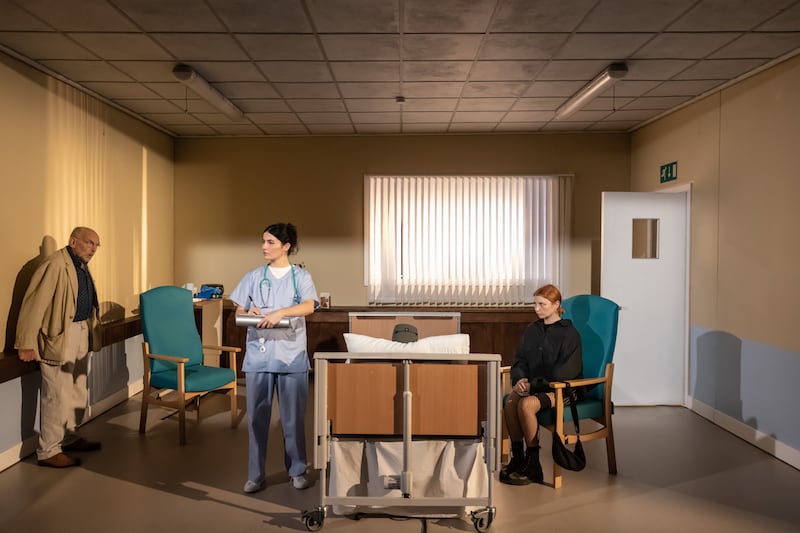
Suspended in his coma, Konstantin endures, unknowable, as around him the world disintegrates, almost like an emblem for Alzheimer’s reversed.
“Perhaps we’re all kidding ourselves,” Jones says. “Nothing matters. Everything matters. Maybe it is just another howl into the abyss, this momentary experience of being alive.”
Konstantin is based on the central character in the Chekhov play The Seagull – “the point,” Jones explains, “around which everybody oscillated. We’re exploring what happens when that central point is gone.”
Her thoughts remain in my mind as I climb the stairs to view Alice’s artwork from a fresh angle. The reds and yellows that background the arabesques of shape and shade in the window were Alice’s choice.
“When we first brought it up here I was kind of freaking out for a while,” she says. “But it’s part of our life now. We are at the stage where I know what’s wrong. It’s really pretty,” she continues, subconsciously switching from thinking about the window to her diagnosis and back.

“She’ll always be there now,” one of the couple’s daughters jokes, coming into the kitchen. “Up there she sees everything.”
“I always do,” Alice adds in the tone that only a loving mother can know.
Has O’Kelly considered the potential of the project as an income stream for commissions? Who wouldn’t want their thoughts made remarkable in glass?
“The one I made in California was for a man who had acquired Alzheimer’s and was a successful businessman,” he says. “His wife had suggested I make them for people they knew, but I can’t go there with it like that.”
O’Kelly prefers to work with people whose circumstances don’t necessarily stretch to art collecting.
As we continue our walk, he delights in pointing out another window, quietly jewel-like, unexpected in the window of a block of council flats.
“That one was harder,” he says. The window’s owner was further into his diagnosis, so he and O’Kelly had to remeet and reacquaint each time. I wonder what that man thinks and feels now, as he sits in his flat, illuminated by the colours of a moment in his mind.
The full processes of dementia are still not fully understood, and sufferers experience it differently. In An Old Song, Half Forgotten, the memories of Murray’s character are triggered by music. As shown by Festival in a Van’s ongoing Songlines project, as well as the choirs around Ireland for people with dementia, music, poetry and song can remain powerfully in the minds of those with cognitive impairment.
In the visual arts, perhaps one of the most moving, and intriguing, artistic insights has come from the US-born figurative painter William Utermohlen, who began a series of self-portraits after being diagnosed with Alzheimer’s disease in 1995. Their increasing abstractions document an elusive balance between the decline of his cognitive and spatial abilities and the desire to depict his inner life.
Utermohlen became unable to paint in 2000; he made his last drawing in 2002. He died in 2007, in London, at the age of 73.
O’Kelly has installed five windows in Ireland. One, for a person who has since moved into a care facility, has been made as a mobile light box. O’Kelly is full of praise for the team at St James’s who contributed their time. Funding permitting, he would like to make more.
“Looking back and holding on to one’s past can be hugely challenging for families,” he says. “It is really hard to see their loved ones disappear.”
We walk on, leaving that window behind, high above the chilly city streets. Perhaps it brings its owner some pleasure; there could be the possibility of joy. We can only imagine. What we can know is that, through his collaboration with O’Kelly, something will endure, a trace of a life made precious, rediscovered as remarkable through art.


