

Ireland garnered international headlines this month when Minister for Arts Patrick O’Donovan announced that the Basic Income for the Arts (BIA) trial established by his predecessor Catherine Martin would be put on a permanent footing. There have been basic income trials elsewhere, but this is the first permanent scheme of its kind anywhere. There were articles about this in The Guardian, CNN, the BBC. The UK Independent asked: “Wuthering Heights is just another example of the poshification of the arts. Does Ireland have the answer?”
O’Donovan sees the scheme as a powerful statement about Irish identity: “In order for this country to separate itself from the rest of the English-speaking world, we have to look at our cultural base and say we are different. We weren’t a colonising force. We weren’t an imperial force. We do value multilateralism. We do value co-operation … Artistic output can be a great vehicle for the small guy.”
The trial was originally proposed by the Arts and Culture Recovery Taskforce established to help struggling artists at the height of the Covid crisis and was launched by Martin very shortly afterwards. It gave 2,000 eligible artists of all kinds €350 a week for three years (the scheme was subsequently extended by six months). Irish culture is regularly rolled out by our Government and institutions to attract both tourists and international investment. And Irish art is currently seeing a wave of international success: with artists such as CMAT and Kneecap, Oscar nominees such as Jessie Buckley, Oscar winner Cillian Murphy and Booker winners like Paul Lynch.
In reality, says Carla Rogers, a member of the steering committee for the National Campaign for the Arts (NCFA), more than 56 per cent of artists and arts workers experience enforced deprivation (that’s three times the rate in the general population).
READ MORE


“Artists in Ireland experience the highest deprivation and precarity. You can see people who seem like they’re doing great. They’re in the paper and they’re on the news and they’ve had a great tour, but they’re sleeping on a couch once they get home … Actors get into a fancy show in London for eight weeks and then have nothing or they’re working as a barista and doing auditions. So often, people are subsidised by doing precarious jobs on top of precarious jobs … So people live in a horrible, mouldy place and work really hard and cut back on all of the things that other people take for granted.”
O’Donovan notes that Irish arts “will be lauded all over the world for that week running into St Patrick’s Day. But what about the other 51 weeks? They can’t live off a sentiment.”
When it comes to the arts in Ireland, he says, we often “celebrate the dead and ignore the living”.
In 2018, the music resource organisation First Music Contact ran a piece of research that advocated for a basic income for artists. When FMC’s chief executive Angela Dorgan later became chair of the NCFA it became a focus for the committee. “When the Greens came in, they [independently] came with an idea of a basic income trial during the lifetime of the government,” she says. “And we saw that as an opportunity for political football. And then Covid happened.”

The Greens’ interest in basic income dates all the way back to the party’s founding in 1981 but Dorgan does not think anything would have happened without Martin, who she calls the “Carlsberg of arts ministers”. During the Covid crisis Martin established the Culture Recovery Taskforce, to which Dorgan was seconded along with representatives of 18 other arts agencies.
The taskforce was chaired by former RTÉ executive Clare Duignan. “There was a real worry that people would leave the sector,” says Duignan.
She worked with the group to formulate the best way to help. “The report was short. There were only 10 recommendations.” Basic income for artists was the first. “And it landed at a time when I think government was very open to thinking outside the box.”
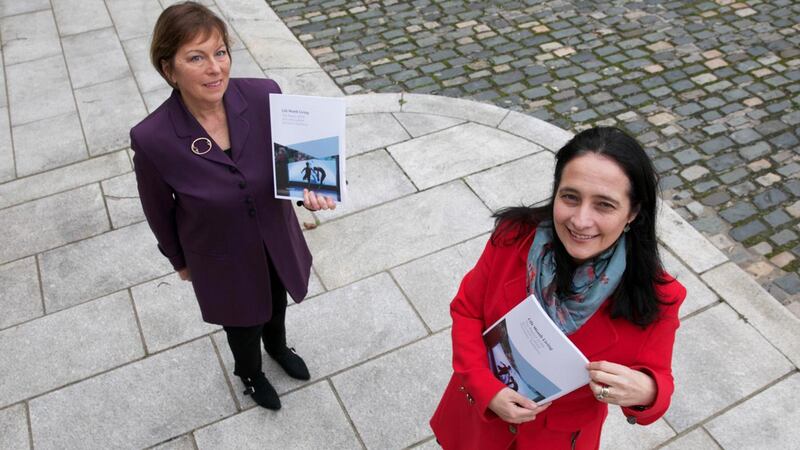
It coincided with a “hearts and minds” campaign undertaken by the NCFA about the importance of the arts and a grassroots campaign in every county. There was also a higher than usual appreciation for the arts due to the successive lockdowns. “Then it was ‘over to you, minister’,” says Dorgan. “Catherine Martin spent every single cent of her political clout getting it through … It was her hill. And I think she was prepared to die on that hill.”
The proposal was put forward by the taskforce in November 2020, Martin (who is now the incoming head of policy for the Ivors Academy Ireland) got a commitment for a pilot in the National Economic Recovery Plan in summer 2021 and the pilot was announced in April 2022.
Some 9,000 people applied: 8,200 were found to be eligible and 2,000 were ultimately selected by lottery. For those rejected, as Carla Rogers notes, “a lottery can’t help but seem cruel”. But for the successful applicants the results were life changing. “It came at a time when I really needed it,” says Dave Tynan, director of the film Dublin Old School and author of the story collection We Used to Dance Here. “It allowed me to subsist. Artists make so little money that that small amount is life changing. It allowed me to work better. It kept the existential dread at bay.”

Over the course of his time on the trial, he wrote and published a book and several screenplays, one of which he hopes to have in production relatively soon. The nature of film-making, he notes, is long, frugal development processes. Early in the process he also took on some ad work. “Dublin prices do not allow for you to be a full-time artist on 17 grand. But what it does is, it takes you out of the relegation zone.”
We gave them this money with no strings attached. They could have done whatever they wanted, but what they decided to do was to spend more time working in the arts
— Nadia Feldkircher
Amy Clarkin, author of a trilogy of YA novels, was another recipient. “I’m disabled, so I can’t work full time, which means for me, the choice was between bill-paying work or my art. [Because of the BIA] I was able to write three books set in Ireland for Irish teens with Ireland’s leading publisher [O’Brien Press]. My books are YA books with queer representation and disabled representation.
“I’ve been lucky enough to meet readers who have told me how much those characters mean in an Irish setting. The basic income [means] more people get to see themselves in art. The BIA does a really good job of helping people who economically might be shut out.”

Alongside the scheme the department ran a unique research project. Some 996 of the unsuccessful candidates agreed to be in a control group to monitor the outcomes of the scheme. “There needed to be very rigorous research done to see, through the life of the pilot, whether it delivered on the things that people hoped for or not,” says Duignan.
Every six months both the recipients and the control group were interviewed. A cost-benefit analysis was also carried out by Alma Economics. Dr Jenny Dagg from the sociological department in Maynooth University interviewed the participants for a qualitative report.
The headline figure was that for every €1 spent on the project €1.39 was returned. “And our economics were conservative,” says Nadia Feldkircher who leads the Basic Income for the Arts research programme. More importantly, it had a positive impact on artists’ quality of life. “We see a big improvement in wellbeing and we see a big decline in poverty. And poverty was very high.”
In the report there are quotes from artists about being suddenly able to afford a winter coat or go for coffee with friends or simply not feel humiliated. But the thing that surprised Feldkircher most was the amount of work they did. “There are no other basic income pilots on different types of populations where we see people working more but these people do. We gave them this money with no strings attached. They could have done whatever they wanted, but what they decided to do was to spend more time working in the arts.”

All this data helped facilitate the renewal of the scheme by the current minister. He has greenlit another €325 a week for 2,000 artists over three years, at which point there will be another application process (artists selected for the first are not eligible for the second). This has generally been welcomed. “I admire him for supporting it and continuing it,” says Dorgan. “I would love it to expand but I think the political commitment has to come from higher parts of Government.”
Many on the trial were hopeful they would retain their payments. This didn’t happen. “[The department] issued us with a code to apply for jobseekers and link to access short term counselling and psychotherapy along with advice on practical, day-to-day issues that may cause anxiety and stress,” writes one artist by email. “I mean it doesn’t get more grim than that.”
“I’m devastated, to be honest,” says Clarkin. “I was actually on the verge of going, ‘Hey, I might actually be able to move out of my parents’ house.’ Without the BIA, that’s not possible. It’s probably going to come down to financially supporting myself or continuing as a writer… Getting the BIA is life-changing but losing it is life-changing as well.”
There are discussions to be had about how the scheme should be developed. Some, such as the musician and music promoter Vincent Dermody, feel it falls problematically between universal basic income and a welfare payment and that the department should be clearer about its purpose and ensuring that it doesn’t take funding from other parts of the arts.
“It does not appear to understand what it is, functionally or philosophically. If it’s welfare, then why isn’t it means-tested and why was there no co-operation with the Department [of Social Protection] to ensure that existing benefits, eg disability, are not compromised? If it’s universal basic income then why is it cyclical, impermanent and limited to 2,000 applicants?”
Others – including the campaign group Basic Income Ireland – see it as a step towards a universal basic income. Most artists, art workers and policymakers contacted for this article would like to see the numbers expanded. That was Martin’s hope and it’s the current minister’s too. It may also inspire similar schemes in other insecure sectors.
“We identified three other precarious industries [where it might be tried]: fisheries, small farmers, weather-based tourism attractions,” says Dorgan. “I think that’s why [the department] made all of their data freely available so that other economists from other sectors can use it to make the argument for others.”
Some, including a few artists I spoke to, are okay with the scheme being finite. “It’s intended to be a support for people [to] get through challenging times and establish themselves,” says Duignan. “I don’t know how sustainable it is to support every artist in the country forever.”
O’Donovan thinks a cyclical scheme is the best way to ensure as many people as possible can benefit. “If it’s expanded, and I wanted to see it expanded, [then more artists] might get a chance to actually get themselves up and running, the bills are paid. And ultimately, they come off of the scheme, and somebody else goes on.”
The NFCA see the cyclical model as “a decent start” but they believe that, given the meagre income of most artists, the basic income for the arts should be a form of ongoing income for those who need it. They would like to see it expanded to around 8,000 places, roughly the number of eligible artists who applied at the trial stage.

“For 8,000 artists nationally, the scheme would cost roughly €134 million annually, just 0.13 per cent of Ireland’s total government budget, much of which will be returned in tax,” says Carla Rogers.
Despite the misgivings over the scope of the new scheme, and the disappointment of those who feel overlooked, there is a lot of relief out there that the BIA has been made permanent. Interested policymakers and arts bodies from all over the world have been in touch with the department. Last year a public consultation showed that 97 per cent of the general public were in favour of retaining the scheme.
Dave Tynan, who just received his final payment, thinks the existence of the BIA is a recognition of “how much learning and craft has to build up in the dark, unpaid, in the hours after a job or childcare … We have potential that goes unrealised.
“There are things beyond market value. If we don’t fund the arts, then we abandon the arts only to people whose parents have Wikipedia pages. And that’s a lesser, shabbier society.”


