This Christmas I’ve resolved to not think about work when I’m not working. I will resemble an “outie” from Severance, on Apple TV, magically possessing zero access to any work memories. These will belong to my “innie”, an entirely different person whose life is confined to the workplace. I don’t know her at all.
What do people do when they’re not working or thinking about work? Binge-watches seem a sensible answer, though experience has taught me that this strategy can go awry.
Earlier this year, I plunged into The Hack, the ITV series that’s as entertaining and astonishing as a drama about the British media’s phone-hacking scandal should be. (You can watch it in Ireland on the Virgin Media Play app.)
But when someone asks Nick Davies (played by David Tennant) if he thinks he can win his battle to expose the hackers, the Guardian scoop-getter’s answer is one giant ouch.
READ MORE


“Journalism isn’t about winning or losing,” the fictional Nick says. “It’s about the gradual erosion of self-worth.”
This year I also enjoyed The Studio, Seth Rogen’s Hollywood satire on Apple TV, though it, too, has some close-to-the-bone moments.
“This is so depressing. I’m, like, 30 years too late to this f**king industry,” Quinn (Chase Sui Wonders) says. So far, so relatable.
Quinn, my favourite character, wants to develop a low-budget slasher movie, but her boss Matt (Rogen) suggests she “help” a male executive with his low-budget slasher movie instead. Cool, Matt. The perfect solution.
The Studio, at its best, is more farce than satire. It rightfully cleaned up at the Emmys. Still, any festive binges should come with that all-important warning: contains themes of work.
“Eat, sleep, police, repeat”, meanwhile, was the tagline for the third season of Blue Lights, on the BBC (and coming to RTÉ Player). The show was tension city as usual. “Promise me you won’t ever get bitter or cynical or tired,” Sandra (Andi Osho), the station sergeant, says to her young colleague Tommy (Nathan Braniff). That’s a big ask, Sandra.

Blue Lights also provides a cautionary tale about not trusting your colleagues. When the macho policeman Shane (Frank Blake) thinks he’s about to be sacked, he tells Annie (Katherine Devlin) his deepest secret: he’s a fan of World of Our Own by Westlife. “It’s a stone-cold banger. They’re wee angels,” he confides. Spoiler: he does not get the sack.
The stone-cold sickness I felt watching the finale of Severance’s first season was not especially relieved this year when Lumon, the show’s villainous corporate enterprise, returned in the second run equipped with cutesy induction videos, “kindness reforms” and a literal child working in HR.
All reminders of the detached outside world remained jarring, with the idea that an employee has a family hilariously presented as a strange unreality.
“Out f**king side! Oh my God, I mean, I knew there was no actual ceiling, but this is f**king insane,” Dylan (Zach Cherry) says during a team-building “outside retreat”. Yeah, we’ve all had years like that.
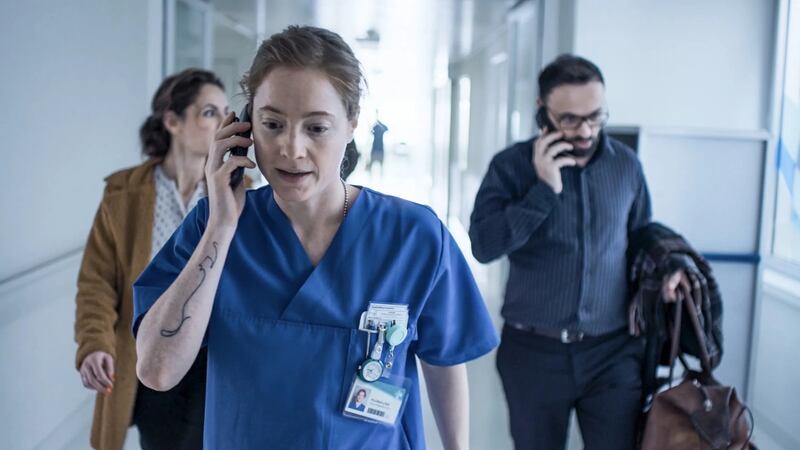
In 2025, two powerful films stood out for placing the unfair mechanics of work at their heart. There’s a drab anonymity to the journeys made by Aurora, the ecommerce warehouse picker in Laura Carreira’s On Falling, and Floria Lind, the hospital nurse in Petra Volpe’s Late Shift, as they enter their workplaces, and a shared physical dimension to their labour.
By the end of each film (which are available to rent), both women require the comfort of strangers, with Aurora (Joana Santos) clinging to a man whose job it is to help her, and Floria (Leonie Benesch) fusing heads with a fellow commuter who manifests as a vision of a patient who died during her shift.
The Scotland-set On Falling lays bare the loneliness, humiliation and depersonalisation of modern work with every beep of Aurora’s barcode scanner. She’s a “top picker” one week and is rewarded with a Wispa bar. It’s shockingly patronising, but Aurora is financially struggling and seems grimly hungry. Tellingly, the only brief joy at work comes when there’s a power outage.
Late Shift, Switzerland’s brilliant entry for the best-international-picture Oscar, has the German title Heldin, meaning Heroine, which Floria is without doubt. “Busy day today,” is the understatement of this compelling film, which depicts how even the most dedicated, efficient and compassionate of people find themselves assaulted by systems that require superhuman bilocation and other impossibilities.
“The worldwide shortage of nurses is a global health crisis,” an end title states, Volpe’s film having shown us the human toll of endemic understaffing.
So what could lighten the mood at this time of year? I’m not taking any chances during my off-duty outie period. To avoid stumbling upon the miseries of exploited, overstretched workers, I’m going to stick to fluffy kids’ stuff, such as, say, K-Pop Demon Hunters.
“The world will know you as pop stars. But you will be much more than that. You will be hunters,” the Netflix megahit begins.
Wow, okay. Employers’ demands really are endless.